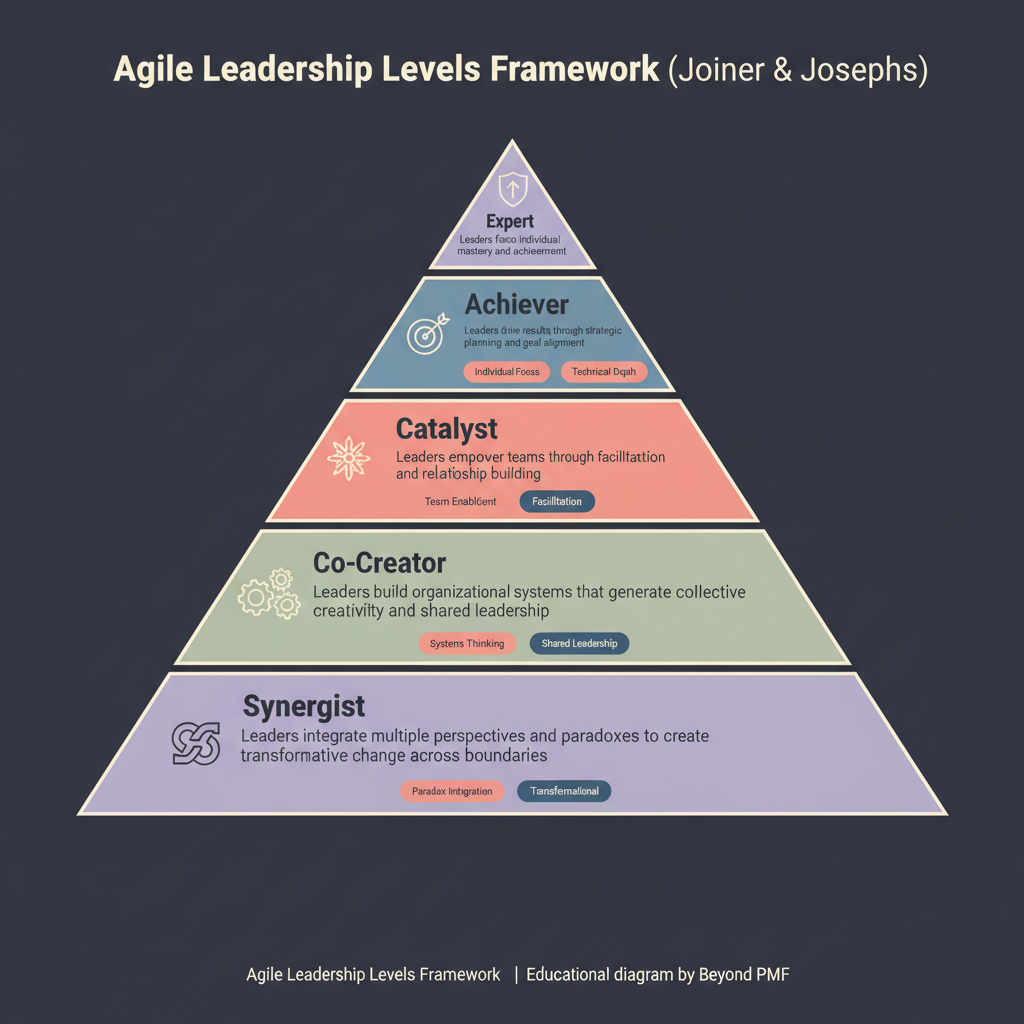
Agile Leadership Levels Framework (Joiner & Josephs)

The Agile Leadership Levels Framework, developed by Bill Joiner and Stephen Josephs, is a leadership maturity model that explains how leaders grow their capacity to handle complexity, drive change, and align stakeholders over time.

Rather than focusing on specific agile practices, the framework emphasizes how leaders think, decide, and act under pressure and ambiguity.

The model outlines five progressive leadership levels, each representing a more advanced way of interpreting reality, engaging others, and shaping outcomes. As leaders move through these levels, they become better equipped to navigate organizational friction, conflicting priorities, and systemic challenges β€” making the framework particularly relevant for agile transformations, digital change initiatives, and strategy execution in complex environments.

Steps / Detailed Description

The framework is developmental rather than procedural, but it can be applied through the following progression:

  • Assess the leader’s current leadership level and dominant mindset
  • Understand how this level shapes decision-making, communication, and conflict handling
  • Identify constraints and friction caused by the current leadership level
  • Develop awareness and practices that enable movement to the next level
  • Apply leadership agility across key situations: conversations, initiatives, and transformations

‍

Leadership Levels (Core Structure)

1. Expert

  • Focuses on personal expertise and problem-solving
  • Values logic, correctness, and technical competence
  • Effective in stable environments but struggles with complexity and ambiguity

2. Achiever

  • Goal-oriented and results-driven
  • Thinks strategically and manages execution across teams
  • Strong at delivery but may over-optimize plans and control

3. Catalyst

  • Change-oriented and visionary
  • Focuses on culture, collaboration, and systemic improvement
  • Comfortable challenging assumptions and enabling transformation

4. Co-Creator

  • Builds shared purpose across boundaries
  • Integrates diverse perspectives into joint ownership
  • Leads through deep collaboration and trust

5. Synergist

  • Operates with a systemic, holistic perspective
  • Sees interdependencies and long-term consequences
  • Enables breakthrough change by aligning purpose, people, and systems

Best Practices

  • Use the framework as a development lens, not a label
  • Combine assessments with real leadership situations
  • Apply it alongside organizational change initiatives
  • Encourage leadership teams to discuss levels openly and without judgment

Pros

  • Provides deep insight into leadership behavior and mindset
  • Helps explain why agile transformations stall or succeed
  • Addresses leadership friction, not just process issues
  • Scales from individual leaders to enterprise leadership systems

Cons

  • Requires self-reflection and willingness to change personal behavior
  • Not a quick fix or checklist-based model
  • Higher levels are difficult to reach without coaching and feedback
  • Can feel abstract without practical application support

When to Use

  • During agile or digital transformation initiatives
  • When leadership behavior creates execution friction
  • In environments with high uncertainty and complexity
  • For leadership development and executive coaching

When Not to Use

  • As a performance ranking or evaluation tool
  • In highly transactional, short-term execution contexts
  • When leaders are unwilling to reflect or adapt

Related Frameworks

Maturity Level

Time to Implement

2–4 Weeks
3–6 Months
1–2 Weeks
3–6 Months
1–2 Months
3–6 Months
1–2 Weeks
Less Than 1 Day
1–2 Weeks
Longer Than 6 Months
1–2 Weeks
Longer Than 6 Months
1–2 Weeks
3–6 Months
1–2 Weeks
1–2 Weeks
1–2 Weeks
1–2 Weeks
1–2 Days
1–2 Weeks
1–2 Weeks
1–2 Weeks
1–2 Weeks
1–2 Weeks
1–2 Weeks
3–6 Months
1–2 Weeks
1–2 Weeks
1–2 Weeks
3–6 Months
1–2 Weeks
1–2 Weeks
2–4 Weeks
1–2 Weeks
1–2 Days
1–2 Weeks
Longer Than 6 Months
3–6 Months
Longer Than 6 Months
1–2 Weeks
Longer Than 6 Months
3–6 Months
Less Than 1 Day
3–6 Months
1–2 Months
3–6 Months
Longer Than 6 Months
3–6 Months
Less Than 1 Day
1–2 Weeks
3–6 Months
3–6 Months
1–2 Weeks
3–6 Months
1–2 Weeks
1–2 Weeks
1–2 Days
1–2 Weeks
1–2 Months
Longer Than 6 Months
1–2 Weeks
Longer Than 6 Months
1–2 Weeks
3–6 Months
1–2 Weeks
Less Than 1 Day
1–2 Weeks
3–6 Months
1–2 Weeks
3–6 Months
1–2 Weeks
1–2 Weeks
Longer Than 6 Months
Less Than 1 Day
3–6 Months
Longer Than 6 Months
1–2 Months
1–2 Weeks
Longer Than 6 Months
1–2 Weeks
3–6 Months
1–2 Weeks
1–2 Weeks
3–6 Months
Less Than 1 Day
1–2 Weeks
1–2 Weeks
3–6 Months
3–6 Months
Less Than 1 Day
1–2 Weeks
Longer Than 6 Months
1–2 Months
1–2 Weeks
1–2 Weeks
1–2 Weeks

Copyright Information

Autor:
Joiner & Josephs – Leadership Agility
2007
Publication: