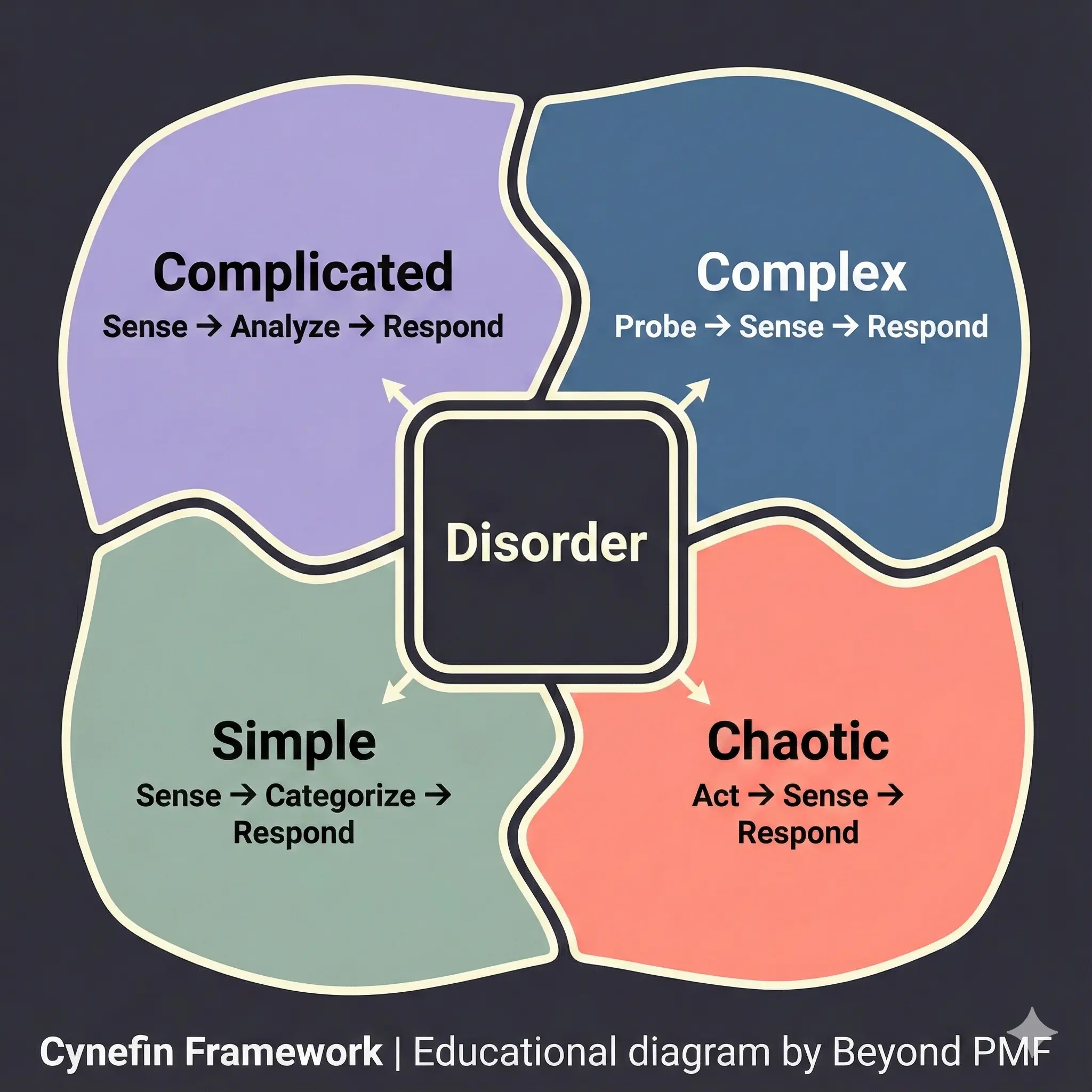
Cynefin Framework

Diagram of the Cynefin Framework showing five domains: Simple, Complicated, Complex, Chaotic, and Disorder at the center. Each domain includes a recommended decision-making approach such as sense–categorize–respond, sense–analyze–respond, probe–sense–respond, and act–sense–respond. Color-coded regions illustrate different types of problem contexts.
The Cynefin Framework primarily addresses the friction of unclear direction and conflicting priorities by providing a categorization system to understand the complexity of a situation. It helps to clarify the context in which decisions are made, thus aiding in strategic alignment and prioritization.

The Cynefin Framework, developed by Dave Snowden in 1999, is a decision-making framework that helps leaders understand the context of complex environments and act accordingly. The framework divides the decision landscape into five domains: simple, complicated, complex, chaotic, and disorder, each requiring different approaches for effective management. It is widely used to enhance decision-making in various fields by clarifying the nature of conditions and situations leaders are dealing with.

Steps / Detailed Description

Identify the nature of the issue and determine which of the five domains it belongs to: simple, complicated, complex, chaotic, or disorder. | Apply the appropriate decision-making approach for the domain: sense-categorize-respond for simple, sense-analyze-respond for complicated, probe-sense-respond for complex, and act-sense-respond for chaotic. | Continuously reassess the situation to ensure that the chosen approach remains effective as the situation evolves.

Best Practices

Regularly train team members on the framework to ensure effective implementation. | Use the framework as a guide rather than a strict rulebook, adapting as necessary. | Regularly review decisions and domains as situations evolve.

Pros

Provides a clear methodology for dealing with different types of problems. | Enhances adaptability by categorizing problems based on their complexity. | Facilitates better decision-making by providing specific strategies for each domain.

Cons

Requires a deep understanding of the framework to be effectively implemented. | May not provide immediate solutions in rapidly changing or unpredictable environments. | Can be overly simplistic for extremely intricate and interconnected issues.

When to Use

In strategic planning sessions to categorize and prioritize issues. | In crisis management to determine the most appropriate response.

When Not to Use

When problems are well-understood and follow a predictable, linear process. | In situations where a quick, decisive action is required without the need for complex analysis.

Related Frameworks

Categories

Lifecycle

Not tied to a specific lifecycle stage

Scope

Scope not defined

Maturity Level

Maturity level not specified

Time to Implement

2–4 Weeks
3–6 Months
1–2 Weeks
3–6 Months
1–2 Months
3–6 Months
1–2 Weeks
Less Than 1 Day
1–2 Weeks
Longer Than 6 Months
1–2 Weeks
Longer Than 6 Months
1–2 Weeks
3–6 Months
1–2 Weeks
1–2 Weeks
1–2 Weeks
1–2 Weeks
1–2 Days
1–2 Weeks
1–2 Weeks
1–2 Weeks
1–2 Weeks
1–2 Weeks
1–2 Weeks
3–6 Months
1–2 Weeks
1–2 Weeks
1–2 Weeks
3–6 Months
1–2 Weeks
1–2 Weeks
2–4 Weeks
1–2 Weeks
1–2 Days
1–2 Weeks
Longer Than 6 Months
3–6 Months
Longer Than 6 Months
1–2 Weeks
Longer Than 6 Months
3–6 Months
Less Than 1 Day
3–6 Months
1–2 Months
3–6 Months
Longer Than 6 Months
3–6 Months
Less Than 1 Day
1–2 Weeks
3–6 Months
3–6 Months
1–2 Weeks
3–6 Months
1–2 Weeks
1–2 Weeks
1–2 Days
1–2 Weeks
1–2 Months
Longer Than 6 Months
1–2 Weeks
Longer Than 6 Months
1–2 Weeks
3–6 Months
1–2 Weeks
Less Than 1 Day
1–2 Weeks
3–6 Months
1–2 Weeks
3–6 Months
1–2 Weeks
1–2 Weeks
Longer Than 6 Months
Less Than 1 Day
3–6 Months
Longer Than 6 Months
1–2 Months
1–2 Weeks
Longer Than 6 Months
1–2 Weeks
3–6 Months
1–2 Weeks
1–2 Weeks
3–6 Months
Less Than 1 Day
1–2 Weeks
1–2 Weeks
3–6 Months
3–6 Months
Less Than 1 Day
1–2 Weeks
Longer Than 6 Months
1–2 Months
1–2 Weeks
1–2 Weeks
1–2 Weeks
Longer Than 6 Months

Copyright Information

Autor:
Dave Snowden
1999
Publication:
Cognitive Edge