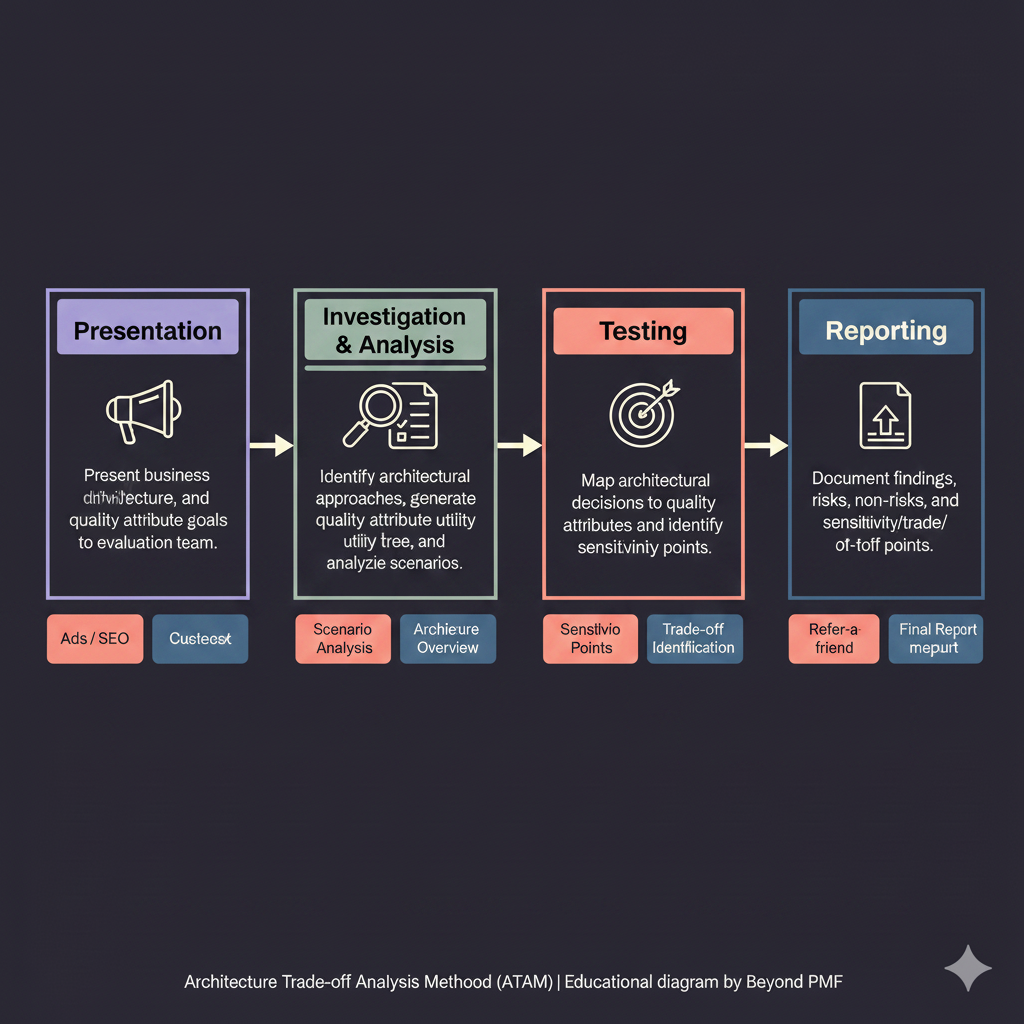
The Architecture Trade-off Analysis Method (ATAM) is a technique for evaluating software architecture decisions with respect to their impact on system quality attributes such as performance, security, and maintainability. Developed by the Software Engineering Institute (SEI), ATAM provides a systematic approach to identify trade-offs and risks in software architectures, facilitating informed decision-making and ensuring alignment with business goals. It is particularly beneficial in complex systems where multiple stakeholders and conflicting interests are involved.
Present the architecture: The architecture team presents the architecture to the evaluation team and stakeholders. | Identify architectural approaches: Discuss and document the architectural styles, patterns, and tactics being used. | Generate quality attribute utility tree: Stakeholders identify critical quality attributes, which are then organized in a utility tree. | Analyze architectural approaches: Evaluate how well the architecture satisfies the identified quality attributes. | Identify sensitivity points and trade-offs: Determine which elements of the architecture are most sensitive to changes and identify trade-offs. | Brainstorm and prioritize scenarios: Develop scenarios that test the architecture's response to various challenges. | Analyze architectural tactics: Review the tactics used to achieve quality attributes and their effectiveness. | Present results: Summarize the findings and present them to stakeholders.
Ensure involvement of all relevant stakeholders | Maintain clear and thorough documentation throughout the process | Regularly update and refine scenarios based on evolving requirements
Facilitates informed decision-making by highlighting trade-offs | Improves stakeholder communication and consensus | Identifies potential risks and vulnerabilities early in the design process
Can be time-consuming and resource-intensive | Requires thorough understanding of quality attributes | May not cover all aspects of system behavior comprehensively
When making critical architectural decisions | In the early stages of system design to ensure alignment with business goals
For small-scale or less complex projects where the overhead may not be justified | When rapid prototyping or agile development methods are prioritized