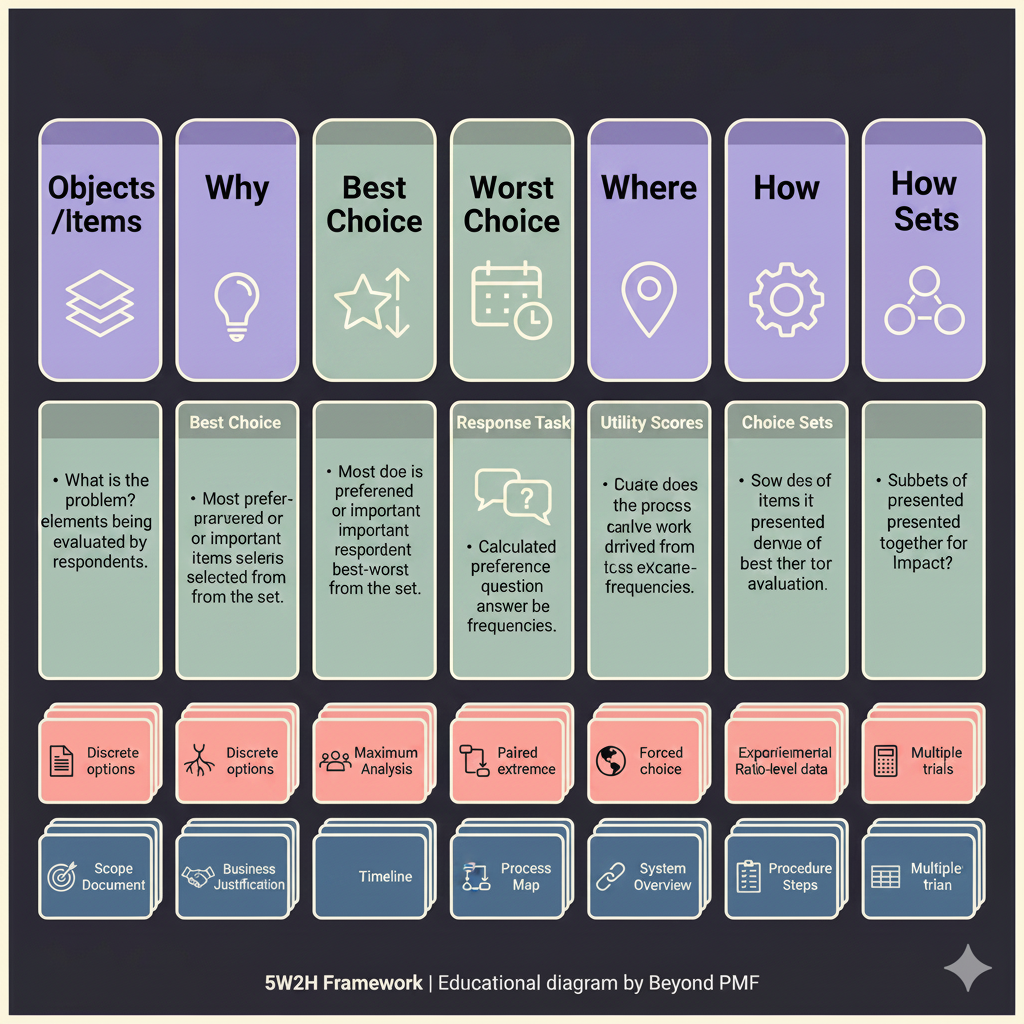
Best-Worst Scaling, also known as MaxDiff analysis, is a survey method used to derive preference/importance scores for a list of items. Participants are shown sets of items and asked to indicate the best and worst items (or most and least important, most and least appealing, etc.) within each set. This method helps in reducing response biases typical of traditional rating scales and provides a more discriminative data on the relative preference or importance of the listed items.
Define the set of items to be evaluated. | Design the survey, grouping items into smaller, manageable sets. | Ask respondents to select the best and worst items in each set. | Collect the survey data. | Analyze the data to calculate preference scores for each item.
Keep the number of items in each set small to avoid respondent fatigue. | Ensure a balanced and representative sampling of items in each set. | Use a robust statistical analysis method to interpret the data.
Reduces scale bias and response styles compared to traditional rating scales. | Provides more discriminative data on preferences. | Easy to understand and complete for respondents.
Requires a larger sample size to achieve stable estimates. | Complex analysis compared to simple ratings. | Not suitable for evaluating a very large number of items.
When needing to rank a moderate number of items by preference or importance. | In market research to determine the most and least appealing product features.
When the list of items is too large. | If the target population is not familiar with the items being evaluated.