Customer Value Chain Analysis

https://ik.imagekit.io/beyondpmf/frameworks/customer-value-chain-analysis.png
Customer Value Chain Analysis primarily addresses friction in the customer experience by dissecting the customer's journey. It helps identify issues in how the product or service is delivered, used, and perceived by the customer, ultimately focusing on implementation and customer UX.

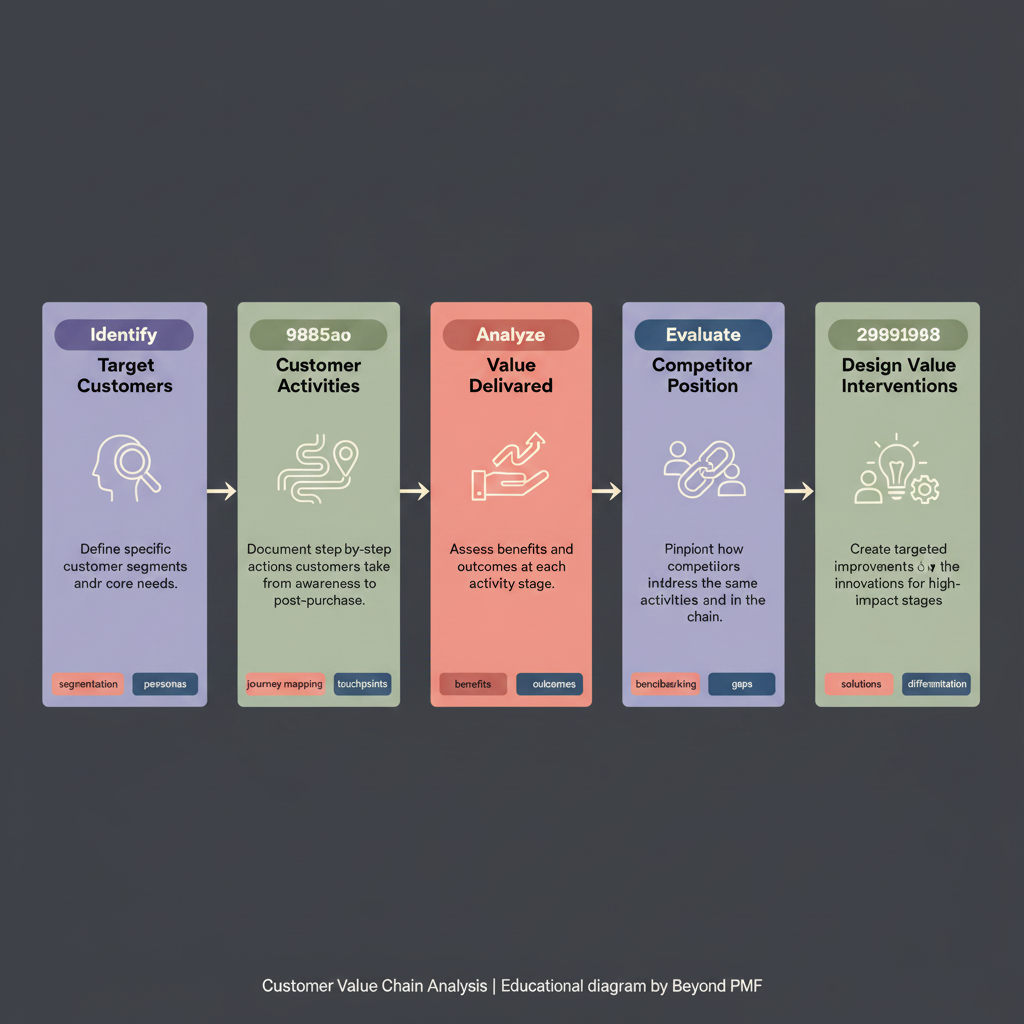
Customer Value Chain Analysis is a strategic tool used by businesses to analyze the specific activities through which firms can create value and competitive advantages. It involves mapping out the step-by-step process customers undergo from discovering a product or service to the final purchase and post-purchase interactions. This analysis helps companies identify key touchpoints that influence customer decisions and satisfaction, enabling them to enhance the customer experience, streamline operations, and increase profitability.

Steps / Detailed Description

Identify customer touchpoints: Map out all the points of interaction between the customer and the company. | Analyze customer activities: Study the actions and behaviors of customers at each touchpoint. | Evaluate value addition: Assess how much value each step adds to the customer experience. | Identify pain points: Locate areas where customers face difficulties or dissatisfaction. | Optimize touchpoints: Implement changes to improve efficiency and customer satisfaction at each step.

Best Practices

Regularly update the analysis to reflect changes in customer behavior | Integrate customer feedback to refine touchpoints | Collaborate across departments for a holistic analysis

Pros

Enhances understanding of customer behavior | Identifies opportunities for improvement | Increases customer satisfaction and loyalty

Cons

Can be time-consuming | May require significant data collection | Focuses primarily on existing processes and may overlook potential innovations

When to Use

When experiencing issues with customer satisfaction | When looking to optimize the customer journey

When Not to Use

In very early stages of product development | When there is insufficient data on customer interactions

Related Frameworks

Scope

Scope not defined

Maturity Level

Maturity level not specified

Time to Implement

2–4 Weeks
3–6 Months
1–2 Weeks
3–6 Months
1–2 Months
3–6 Months
1–2 Weeks
Less Than 1 Day
1–2 Weeks
Longer Than 6 Months
1–2 Weeks
Longer Than 6 Months
1–2 Weeks
3–6 Months
1–2 Weeks
1–2 Weeks
1–2 Weeks
1–2 Weeks
1–2 Days
1–2 Weeks
1–2 Weeks
1–2 Weeks
1–2 Weeks
1–2 Weeks
1–2 Weeks
3–6 Months
1–2 Weeks
1–2 Weeks
1–2 Weeks
3–6 Months
1–2 Weeks
1–2 Weeks
2–4 Weeks
1–2 Weeks
1–2 Days
1–2 Weeks
Longer Than 6 Months
3–6 Months
Longer Than 6 Months
1–2 Weeks
Longer Than 6 Months
3–6 Months
Less Than 1 Day
3–6 Months
1–2 Months
3–6 Months
Longer Than 6 Months
3–6 Months
Less Than 1 Day
1–2 Weeks
3–6 Months
3–6 Months
1–2 Weeks
3–6 Months
1–2 Weeks
1–2 Weeks
1–2 Days
1–2 Weeks
1–2 Months
Longer Than 6 Months
1–2 Weeks
Longer Than 6 Months
1–2 Weeks
3–6 Months
1–2 Weeks
Less Than 1 Day
1–2 Weeks
3–6 Months
1–2 Weeks
3–6 Months
1–2 Weeks
1–2 Weeks
Longer Than 6 Months
Less Than 1 Day
3–6 Months
Longer Than 6 Months
1–2 Months
1–2 Weeks
Longer Than 6 Months
1–2 Weeks
3–6 Months
1–2 Weeks
1–2 Weeks
3–6 Months
Less Than 1 Day
1–2 Weeks
1–2 Weeks
3–6 Months
3–6 Months
Less Than 1 Day
1–2 Weeks
Longer Than 6 Months
1–2 Months
1–2 Weeks
1–2 Weeks
1–2 Weeks
Longer Than 6 Months

Copyright Information

Autor:
Public Domain
N/A
Publication:
Generic Business Tool