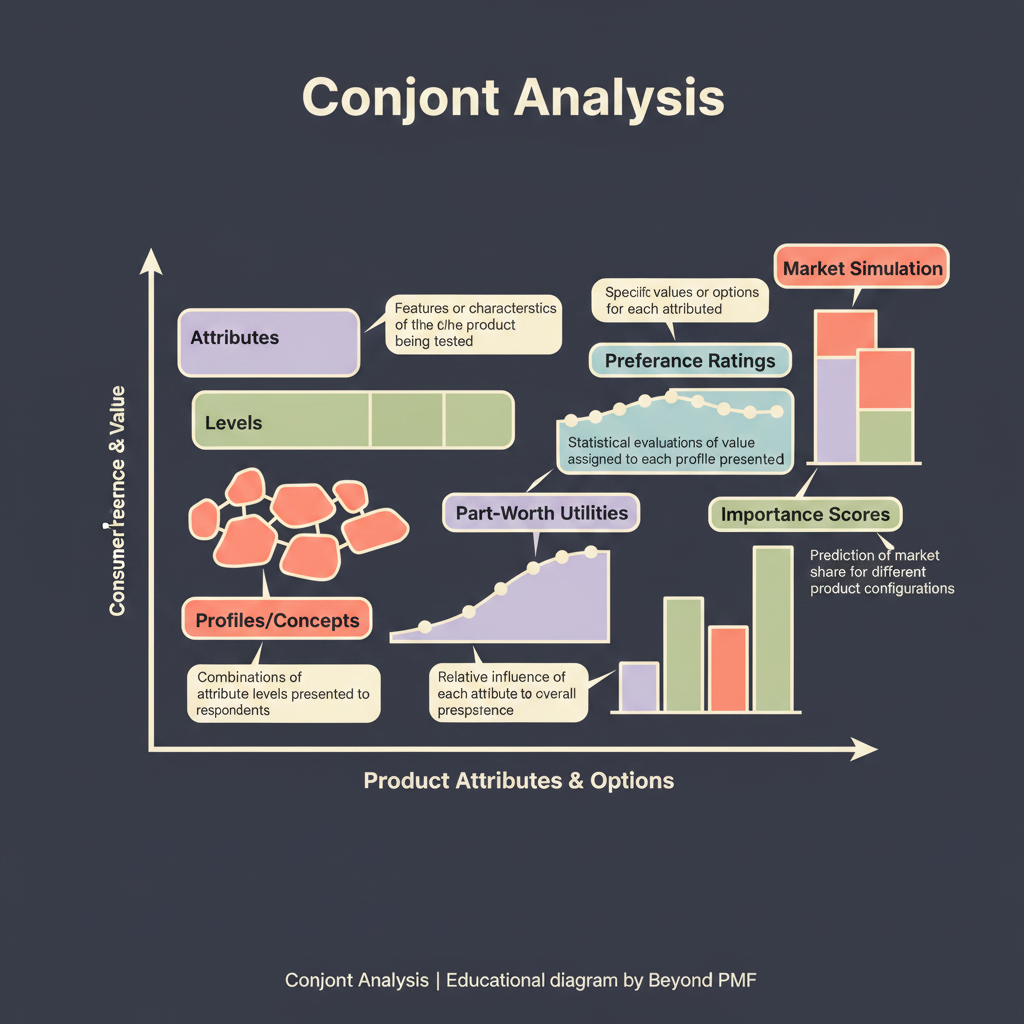
Conjoint Analysis

https://ik.imagekit.io/beyondpmf/frameworks/conjoint-analysis.png
Conjoint Analysis primarily addresses the strategic friction of market alignment. By understanding how customers value different product attributes, businesses can make informed decisions about product design, pricing, and overall market positioning, thus refining their vision and strategy.

Conjoint Analysis is a survey-based statistical technique used in market research that helps determine how people value different features that make up an individual product or service. The main goal of conjoint analysis is to measure the preferences and relative importance that consumers place on various attributes of a product. This analysis helps businesses in product development, pricing strategies, and market segmentation by revealing consumer preferences and the trade-offs they are willing to make.

Steps / Detailed Description

Define the problem and objectives: Clearly identify what you want to learn from the conjoint analysis. | Choose the attributes and levels: Select the features of the product and the variations of these features to be tested. | Design the survey: Create a set of hypothetical products or services with different combinations of attributes. | Collect data: Distribute the survey to a representative sample of the target market. | Analyze the data: Use statistical software to analyze the data and determine the relative importance of each attribute. | Interpret and apply the results: Use the insights gained to inform business decisions such as product design and marketing strategies.

Best Practices

Ensure clarity and simplicity in survey design to avoid respondent fatigue | Use a balanced and representative sample of the target market | Regularly update the attributes and levels to reflect current market conditions

Pros

Provides detailed insights into customer preferences | Helps in optimizing product features according to customer needs | Facilitates better segmentation and targeting

Cons

Can be complex and time-consuming to implement | Requires a sufficient sample size to be statistically significant | Results can be influenced by how the survey is designed

When to Use

New product development | Pricing strategy formulation

When Not to Use

When the target market is too small for meaningful analysis | When quick, superficial market insights are needed

Related Frameworks

Scope

Scope not defined

Maturity Level

Maturity level not specified

Time to Implement

2–4 Weeks
3–6 Months
1–2 Weeks
3–6 Months
1–2 Months
3–6 Months
1–2 Weeks
Less Than 1 Day
1–2 Weeks
Longer Than 6 Months
1–2 Weeks
Longer Than 6 Months
1–2 Weeks
3–6 Months
1–2 Weeks
1–2 Weeks
1–2 Weeks
1–2 Weeks
1–2 Days
1–2 Weeks
1–2 Weeks
1–2 Weeks
1–2 Weeks
1–2 Weeks
1–2 Weeks
3–6 Months
1–2 Weeks
1–2 Weeks
1–2 Weeks
3–6 Months
1–2 Weeks
1–2 Weeks
2–4 Weeks
1–2 Weeks
1–2 Days
1–2 Weeks
Longer Than 6 Months
3–6 Months
Longer Than 6 Months
1–2 Weeks
Longer Than 6 Months
3–6 Months
Less Than 1 Day
3–6 Months
1–2 Months
3–6 Months
Longer Than 6 Months
3–6 Months
Less Than 1 Day
1–2 Weeks
3–6 Months
3–6 Months
1–2 Weeks
3–6 Months
1–2 Weeks
1–2 Weeks
1–2 Days
1–2 Weeks
1–2 Months
Longer Than 6 Months
1–2 Weeks
Longer Than 6 Months
1–2 Weeks
3–6 Months
1–2 Weeks
Less Than 1 Day
1–2 Weeks
3–6 Months
1–2 Weeks
3–6 Months
1–2 Weeks
1–2 Weeks
Longer Than 6 Months
Less Than 1 Day
3–6 Months
Longer Than 6 Months
1–2 Months
1–2 Weeks
Longer Than 6 Months
1–2 Weeks
3–6 Months
1–2 Weeks
1–2 Weeks
3–6 Months
Less Than 1 Day
1–2 Weeks
1–2 Weeks
3–6 Months
3–6 Months
Less Than 1 Day
1–2 Weeks
Longer Than 6 Months
1–2 Months
1–2 Weeks
1–2 Weeks
1–2 Weeks
Longer Than 6 Months

Copyright Information

Autor:
Public Domain
N/A
Publication:
Generic Business Tool