Customer Journey Mapping

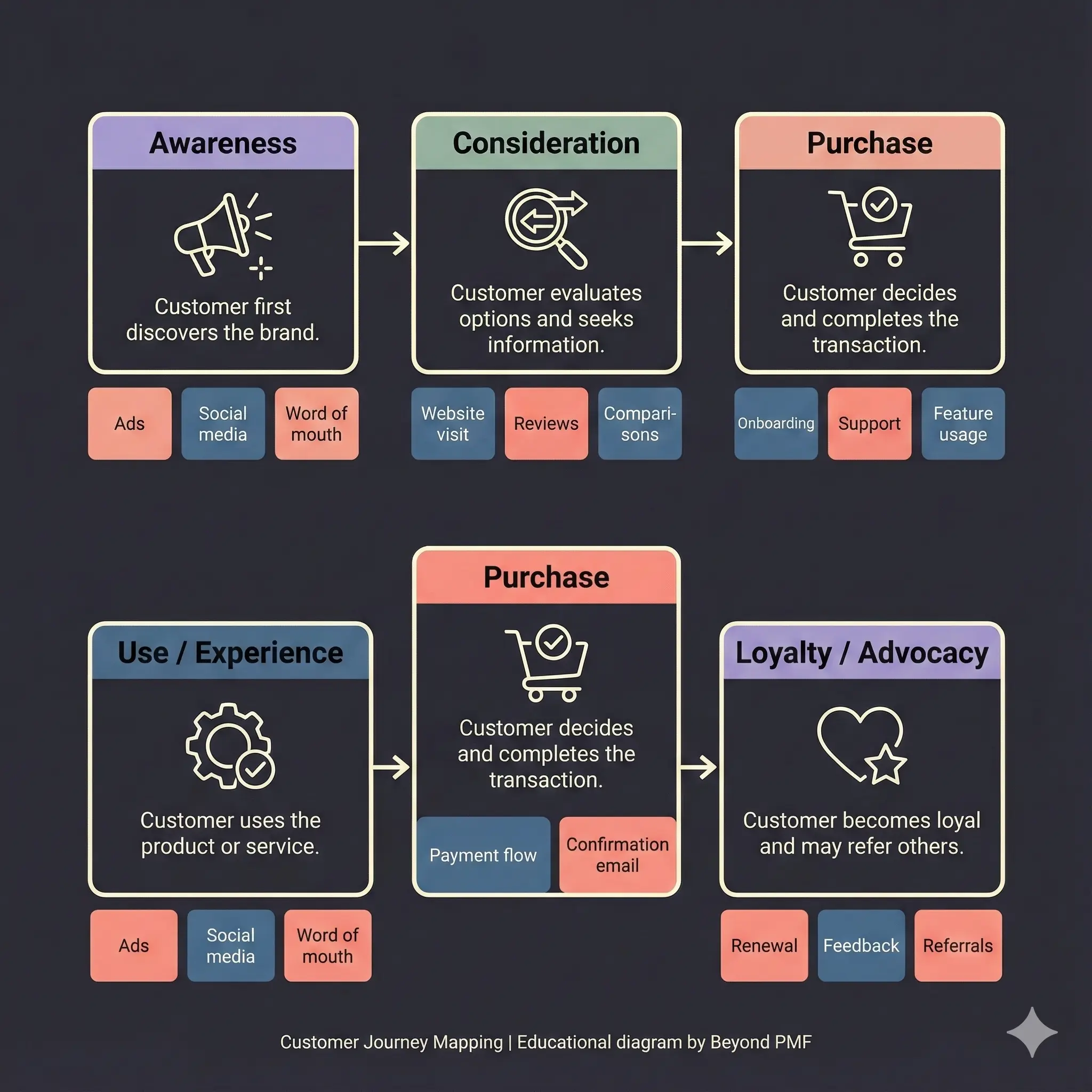
Customer Journey Mapping diagram showing the stages Awareness, Consideration, Purchase, Use/Experience, and Loyalty/Advocacy. Each stage includes typical customer actions and touchpoints such as ads, social media, website visits, reviews, onboarding, support, feature usage, payment flow, confirmation emails, renewals, feedback, and referrals.
Customer Journey Mapping primarily addresses execution-related friction by focusing on the customer experience and identifying pain points in their interactions with a brand. It helps to improve delivery, customer UX, and overall implementation by visualizing the customer's journey and highlighting areas for optimization.

Customer Journey Mapping is a strategic approach to understanding the flow of experiences a customer has with an organization. By mapping out each touchpoint that the customer interacts with, businesses can visualize the path from initial awareness to post-purchase behavior. This framework is used to identify gaps in the customer experience, areas for improvement, and opportunities to enhance customer satisfaction and loyalty. The benefits include improved customer engagement, more efficient business processes, and increased chances of meeting and exceeding customer expectations.

Steps / Detailed Description

Define your objectives for the map. | Profile your personas and define their goals. | List out all the touchpoints and channels. | Conduct research to gather customer feedback and data. | Map the journey stages from awareness to advocacy. | Identify key moments of truth and pain points. | Take action to improve the customer experience.

Best Practices

Involve a cross-functional team in the mapping process. | Regularly update the journey map as products and services evolve. | Use real customer data and feedback for accuracy.

Pros

Provides a holistic view of the customer experience. | Identifies disconnects between desired and actual customer experiences. | Facilitates targeted improvements based on specific customer feedback.

Cons

Can be time-consuming to create and maintain. | May require substantial customer data that is not always available. | Risk of oversimplification, missing out on nuanced customer interactions.

When to Use

When entering a new market or launching a new product. | When experiencing issues in customer satisfaction or retention.

When Not to Use

When there is insufficient data about customer interactions. | For very small or short-term tactical decisions.

Related Frameworks

Scope

Scope not defined

Maturity Level

Maturity level not specified

Time to Implement

2–4 Weeks
3–6 Months
1–2 Weeks
3–6 Months
1–2 Months
3–6 Months
1–2 Weeks
Less Than 1 Day
1–2 Weeks
Longer Than 6 Months
1–2 Weeks
Longer Than 6 Months
1–2 Weeks
3–6 Months
1–2 Weeks
1–2 Weeks
1–2 Weeks
1–2 Weeks
1–2 Days
1–2 Weeks
1–2 Weeks
1–2 Weeks
1–2 Weeks
1–2 Weeks
1–2 Weeks
3–6 Months
1–2 Weeks
1–2 Weeks
1–2 Weeks
3–6 Months
1–2 Weeks
1–2 Weeks
2–4 Weeks
1–2 Weeks
1–2 Days
1–2 Weeks
Longer Than 6 Months
3–6 Months
Longer Than 6 Months
1–2 Weeks
Longer Than 6 Months
3–6 Months
Less Than 1 Day
3–6 Months
1–2 Months
3–6 Months
Longer Than 6 Months
3–6 Months
Less Than 1 Day
1–2 Weeks
3–6 Months
3–6 Months
1–2 Weeks
3–6 Months
1–2 Weeks
1–2 Weeks
1–2 Days
1–2 Weeks
1–2 Months
Longer Than 6 Months
1–2 Weeks
Longer Than 6 Months
1–2 Weeks
3–6 Months
1–2 Weeks
Less Than 1 Day
1–2 Weeks
3–6 Months
1–2 Weeks
3–6 Months
1–2 Weeks
1–2 Weeks
Longer Than 6 Months
Less Than 1 Day
3–6 Months
Longer Than 6 Months
1–2 Months
1–2 Weeks
Longer Than 6 Months
1–2 Weeks
3–6 Months
1–2 Weeks
1–2 Weeks
3–6 Months
Less Than 1 Day
1–2 Weeks
1–2 Weeks
3–6 Months
3–6 Months
Less Than 1 Day
1–2 Weeks
Longer Than 6 Months
1–2 Months
1–2 Weeks
1–2 Weeks
1–2 Weeks
Longer Than 6 Months

Copyright Information

Autor:
Public Domain
N/A
Publication:
Generic Business Tool