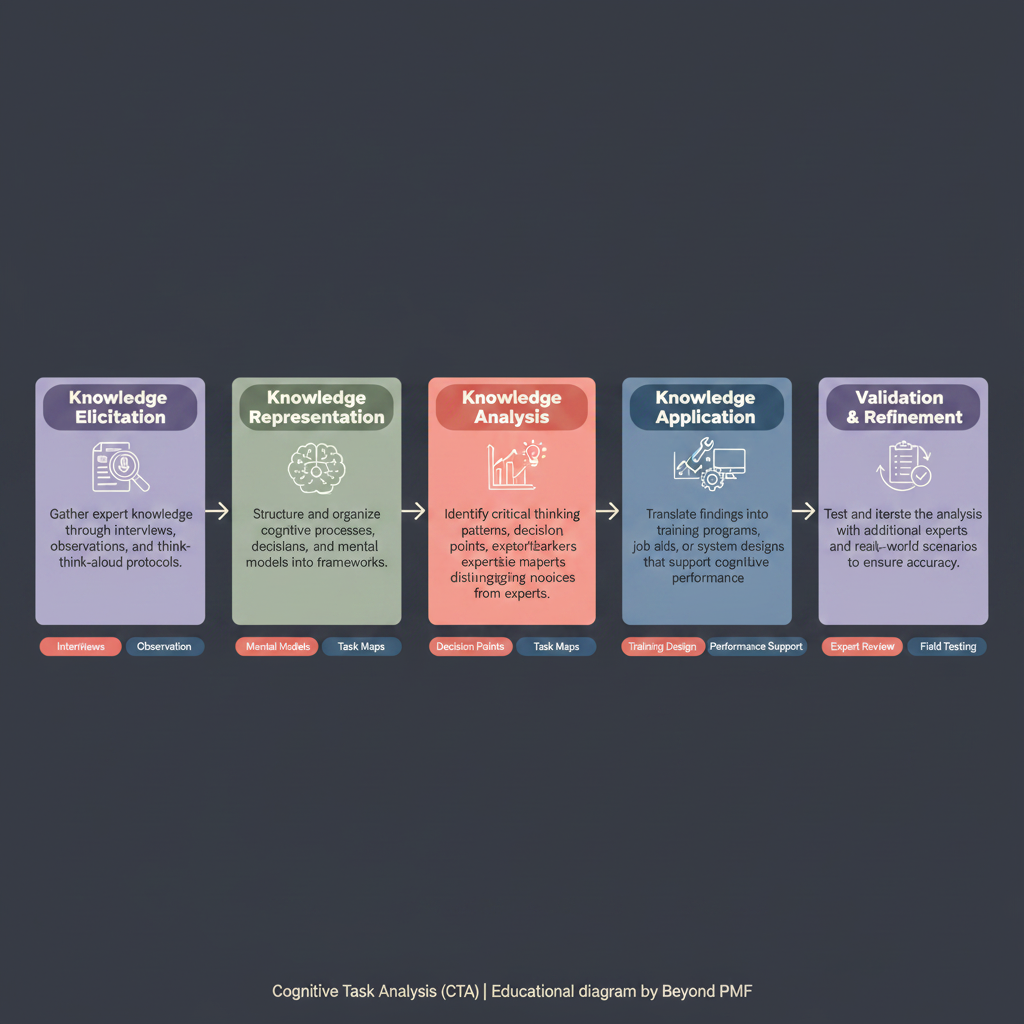
Cognitive Task Analysis (CTA) is a set of procedures used to understand the thought processes involved in task execution. It aims to uncover the cognitive skills, strategies, and knowledge that experts use but may not be aware of or able to articulate. CTA is beneficial for designing training programs, improving performance, and creating systems that support user cognition, making it invaluable in fields such as education, military, and healthcare.
Identify the task and expert performers: Select the task to analyze and identify experts who perform it proficiently. | Data collection: Use interviews, observations, and simulations to gather detailed data on task performance. | Data analysis: Analyze the collected data to identify cognitive processes, decision points, and knowledge used. | Model development: Develop models that represent the task processes, including flowcharts or cognitive maps. | Validation: Validate the models with experts to ensure accuracy. | Application: Apply the findings to design educational tools, training programs, or systems enhancements.
Engage multiple experts to avoid biased views | Combine multiple data collection methods for comprehensive analysis | Iteratively refine models based on feedback
Provides deep insights into expert performance | Enhances training effectiveness by focusing on cognitive skills | Supports system design by aligning with user mental models
Time-consuming and resource-intensive | Depends heavily on the expertise of the analyst | May not capture all implicit expert knowledge
Designing training programs for complex tasks | Developing user interfaces for technical systems
Simple, well-documented tasks | When time and resources are limited