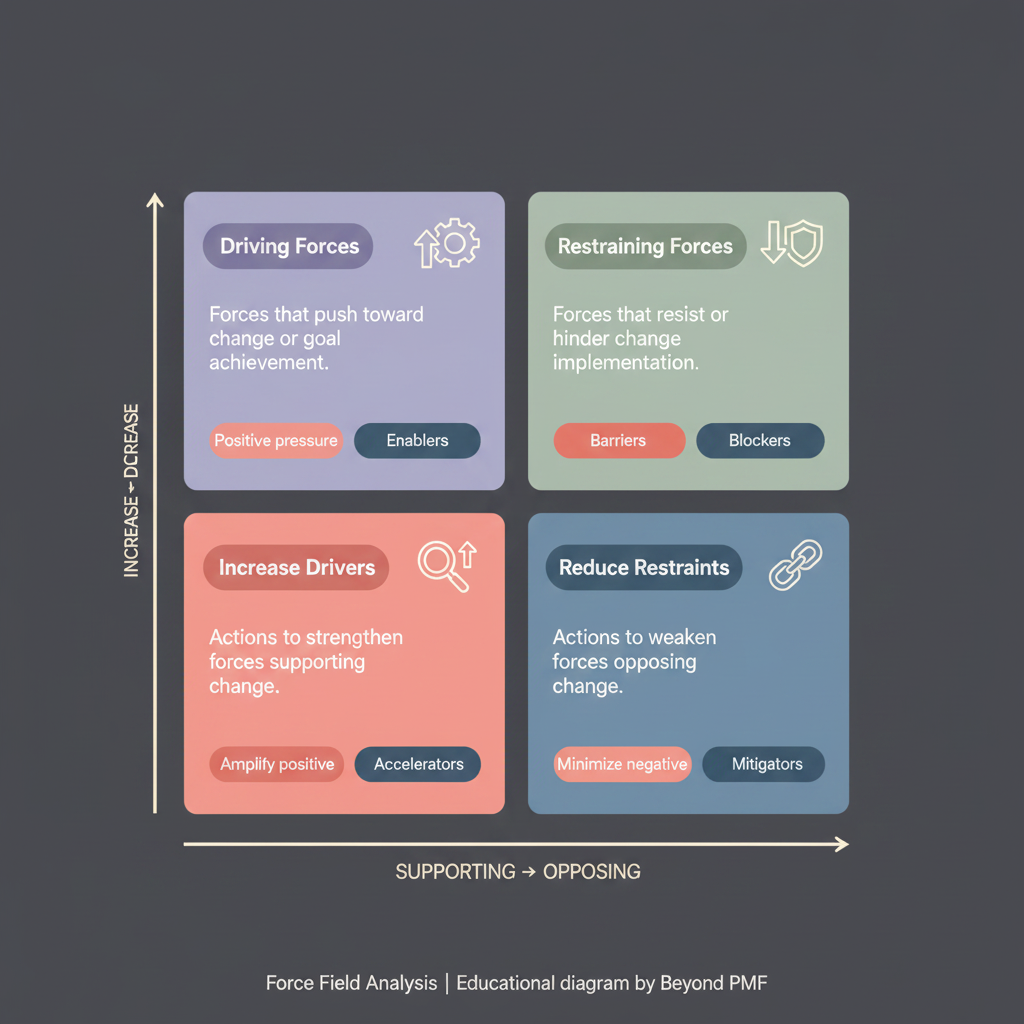
Force Field Analysis

https://ik.imagekit.io/beyondpmf/frameworks/force-field-analysis.png
Force Field Analysis primarily helps to understand forces that support or oppose a change initiative, which is intrinsically tied to strategic decisions about direction and implementation. It assists in assessing the feasibility and potential roadblocks of strategic initiatives.

Force Field Analysis is a management strategy tool developed by Kurt Lewin in the 1940s. It is used to identify the forces that either drive or hinder change within an organization. This framework helps in understanding what factors are working in favor of a decision and what factors are against it, enabling more informed decision-making. By analyzing these forces, organizations can develop strategies to strengthen positive forces or reduce the impact of negative forces.

Steps / Detailed Description

Define the desired change or decision to be analyzed. | Identify and list all driving forces that support the change. | Identify and list all restraining forces that oppose the change. | Assign scores to each force based on their strength and influence. | Analyze the forces and consider ways to strengthen driving forces or weaken restraining forces. | Review and modify the change strategy based on the analysis.

Best Practices

Involve a diverse group of stakeholders to get multiple perspectives | Regularly update the analysis to reflect changes in the environment | Use quantitative data to support the scoring of forces when possible

Pros

Provides a clear visualization of supporting and opposing forces | Helps in strategic planning by identifying key influencers | Facilitates more effective change management

Cons

Can be subjective, as scoring depends on personal judgment | May not capture all nuances of each force | Time-consuming if the number of forces is large

When to Use

When planning organizational changes | When trying to overcome resistance to change

When Not to Use

In situations requiring quick, immediate decisions | When there is insufficient information to properly analyze forces

Related Frameworks

Categories

Scope

Scope not defined

Maturity Level

Maturity level not specified

Time to Implement

2–4 Weeks
3–6 Months
1–2 Weeks
3–6 Months
1–2 Months
3–6 Months
1–2 Weeks
Less Than 1 Day
1–2 Weeks
Longer Than 6 Months
1–2 Weeks
Longer Than 6 Months
1–2 Weeks
3–6 Months
1–2 Weeks
1–2 Weeks
1–2 Weeks
1–2 Weeks
1–2 Days
1–2 Weeks
1–2 Weeks
1–2 Weeks
1–2 Weeks
1–2 Weeks
1–2 Weeks
3–6 Months
1–2 Weeks
1–2 Weeks
1–2 Weeks
3–6 Months
1–2 Weeks
1–2 Weeks
2–4 Weeks
1–2 Weeks
1–2 Days
1–2 Weeks
Longer Than 6 Months
3–6 Months
Longer Than 6 Months
1–2 Weeks
Longer Than 6 Months
3–6 Months
Less Than 1 Day
3–6 Months
1–2 Months
3–6 Months
Longer Than 6 Months
3–6 Months
Less Than 1 Day
1–2 Weeks
3–6 Months
3–6 Months
1–2 Weeks
3–6 Months
1–2 Weeks
1–2 Weeks
1–2 Days
1–2 Weeks
1–2 Months
Longer Than 6 Months
1–2 Weeks
Longer Than 6 Months
1–2 Weeks
3–6 Months
1–2 Weeks
Less Than 1 Day
1–2 Weeks
3–6 Months
1–2 Weeks
3–6 Months
1–2 Weeks
1–2 Weeks
Longer Than 6 Months
Less Than 1 Day
3–6 Months
Longer Than 6 Months
1–2 Months
1–2 Weeks
Longer Than 6 Months
1–2 Weeks
3–6 Months
1–2 Weeks
1–2 Weeks
3–6 Months
Less Than 1 Day
1–2 Weeks
1–2 Weeks
3–6 Months
3–6 Months
Less Than 1 Day
1–2 Weeks
Longer Than 6 Months
1–2 Months
1–2 Weeks
1–2 Weeks
1–2 Weeks
Longer Than 6 Months

Copyright Information

Autor:
Public Domain
N/A
Publication:
Generic Business Tool