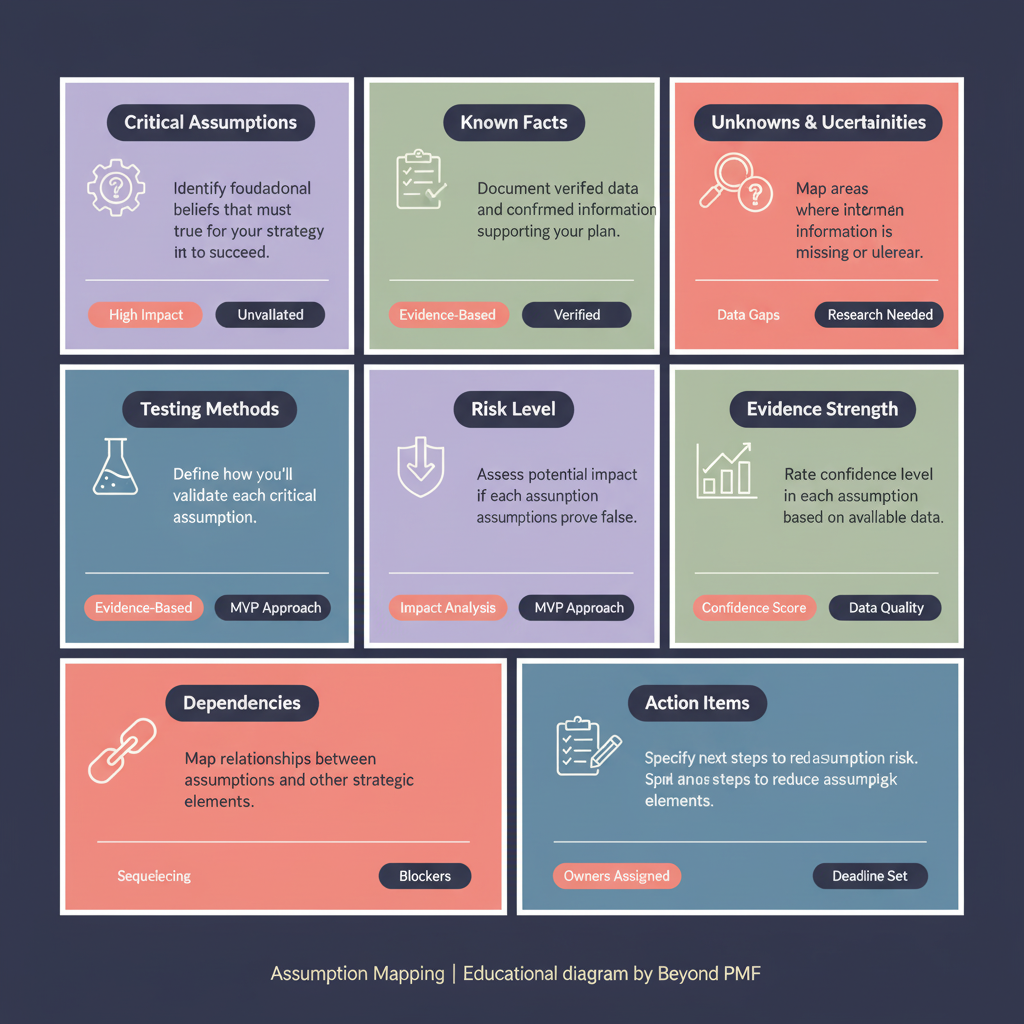
Assumption Mapping

Assumption Mapping helps to identify and validate the underlying beliefs that support a project or business idea. By uncovering and testing these assumptions, it reduces the risk of pursuing strategies based on flawed understandings of the market, customers, or technology.

Assumption Mapping is a framework that helps teams and individuals identify, prioritize, and test the assumptions underlying their projects or business strategies. By mapping out these assumptions, teams can focus on validating the most critical and uncertain ones first, reducing risk and increasing the likelihood of success. This approach is particularly beneficial in environments where information is incomplete or ambiguous, enabling more informed decision-making and resource allocation.

Steps / Detailed Description

Identify all assumptions related to the project or idea. | Categorize assumptions by their impact and the ease of testing them. | Prioritize assumptions based on their potential risk to the project. | Design experiments or tests to validate the most critical assumptions. | Analyze the results and refine the project or idea based on insights gained.

Best Practices

Involve diverse team members to ensure a comprehensive identification of assumptions. | Use a structured approach or tool for mapping and prioritizing assumptions. | Regularly review and update the assumptions map as the project progresses and new information becomes available.

Pros

Reduces risk by addressing uncertainties early in the project. | Improves decision-making by focusing on data-driven insights. | Enhances project adaptability by allowing for iterative refinement.

Cons

Can be time-consuming to identify and test all critical assumptions. | May require additional resources or expertise to conduct effective tests. | Relies heavily on the initial accuracy and comprehensiveness of the assumption identification process.

When to Use

When launching a new product or service. | In the early stages of project planning and development.

When Not to Use

In projects where all major variables are already well understood and tested. | When time constraints do not allow for thorough testing of assumptions.

Related Frameworks

Scope

Scope not defined

Maturity Level

Maturity level not specified

Time to Implement

2–4 Weeks
3–6 Months
1–2 Weeks
3–6 Months
1–2 Months
3–6 Months
1–2 Weeks
Less Than 1 Day
1–2 Weeks
Longer Than 6 Months
1–2 Weeks
Longer Than 6 Months
1–2 Weeks
3–6 Months
1–2 Weeks
1–2 Weeks
1–2 Weeks
1–2 Weeks
1–2 Days
1–2 Weeks
1–2 Weeks
1–2 Weeks
1–2 Weeks
1–2 Weeks
1–2 Weeks
3–6 Months
1–2 Weeks
1–2 Weeks
1–2 Weeks
3–6 Months
1–2 Weeks
1–2 Weeks
2–4 Weeks
1–2 Weeks
1–2 Days
1–2 Weeks
Longer Than 6 Months
3–6 Months
Longer Than 6 Months
1–2 Weeks
Longer Than 6 Months
3–6 Months
Less Than 1 Day
3–6 Months
1–2 Months
3–6 Months
Longer Than 6 Months
3–6 Months
Less Than 1 Day
1–2 Weeks
3–6 Months
3–6 Months
1–2 Weeks
3–6 Months
1–2 Weeks
1–2 Weeks
1–2 Days
1–2 Weeks
1–2 Months
Longer Than 6 Months
1–2 Weeks
Longer Than 6 Months
1–2 Weeks
3–6 Months
1–2 Weeks
Less Than 1 Day
1–2 Weeks
3–6 Months
1–2 Weeks
3–6 Months
1–2 Weeks
1–2 Weeks
Longer Than 6 Months
Less Than 1 Day
3–6 Months
Longer Than 6 Months
1–2 Months
1–2 Weeks
Longer Than 6 Months
1–2 Weeks
3–6 Months
1–2 Weeks
1–2 Weeks
3–6 Months
Less Than 1 Day
1–2 Weeks
1–2 Weeks
3–6 Months
3–6 Months
Less Than 1 Day
1–2 Weeks
Longer Than 6 Months
1–2 Months
1–2 Weeks
1–2 Weeks
1–2 Weeks

Copyright Information

Autor:
Public Domain
N/A
Publication:
Generic Business Tool