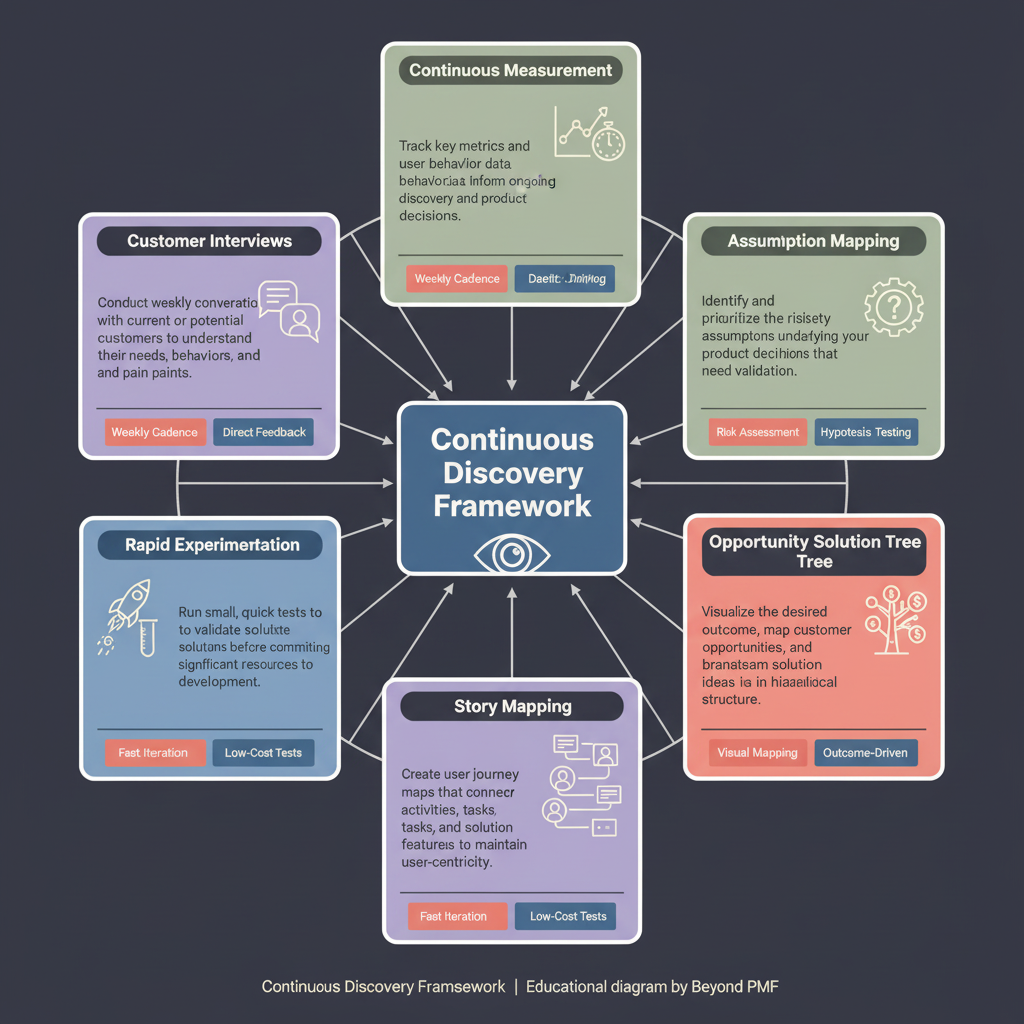
Continuous Discovery Framework

https://ik.imagekit.io/beyondpmf/frameworks/continuous-discovery-framework-teresa-torres.png
The Continuous Discovery Framework focuses on validating ideas and ensuring product-market fit through ongoing customer interaction. This addresses friction related to poor customer experience and ultimately poor implementation by ensuring the product aligns with customer needs during the delivery of the product.

The Continuous Discovery Framework is a modern approach used in product management that integrates regular customer feedback into the product development process. This framework encourages teams to continuously engage with customers through interviews, usability tests, and other feedback mechanisms to gather insights that inform product decisions. The goal is to reduce risks associated with product development by ensuring that the product evolves based on actual user needs and behaviors, thus increasing the likelihood of success in the market.

Steps / Detailed Description

Identify customer targets: Define who your customers are and segment them appropriately. | Generate hypotheses: Formulate assumptions about what customers need or want. | Conduct customer interviews: Regularly interact with customers to validate hypotheses. | Prototype potential solutions: Develop minimal viable products (MVPs) or prototypes to test ideas. | Gather and analyze feedback: Collect data from customer interactions and analyze it to inform decisions. | Iterate based on feedback: Refine or pivot product features based on customer insights.

Best Practices

Maintain a regular schedule of customer interactions | Focus on actionable insights that can directly influence product decisions | Use a variety of feedback tools to gather diverse customer insights

Pros

Ensures product relevance by aligning development with customer needs | Reduces the risk of market failure through continuous validation | Increases agility and adaptability in product development

Cons

Can be resource-intensive, requiring ongoing time and investment | May lead to scope creep if not properly managed | Relies heavily on the quality and frequency of customer interactions

When to Use

When developing new products or features | When entering new markets or targeting new customer segments

When Not to Use

In highly regulated industries where changes must be minimal and slow | When the product development cycle is extremely short

Related Frameworks

Scope

Scope not defined

Maturity Level

Maturity level not specified

Time to Implement

2–4 Weeks
3–6 Months
1–2 Weeks
3–6 Months
1–2 Months
3–6 Months
1–2 Weeks
Less Than 1 Day
1–2 Weeks
Longer Than 6 Months
1–2 Weeks
Longer Than 6 Months
1–2 Weeks
3–6 Months
1–2 Weeks
1–2 Weeks
1–2 Weeks
1–2 Weeks
1–2 Days
1–2 Weeks
1–2 Weeks
1–2 Weeks
1–2 Weeks
1–2 Weeks
1–2 Weeks
3–6 Months
1–2 Weeks
1–2 Weeks
1–2 Weeks
3–6 Months
1–2 Weeks
1–2 Weeks
2–4 Weeks
1–2 Weeks
1–2 Days
1–2 Weeks
Longer Than 6 Months
3–6 Months
Longer Than 6 Months
1–2 Weeks
Longer Than 6 Months
3–6 Months
Less Than 1 Day
3–6 Months
1–2 Months
3–6 Months
Longer Than 6 Months
3–6 Months
Less Than 1 Day
1–2 Weeks
3–6 Months
3–6 Months
1–2 Weeks
3–6 Months
1–2 Weeks
1–2 Weeks
1–2 Days
1–2 Weeks
1–2 Months
Longer Than 6 Months
1–2 Weeks
Longer Than 6 Months
1–2 Weeks
3–6 Months
1–2 Weeks
Less Than 1 Day
1–2 Weeks
3–6 Months
1–2 Weeks
3–6 Months
1–2 Weeks
1–2 Weeks
Longer Than 6 Months
Less Than 1 Day
3–6 Months
Longer Than 6 Months
1–2 Months
1–2 Weeks
Longer Than 6 Months
1–2 Weeks
3–6 Months
1–2 Weeks
1–2 Weeks
3–6 Months
Less Than 1 Day
1–2 Weeks
1–2 Weeks
3–6 Months
3–6 Months
Less Than 1 Day
1–2 Weeks
Longer Than 6 Months
1–2 Months
1–2 Weeks
1–2 Weeks
1–2 Weeks
Longer Than 6 Months

Copyright Information

Autor:
Unknown
N/A
Publication:
Generic Business Tool