Build-Measure-Learn Loop

https://ik.imagekit.io/beyondpmf/frameworks/build-measure-learn-loop.png
The Build-Measure-Learn Loop primarily addresses the friction of validating ideas and ensuring market alignment. It helps businesses avoid building products that no one wants by iteratively testing assumptions and adapting based on customer feedback, thus reducing the risk of a misaligned strategy.

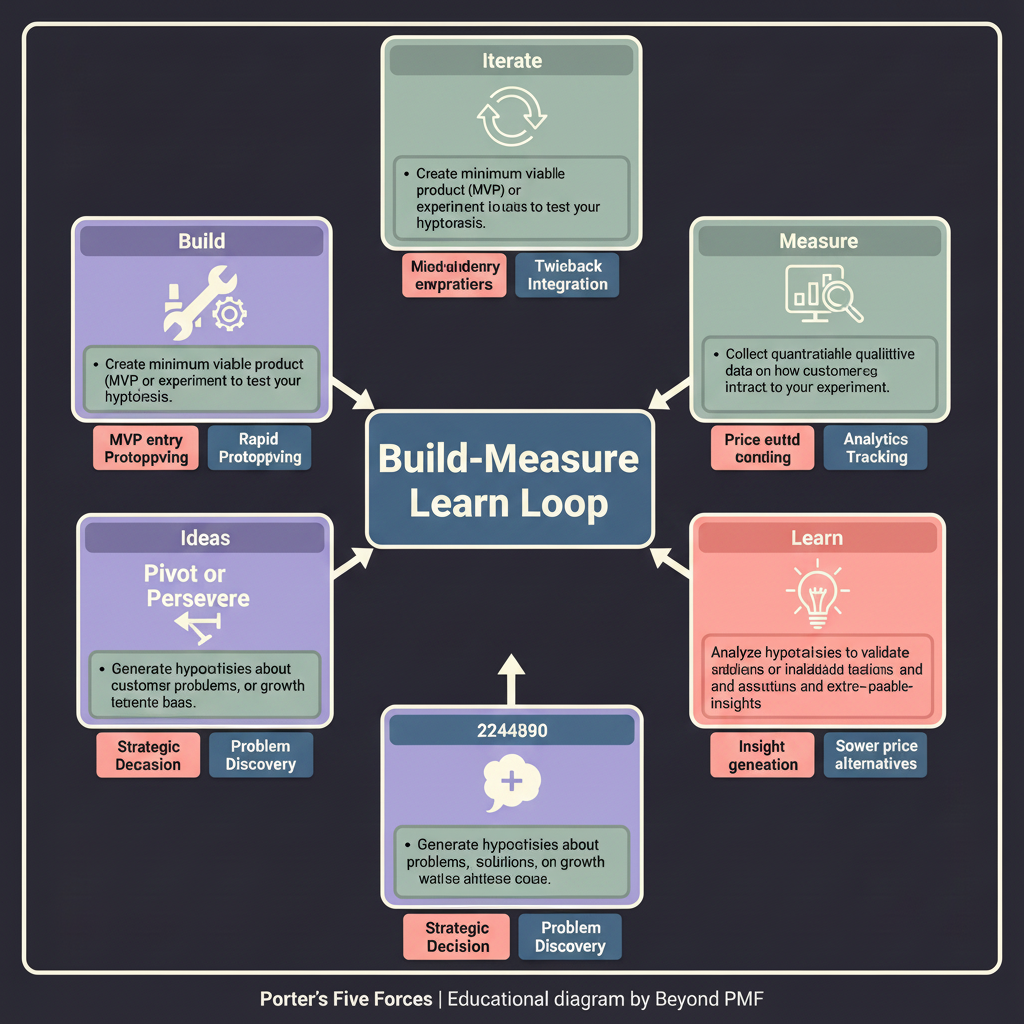
The Build-Measure-Learn Loop is a systematic process used in product development and startup environments to enhance the speed at which a product is developed and refined. It emphasizes building a minimum viable product (MVP), measuring its performance in the market, and learning from the results to make informed decisions. This iterative cycle helps in minimizing the time and resources spent on developing features that do not meet customer needs, thereby increasing the efficiency and effectiveness of development efforts.

Steps / Detailed Description

Build: Develop a minimum viable product (MVP) that includes only the core features necessary to test the key business hypotheses. | Measure: Collect and analyze data on how the MVP performs in the real market scenario. This could involve user feedback, analytics, and other relevant metrics. | Learn: Analyze the data collected to gain insights into what customers really want and need. Use these insights to decide whether to pivot (change strategy) or persevere (keep improving on the current path).

Best Practices

Start with a clear hypothesis for each Build-Measure-Learn cycle | Define success metrics upfront to accurately measure impact | Iterate quickly and incorporate feedback consistently

Pros

Facilitates rapid iteration and learning | Reduces the cost and risk of developing new products | Helps in quickly validating business hypotheses

Cons

May lead to frequent changes in direction which can confuse stakeholders | Can be challenging to define the right metrics to measure success | Might overlook long-term planning in favor of short-term learning

When to Use

In startup environments where speed and agility are crucial | When launching new products to an uncertain market

When Not to Use

In highly regulated industries where changes require lengthy approval processes | When the product development requires heavy upfront investment

Related Frameworks

Scope

Scope not defined

Maturity Level

Maturity level not specified

Time to Implement

2–4 Weeks
3–6 Months
1–2 Weeks
3–6 Months
1–2 Months
3–6 Months
1–2 Weeks
Less Than 1 Day
1–2 Weeks
Longer Than 6 Months
1–2 Weeks
Longer Than 6 Months
1–2 Weeks
3–6 Months
1–2 Weeks
1–2 Weeks
1–2 Weeks
1–2 Weeks
1–2 Days
1–2 Weeks
1–2 Weeks
1–2 Weeks
1–2 Weeks
1–2 Weeks
1–2 Weeks
3–6 Months
1–2 Weeks
1–2 Weeks
1–2 Weeks
3–6 Months
1–2 Weeks
1–2 Weeks
2–4 Weeks
1–2 Weeks
1–2 Days
1–2 Weeks
Longer Than 6 Months
3–6 Months
Longer Than 6 Months
1–2 Weeks
Longer Than 6 Months
3–6 Months
Less Than 1 Day
3–6 Months
1–2 Months
3–6 Months
Longer Than 6 Months
3–6 Months
Less Than 1 Day
1–2 Weeks
3–6 Months
3–6 Months
1–2 Weeks
3–6 Months
1–2 Weeks
1–2 Weeks
1–2 Days
1–2 Weeks
1–2 Months
Longer Than 6 Months
1–2 Weeks
Longer Than 6 Months
1–2 Weeks
3–6 Months
1–2 Weeks
Less Than 1 Day
1–2 Weeks
3–6 Months
1–2 Weeks
3–6 Months
1–2 Weeks
1–2 Weeks
Longer Than 6 Months
Less Than 1 Day
3–6 Months
Longer Than 6 Months
1–2 Months
1–2 Weeks
Longer Than 6 Months
1–2 Weeks
3–6 Months
1–2 Weeks
1–2 Weeks
3–6 Months
Less Than 1 Day
1–2 Weeks
1–2 Weeks
3–6 Months
3–6 Months
Less Than 1 Day
1–2 Weeks
Longer Than 6 Months
1–2 Months
1–2 Weeks
1–2 Weeks
1–2 Weeks
Longer Than 6 Months

Copyright Information

Autor:
Eric Ries
2011
Publication:
The Lean Startup