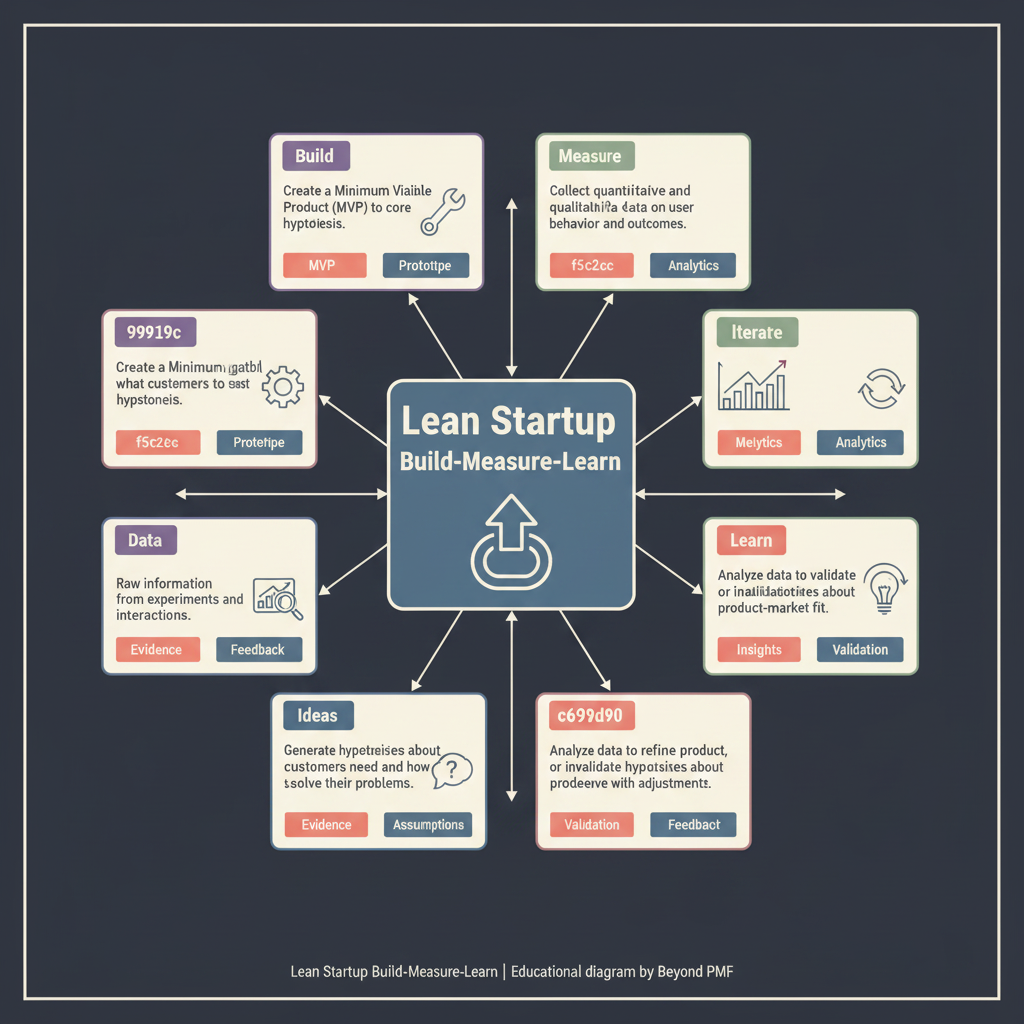
The Lean Startup Build-Measure-Learn framework is a core component of the Lean Startup methodology, which emphasizes rapid prototyping, validated learning, and iterative design to develop products that meet consumer needs more effectively. It encourages startups to invest their time into iteratively building products or services to meet the needs of early customers, thus reducing the market risks and sidestepping the need for large initial funding.
Build: Develop a minimum viable product (MVP) that includes only the core features necessary to satisfy early adopters and to test key business hypotheses. | Measure: Use qualitative and quantitative methods to gather data on how the MVP is performing in the real market scenario. This involves tracking user engagement, feedback, and conversion metrics. | Learn: Analyze the data collected to make informed decisions about whether to pivot (change course) or persevere (keep improving on the current course).
Start with a clear hypothesis for what you believe will bring value to customers. | Ensure accurate and actionable metrics are in place for measurement. | Be prepared to pivot based on what the data shows, not on hunches.
Minimizes time and resources spent on unviable products | Facilitates learning from real user feedback | Promotes agile adaptation to market demands
May lead to frequent pivoting, which can strain resources | Risk of building too simple an MVP that fails to engage | Dependence on measurable metrics which might not capture long-term value
When launching a new product in an uncertain market | When seeking to innovate or disrupt established markets
In highly regulated industries where changes can be costly or limited | When the product requires extensive safety or compliance testing before release