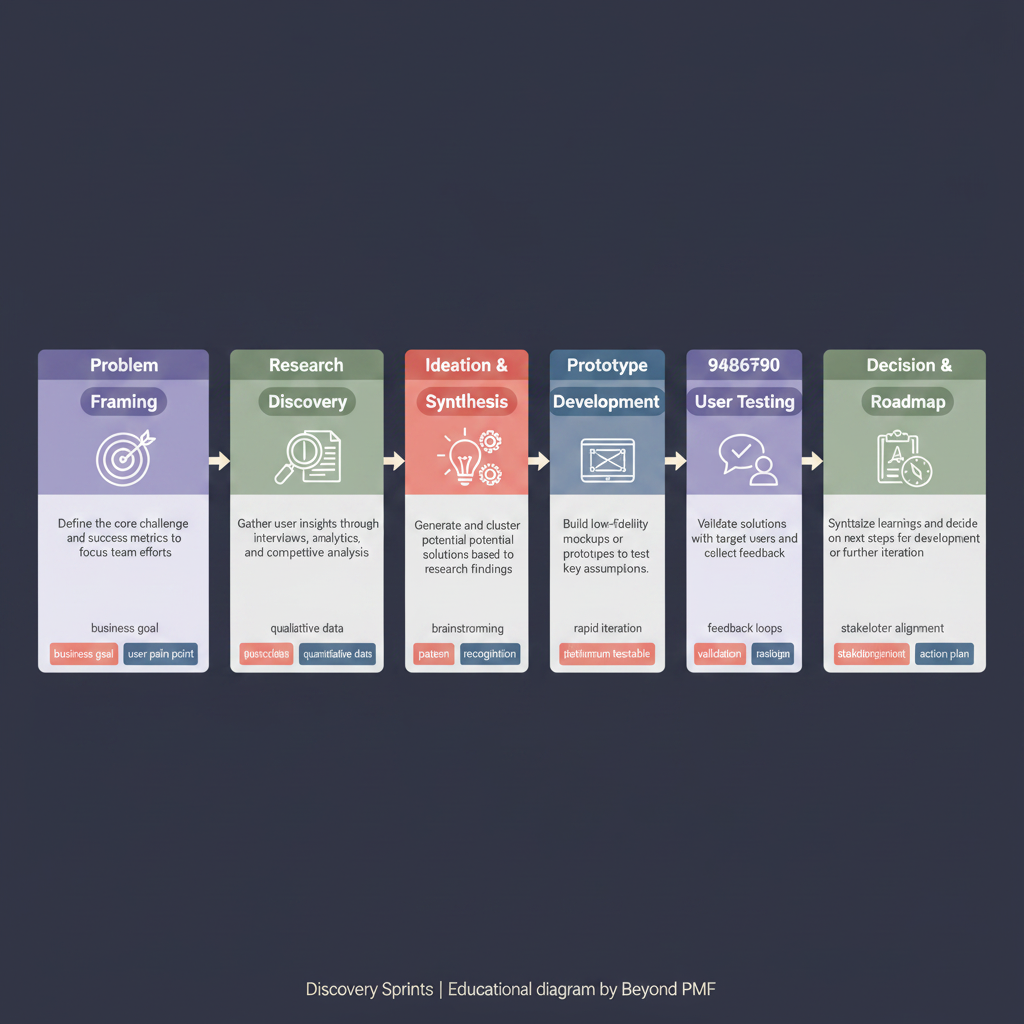
Discovery Sprints

https://ik.imagekit.io/beyondpmf/frameworks/discovery-sprints.png
Discovery Sprints focus on quickly developing insights and solutions to address specific business challenges. This inherently involves addressing issues related to the speed of finding solutions, the quality of these solutions, and the potential customer experience issues related to the challenge.

Discovery Sprints are a framework used to rapidly explore and validate ideas, products, or services within a short timeframe, typically one to two weeks. This approach is rooted in design thinking and agile methodologies, focusing on collaborative and cross-functional team efforts to ideate, prototype, and test solutions. The primary benefits include accelerated learning, reduced risk, and focused alignment across team members, leading to more informed decision-making.

Steps / Detailed Description

Define the challenge: Clearly articulate the problem or opportunity to address. | Map out the process: Create a roadmap of activities and timelines for the sprint. | Sketch solutions: Team members individually develop potential solutions. | Decide on a direction: Collaboratively select the most promising ideas for prototyping. | Prototype: Quickly build a testable version of the selected ideas. | Test with users: Gather feedback from real users or stakeholders. | Iterate and conclude: Analyze feedback, refine solutions, and decide on next steps.

Best Practices

Ensure diverse team expertise | Keep the scope narrow and focused | Prepare thoroughly to maximize sprint efficiency

Pros

Rapid validation of ideas | Enhanced team collaboration and creativity | Cost-effective risk management

Cons

May not be thorough for complex problems | Dependent on high-quality team input | Can be exhausting due to intense nature

When to Use

Early stages of product development | When facing a specific business challenge or opportunity

When Not to Use

For solving deeply technical or specialized issues | When there is a lack of time or resources to prepare effectively

Related Frameworks

Scope

Scope not defined

Maturity Level

Maturity level not specified

Time to Implement

2–4 Weeks
3–6 Months
1–2 Weeks
3–6 Months
1–2 Months
3–6 Months
1–2 Weeks
Less Than 1 Day
1–2 Weeks
Longer Than 6 Months
1–2 Weeks
Longer Than 6 Months
1–2 Weeks
3–6 Months
1–2 Weeks
1–2 Weeks
1–2 Weeks
1–2 Weeks
1–2 Days
1–2 Weeks
1–2 Weeks
1–2 Weeks
1–2 Weeks
1–2 Weeks
1–2 Weeks
3–6 Months
1–2 Weeks
1–2 Weeks
1–2 Weeks
3–6 Months
1–2 Weeks
1–2 Weeks
2–4 Weeks
1–2 Weeks
1–2 Days
1–2 Weeks
Longer Than 6 Months
3–6 Months
Longer Than 6 Months
1–2 Weeks
Longer Than 6 Months
3–6 Months
Less Than 1 Day
3–6 Months
1–2 Months
3–6 Months
Longer Than 6 Months
3–6 Months
Less Than 1 Day
1–2 Weeks
3–6 Months
3–6 Months
1–2 Weeks
3–6 Months
1–2 Weeks
1–2 Weeks
1–2 Days
1–2 Weeks
1–2 Months
Longer Than 6 Months
1–2 Weeks
Longer Than 6 Months
1–2 Weeks
3–6 Months
1–2 Weeks
Less Than 1 Day
1–2 Weeks
3–6 Months
1–2 Weeks
3–6 Months
1–2 Weeks
1–2 Weeks
Longer Than 6 Months
Less Than 1 Day
3–6 Months
Longer Than 6 Months
1–2 Months
1–2 Weeks
Longer Than 6 Months
1–2 Weeks
3–6 Months
1–2 Weeks
1–2 Weeks
3–6 Months
Less Than 1 Day
1–2 Weeks
1–2 Weeks
3–6 Months
3–6 Months
Less Than 1 Day
1–2 Weeks
Longer Than 6 Months
1–2 Months
1–2 Weeks
1–2 Weeks
1–2 Weeks
Longer Than 6 Months

Copyright Information

Autor:
Unknown
N/A
Publication:
Unknown