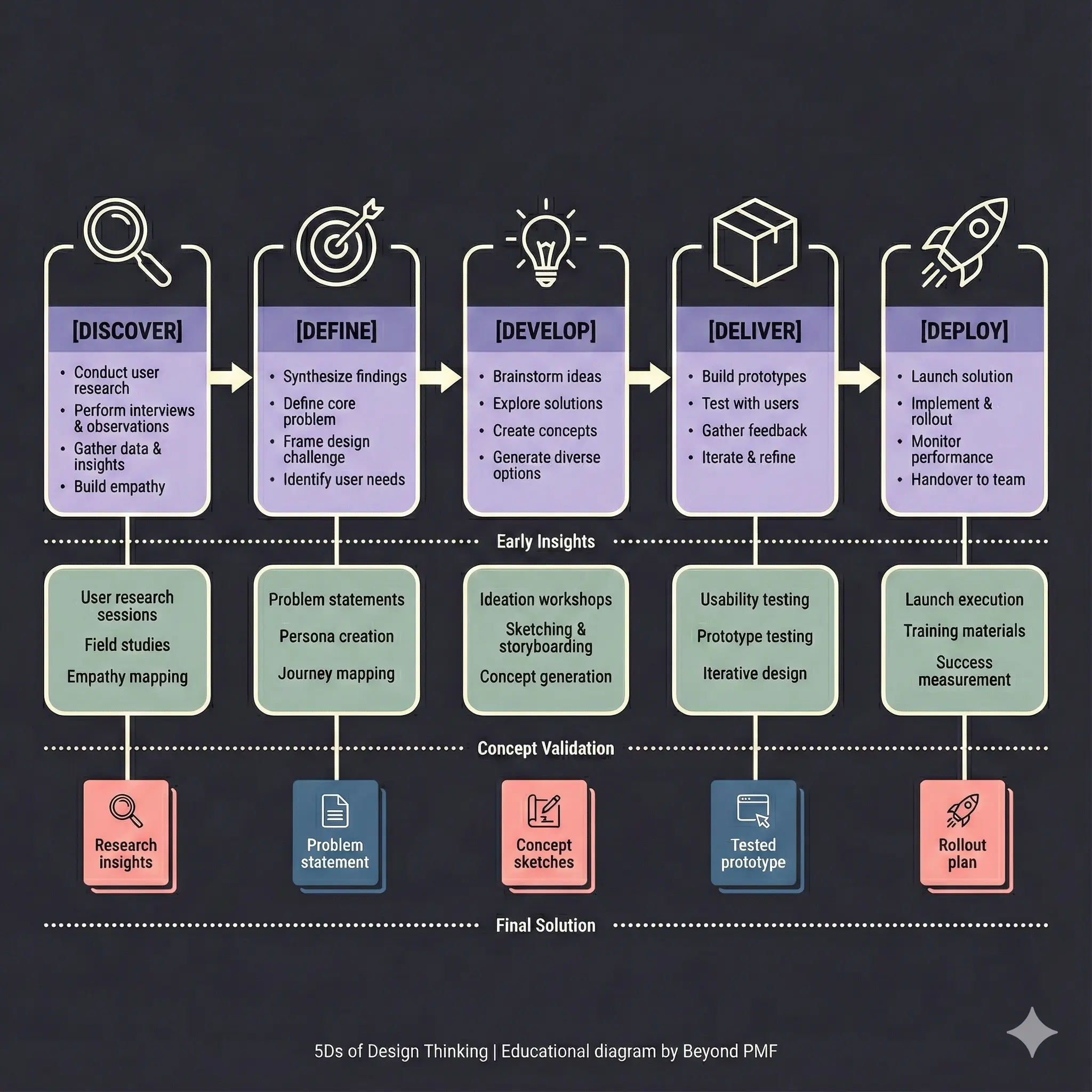
5Ds of Design Thinking

Diagram of the 5Ds of Design Thinking showing five stages: Discover, Define, Develop, Deliver, and Deploy. Each stage lists key activities such as user research, problem definition, ideation, prototyping, testing, and rollout. Icons and workflow arrows illustrate how insights progress from research to final solution.
The 5Ds of Design Thinking is a framework that directly addresses execution-related friction by providing a structured process for problem-solving, innovation, and ultimately, the delivery of solutions (including customer-facing ones) that meet user needs. It focuses on the implementation and creation of tangible outcomes.

The 5Ds of Design Thinking is a structured approach used to solve complex problems and foster innovation in a user-centered way. It involves five phases: Discover, Define, Develop, Deliver, and Debrief. This framework encourages multidisciplinary teams to collaborate and iterate on solutions, focusing on understanding the user's needs and continuously refining ideas until a viable solution is achieved. The benefits include improved product usability, innovative solutions, and enhanced team collaboration.

Steps / Detailed Description

Discover: Gather insights through research to understand the problem space and user needs. | Define: Synthesize findings to define the core problems and establish project scope and goals. | Develop: Ideate and prototype potential solutions, utilizing creative thinking techniques. | Deliver: Implement the solution, followed by testing and refinement based on user feedback. | Debrief: Reflect on the process and outcomes to identify lessons learned and potential improvements.

Best Practices

Engage a diverse team to gain multiple perspectives | Maintain user-centered focus throughout the process | Iterate based on real user feedback

Pros

Promotes deep understanding of user needs | Encourages creativity and innovation | Facilitates iterative development and continuous improvement

Cons

Time-consuming due to extensive research and iterations | Can be resource-intensive | Dependent on effective cross-disciplinary collaboration

When to Use

When developing new products or services | When solving complex user-centered problems

When Not to Use

For simple or well-defined problems with clear solutions | When quick, decisive action is required without room for iteration

Related Frameworks

Categories

Scope

Scope not defined

Maturity Level

Maturity level not specified

Time to Implement

2–4 Weeks
3–6 Months
1–2 Weeks
3–6 Months
1–2 Months
3–6 Months
1–2 Weeks
Less Than 1 Day
1–2 Weeks
Longer Than 6 Months
1–2 Weeks
Longer Than 6 Months
1–2 Weeks
3–6 Months
1–2 Weeks
1–2 Weeks
1–2 Weeks
1–2 Weeks
1–2 Days
1–2 Weeks
1–2 Weeks
1–2 Weeks
1–2 Weeks
1–2 Weeks
1–2 Weeks
3–6 Months
1–2 Weeks
1–2 Weeks
1–2 Weeks
3–6 Months
1–2 Weeks
1–2 Weeks
2–4 Weeks
1–2 Weeks
1–2 Days
1–2 Weeks
Longer Than 6 Months
3–6 Months
Longer Than 6 Months
1–2 Weeks
Longer Than 6 Months
3–6 Months
Less Than 1 Day
3–6 Months
1–2 Months
3–6 Months
Longer Than 6 Months
3–6 Months
Less Than 1 Day
1–2 Weeks
3–6 Months
3–6 Months
1–2 Weeks
3–6 Months
1–2 Weeks
1–2 Weeks
1–2 Days
1–2 Weeks
1–2 Months
Longer Than 6 Months
1–2 Weeks
Longer Than 6 Months
1–2 Weeks
3–6 Months
1–2 Weeks
Less Than 1 Day
1–2 Weeks
3–6 Months
1–2 Weeks
3–6 Months
1–2 Weeks
1–2 Weeks
Longer Than 6 Months
Less Than 1 Day
3–6 Months
Longer Than 6 Months
1–2 Months
1–2 Weeks
Longer Than 6 Months
1–2 Weeks
3–6 Months
1–2 Weeks
1–2 Weeks
3–6 Months
Less Than 1 Day
1–2 Weeks
1–2 Weeks
3–6 Months
3–6 Months
Less Than 1 Day
1–2 Weeks
Longer Than 6 Months
1–2 Months
1–2 Weeks
1–2 Weeks
1–2 Weeks
Longer Than 6 Months

Copyright Information

Autor:
Unknown
N/A
Publication:
Unknown