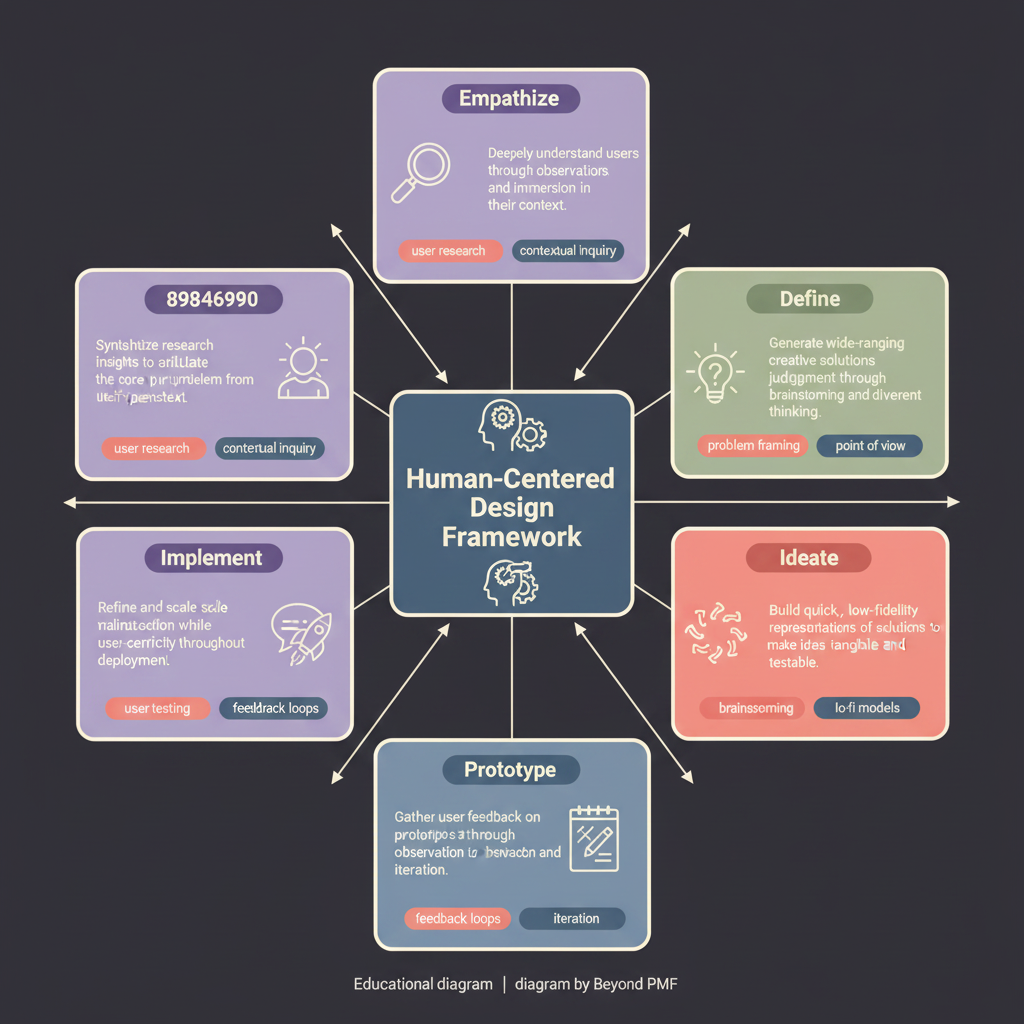
Human-Centered Design Framework

https://ik.imagekit.io/beyondpmf/frameworks/human-centered-design-framework.png
Human-Centered Design directly addresses issues with customer experience (UX) and the quality of solutions delivered to meet user needs. It focuses on implementing solutions that are tailored to the end-user's requirements.

The Human-Centered Design Framework is an iterative process that focuses on understanding the users, their environment, and the problems they face, in order to develop solutions that are both effective and sustainable. It emphasizes empathy, ideation, and prototyping to explore and create solutions that are deeply rooted in user needs. This framework is used to ensure that the outcomes are not only usable but also useful, enhancing user satisfaction and engagement.

Steps / Detailed Description

Empathize: Understand the users, their needs, experiences, and motivations. | Define: Clearly articulate the problem based on insights gained during the empathy phase. | Ideate: Generate a wide range of ideas and solutions. | Prototype: Build a representation of one or more of your ideas to show to others. | Test: Return to your users for feedback and refine the prototype or solutions accordingly.

Best Practices

Involve a diverse group of people in the HCD process | Maintain flexibility and openness in all phases | Iterate based on user feedback and testing

Pros

Increases relevance and usability of solutions | Enhances user satisfaction and engagement | Fosters innovation through user insights

Cons

Can be time-consuming | May require significant resources | Relies heavily on user involvement, which can be challenging to manage

When to Use

When developing new products or services | When redesigning or improving existing solutions

When Not to Use

When quick decisions are needed without thorough user engagement | When there is a lack of resources to engage in an iterative design process

Related Frameworks

Categories

Scope

Scope not defined

Maturity Level

Maturity level not specified

Time to Implement

2–4 Weeks
3–6 Months
1–2 Weeks
3–6 Months
1–2 Months
3–6 Months
1–2 Weeks
Less Than 1 Day
1–2 Weeks
Longer Than 6 Months
1–2 Weeks
Longer Than 6 Months
1–2 Weeks
3–6 Months
1–2 Weeks
1–2 Weeks
1–2 Weeks
1–2 Weeks
1–2 Days
1–2 Weeks
1–2 Weeks
1–2 Weeks
1–2 Weeks
1–2 Weeks
1–2 Weeks
3–6 Months
1–2 Weeks
1–2 Weeks
1–2 Weeks
3–6 Months
1–2 Weeks
1–2 Weeks
2–4 Weeks
1–2 Weeks
1–2 Days
1–2 Weeks
Longer Than 6 Months
3–6 Months
Longer Than 6 Months
1–2 Weeks
Longer Than 6 Months
3–6 Months
Less Than 1 Day
3–6 Months
1–2 Months
3–6 Months
Longer Than 6 Months
3–6 Months
Less Than 1 Day
1–2 Weeks
3–6 Months
3–6 Months
1–2 Weeks
3–6 Months
1–2 Weeks
1–2 Weeks
1–2 Days
1–2 Weeks
1–2 Months
Longer Than 6 Months
1–2 Weeks
Longer Than 6 Months
1–2 Weeks
3–6 Months
1–2 Weeks
Less Than 1 Day
1–2 Weeks
3–6 Months
1–2 Weeks
3–6 Months
1–2 Weeks
1–2 Weeks
Longer Than 6 Months
Less Than 1 Day
3–6 Months
Longer Than 6 Months
1–2 Months
1–2 Weeks
Longer Than 6 Months
1–2 Weeks
3–6 Months
1–2 Weeks
1–2 Weeks
3–6 Months
Less Than 1 Day
1–2 Weeks
1–2 Weeks
3–6 Months
3–6 Months
Less Than 1 Day
1–2 Weeks
Longer Than 6 Months
1–2 Months
1–2 Weeks
1–2 Weeks
1–2 Weeks
Longer Than 6 Months

Copyright Information

Autor:
Public Domain
N/A
Publication:
Generic Business Tool