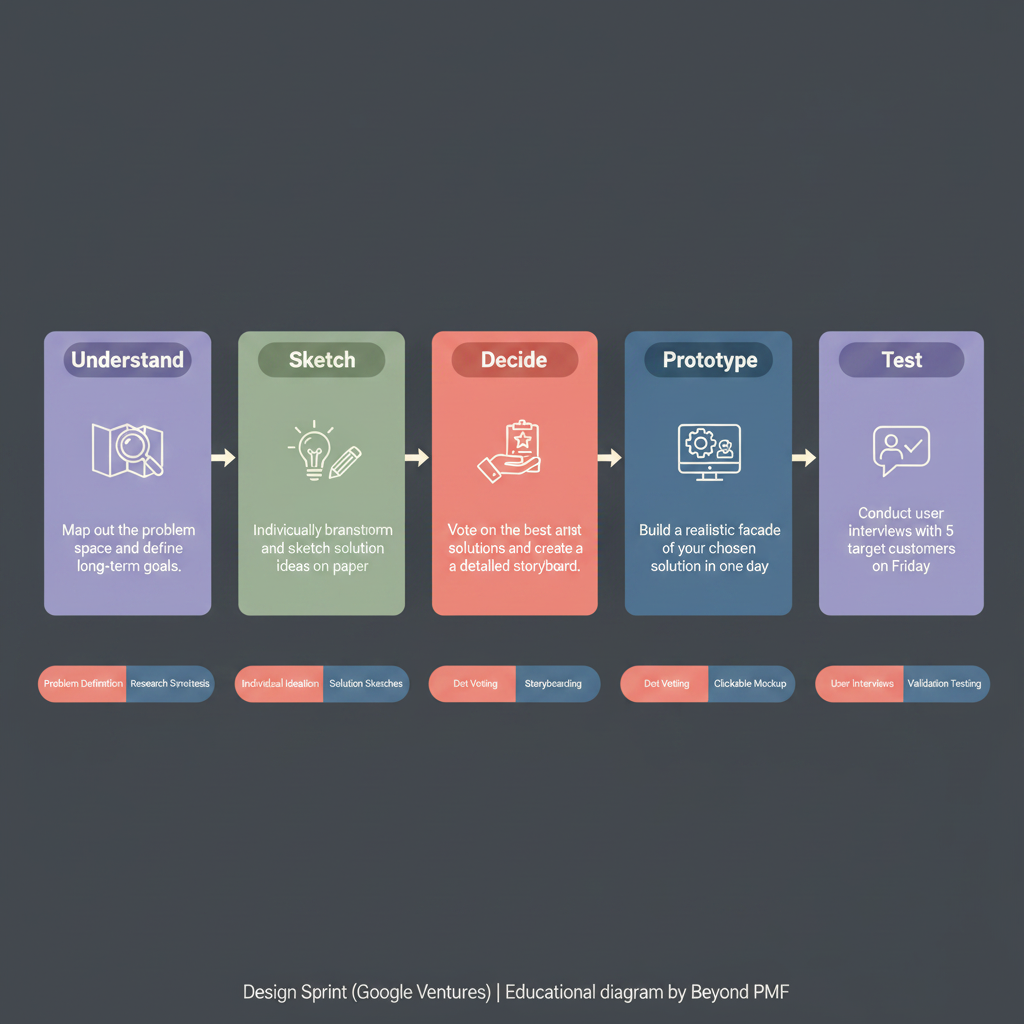
Design Sprint (Google Ventures)

https://ik.imagekit.io/beyondpmf/frameworks/design-sprint-google-ventures.png
The Design Sprint addresses issues related to customer experience and rapid prototyping of solutions. By testing ideas with customers, it aims to improve customer UX and ensure successful implementation.

Developed by Google Ventures, the Design Sprint is a unique five-day process aimed at helping businesses solve complex problems and test new ideas in just one week. Originally created by a group of thinkers, engineers, and designers at Google, this framework guides teams from ideation to prototype, culminating in user testing. The sprint enables teams to fast-forward into the future to see their finished product and customer reactions, before making any expensive commitments.

Steps / Detailed Description

Day 1: Understand - Map out the problem and pick an area to focus. | Day 2: Diverge - Sketch competing solutions on paper. | Day 3: Decide - Make decisions and turn ideas into a testable hypothesis. | Day 4: Prototype - Build a realistic prototype. | Day 5: Test - Test the prototype with real live users.

Best Practices

Ensure full team participation | Prepare well by choosing the right problem and the right team | Focus on user feedback rather than opinions

Pros

Rapidly tests and validates ideas | Encourages user-centered thinking | Facilitates cross-functional collaboration

Cons

Can be resource-intensive | May not be suitable for solving every type of problem | Requires full participation from key team members

When to Use

When launching a new product | When trying to solve a complex problem quickly

When Not to Use

For well-understood problems with clear solutions | When the team cannot commit to the full sprint duration

Related Frameworks

Categories

Scope

Scope not defined

Maturity Level

Maturity level not specified

Time to Implement

2–4 Weeks
3–6 Months
1–2 Weeks
3–6 Months
1–2 Months
3–6 Months
1–2 Weeks
Less Than 1 Day
1–2 Weeks
Longer Than 6 Months
1–2 Weeks
Longer Than 6 Months
1–2 Weeks
3–6 Months
1–2 Weeks
1–2 Weeks
1–2 Weeks
1–2 Weeks
1–2 Days
1–2 Weeks
1–2 Weeks
1–2 Weeks
1–2 Weeks
1–2 Weeks
1–2 Weeks
3–6 Months
1–2 Weeks
1–2 Weeks
1–2 Weeks
3–6 Months
1–2 Weeks
1–2 Weeks
2–4 Weeks
1–2 Weeks
1–2 Days
1–2 Weeks
Longer Than 6 Months
3–6 Months
Longer Than 6 Months
1–2 Weeks
Longer Than 6 Months
3–6 Months
Less Than 1 Day
3–6 Months
1–2 Months
3–6 Months
Longer Than 6 Months
3–6 Months
Less Than 1 Day
1–2 Weeks
3–6 Months
3–6 Months
1–2 Weeks
3–6 Months
1–2 Weeks
1–2 Weeks
1–2 Days
1–2 Weeks
1–2 Months
Longer Than 6 Months
1–2 Weeks
Longer Than 6 Months
1–2 Weeks
3–6 Months
1–2 Weeks
Less Than 1 Day
1–2 Weeks
3–6 Months
1–2 Weeks
3–6 Months
1–2 Weeks
1–2 Weeks
Longer Than 6 Months
Less Than 1 Day
3–6 Months
Longer Than 6 Months
1–2 Months
1–2 Weeks
Longer Than 6 Months
1–2 Weeks
3–6 Months
1–2 Weeks
1–2 Weeks
3–6 Months
Less Than 1 Day
1–2 Weeks
1–2 Weeks
3–6 Months
3–6 Months
Less Than 1 Day
1–2 Weeks
Longer Than 6 Months
1–2 Months
1–2 Weeks
1–2 Weeks
1–2 Weeks
Longer Than 6 Months

Copyright Information

Autor:
Google Ventures
2010
Publication:
Organization