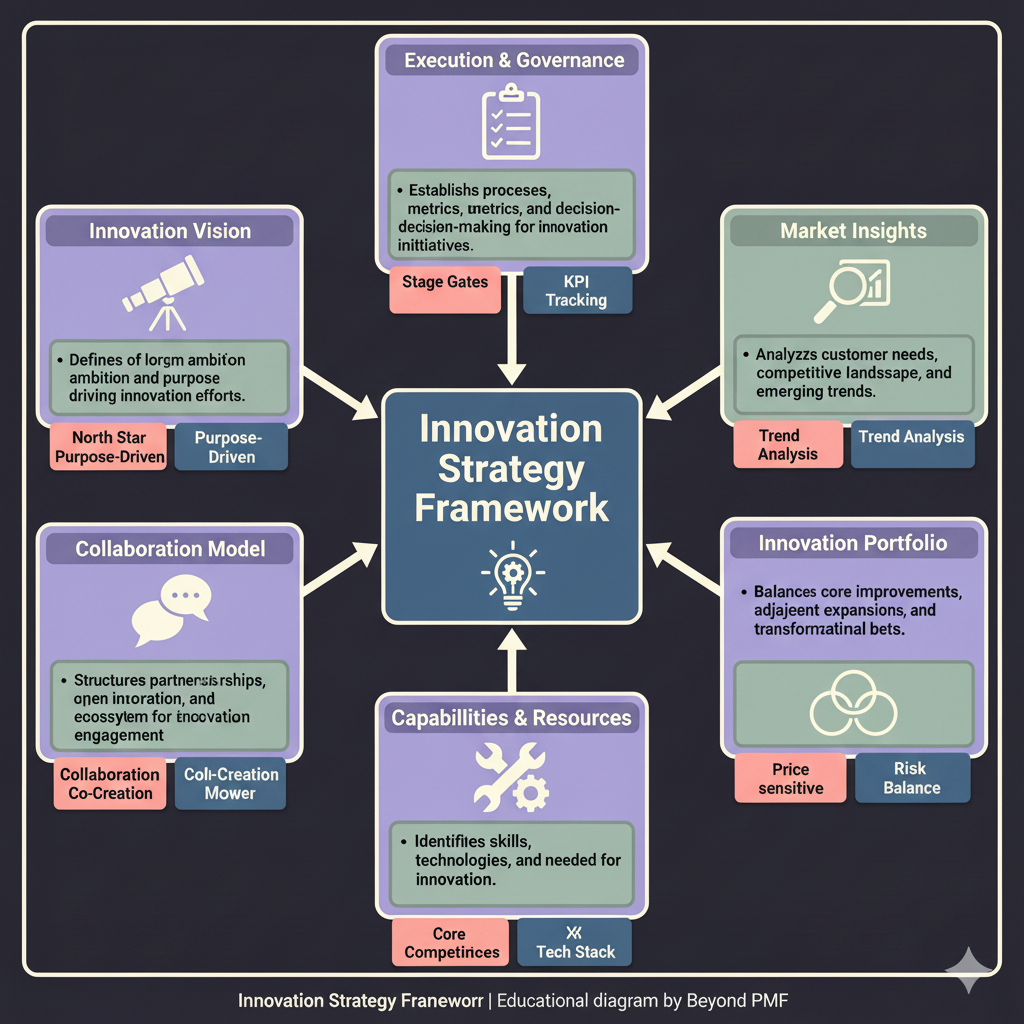
Innovation Strategy Framework

https://ik.imagekit.io/beyondpmf/frameworks/innovation-strategy-framework.png
The Innovation Strategy Framework directly addresses the strategic friction of unclear direction. It aims to guide organizations in defining their innovation goals, aligning on a vision, and developing a strategic roadmap.

The Innovation Strategy Framework is a comprehensive approach that helps organizations align their innovation activities with their overall business strategy. It involves identifying areas for innovation, setting clear objectives, and deploying resources effectively to achieve these goals. The framework aids in creating a structured environment that encourages creative thinking and sustainable growth, making it crucial for businesses aiming to maintain competitive advantage in rapidly changing markets.

Steps / Detailed Description

Identify innovation goals aligned with the business strategy. | Analyze the current market and technological trends. | Define key focus areas for innovation based on analysis. | Develop a roadmap for implementing innovation initiatives. | Allocate resources and assign responsibilities. | Monitor progress and make adjustments as necessary.

Best Practices

Regularly update the framework to reflect changes in the business environment | Encourage cross-functional collaboration to enhance creativity | Use metrics and KPIs to measure innovation performance

Pros

Enhances alignment between innovation and business objectives | Facilitates systematic and strategic approach to innovation | Improves competitiveness by fostering continuous improvement

Cons

Can be time-consuming to implement and maintain | Requires significant resource allocation | May not be flexible enough to adapt to rapid market changes

When to Use

When launching new products or entering new markets | When seeking to revitalize or redirect business strategy

When Not to Use

In very small or resource-constrained organizations | When immediate results are required without long-term focus

Related Frameworks

Scope

Scope not defined

Maturity Level

Maturity level not specified

Time to Implement

2–4 Weeks
3–6 Months
1–2 Weeks
3–6 Months
1–2 Months
3–6 Months
1–2 Weeks
Less Than 1 Day
1–2 Weeks
Longer Than 6 Months
1–2 Weeks
Longer Than 6 Months
1–2 Weeks
3–6 Months
1–2 Weeks
1–2 Weeks
1–2 Weeks
1–2 Weeks
1–2 Days
1–2 Weeks
1–2 Weeks
1–2 Weeks
1–2 Weeks
1–2 Weeks
1–2 Weeks
3–6 Months
1–2 Weeks
1–2 Weeks
1–2 Weeks
3–6 Months
1–2 Weeks
1–2 Weeks
2–4 Weeks
1–2 Weeks
1–2 Days
1–2 Weeks
Longer Than 6 Months
3–6 Months
Longer Than 6 Months
1–2 Weeks
Longer Than 6 Months
3–6 Months
Less Than 1 Day
3–6 Months
1–2 Months
3–6 Months
Longer Than 6 Months
3–6 Months
Less Than 1 Day
1–2 Weeks
3–6 Months
3–6 Months
1–2 Weeks
3–6 Months
1–2 Weeks
1–2 Weeks
1–2 Days
1–2 Weeks
1–2 Months
Longer Than 6 Months
1–2 Weeks
Longer Than 6 Months
1–2 Weeks
3–6 Months
1–2 Weeks
Less Than 1 Day
1–2 Weeks
3–6 Months
1–2 Weeks
3–6 Months
1–2 Weeks
1–2 Weeks
Longer Than 6 Months
Less Than 1 Day
3–6 Months
Longer Than 6 Months
1–2 Months
1–2 Weeks
Longer Than 6 Months
1–2 Weeks
3–6 Months
1–2 Weeks
1–2 Weeks
3–6 Months
Less Than 1 Day
1–2 Weeks
1–2 Weeks
3–6 Months
3–6 Months
Less Than 1 Day
1–2 Weeks
Longer Than 6 Months
1–2 Months
1–2 Weeks
1–2 Weeks
1–2 Weeks
Longer Than 6 Months

Copyright Information

Autor:
Public Domain
N/A
Publication:
Generic Business Tool