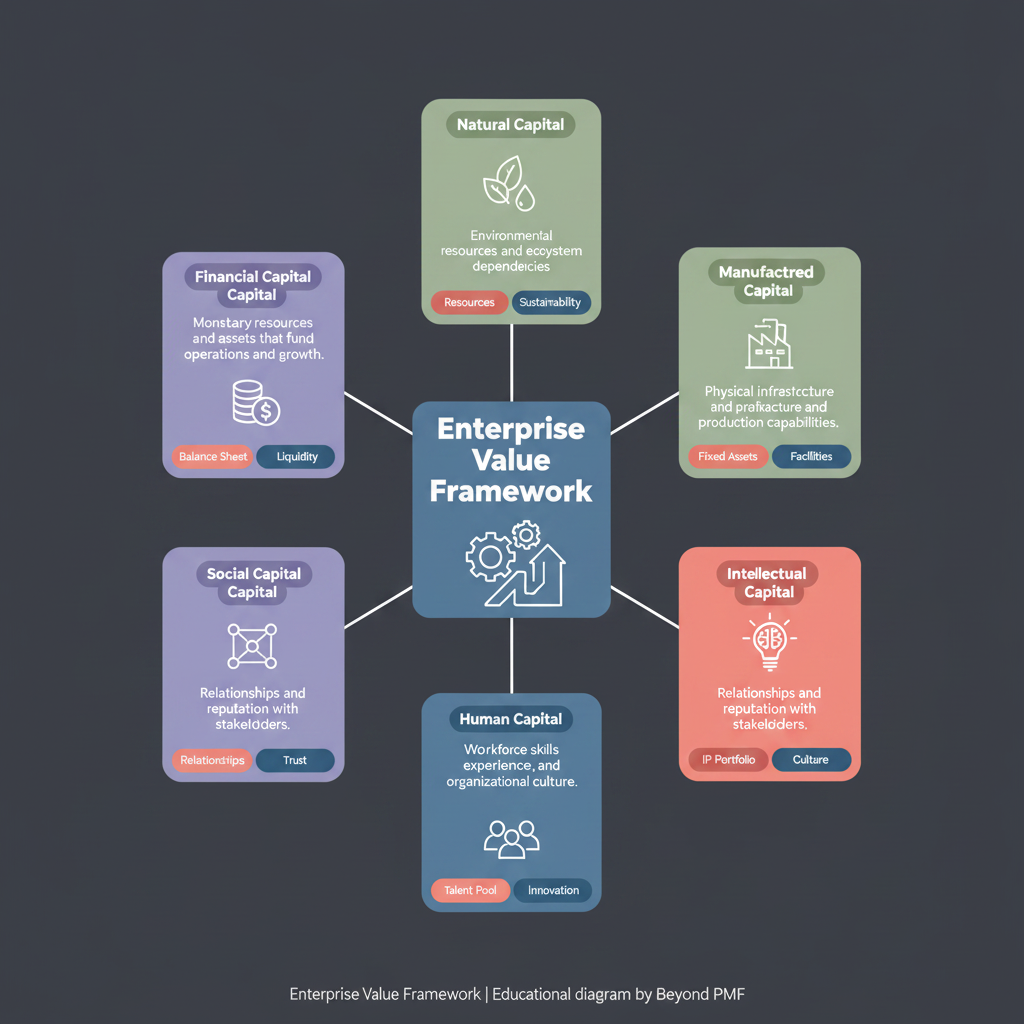
Enterprise Value Framework

https://ik.imagekit.io/beyondpmf/frameworks/enterprise-value-framework.png
The Enterprise Value Framework directly addresses strategic friction by providing a tool to assess and enhance a company's value creation potential. This inherently involves clarifying direction, ensuring market alignment, and refining the business model to maximize value.

The Enterprise Value Framework is designed to help organizations evaluate and optimize their overall value creation capabilities. It focuses on aligning business strategies with operational processes and market opportunities to maximize enterprise value. The framework is beneficial for guiding strategic decisions, improving financial performance, and enhancing stakeholder value.

Steps / Detailed Description

Identify key value drivers: Determine the primary elements that contribute significantly to the company's value. | Assess current performance: Evaluate how well the company is currently managing and optimizing these value drivers. | Define strategic objectives: Set clear goals aimed at enhancing the performance and impact of identified value drivers. | Implement improvements: Develop and execute action plans to improve areas critical for value creation. | Monitor and adjust: Continuously track progress against strategic objectives and make necessary adjustments.

Best Practices

Regularly update the framework to reflect changes in the business environment | Ensure cross-departmental collaboration for holistic value assessment | Utilize advanced analytics for accurate and actionable insights

Pros

Enhances strategic focus on value creation | Improves alignment between operations and business goals | Facilitates better decision-making and performance evaluation

Cons

Can be complex to implement and maintain | Requires significant data and insights for accurate assessment | May lead to short-term focus at the expense of long-term sustainability

When to Use

During strategic planning sessions | When preparing for significant organizational changes

When Not to Use

In very small or early-stage companies with limited resources | When immediate, tactical decisions are required without the need for comprehensive analysis

Related Frameworks

Scope

Scope not defined

Maturity Level

Maturity level not specified

Time to Implement

2–4 Weeks
3–6 Months
1–2 Weeks
3–6 Months
1–2 Months
3–6 Months
1–2 Weeks
Less Than 1 Day
1–2 Weeks
Longer Than 6 Months
1–2 Weeks
Longer Than 6 Months
1–2 Weeks
3–6 Months
1–2 Weeks
1–2 Weeks
1–2 Weeks
1–2 Weeks
1–2 Days
1–2 Weeks
1–2 Weeks
1–2 Weeks
1–2 Weeks
1–2 Weeks
1–2 Weeks
3–6 Months
1–2 Weeks
1–2 Weeks
1–2 Weeks
3–6 Months
1–2 Weeks
1–2 Weeks
2–4 Weeks
1–2 Weeks
1–2 Days
1–2 Weeks
Longer Than 6 Months
3–6 Months
Longer Than 6 Months
1–2 Weeks
Longer Than 6 Months
3–6 Months
Less Than 1 Day
3–6 Months
1–2 Months
3–6 Months
Longer Than 6 Months
3–6 Months
Less Than 1 Day
1–2 Weeks
3–6 Months
3–6 Months
1–2 Weeks
3–6 Months
1–2 Weeks
1–2 Weeks
1–2 Days
1–2 Weeks
1–2 Months
Longer Than 6 Months
1–2 Weeks
Longer Than 6 Months
1–2 Weeks
3–6 Months
1–2 Weeks
Less Than 1 Day
1–2 Weeks
3–6 Months
1–2 Weeks
3–6 Months
1–2 Weeks
1–2 Weeks
Longer Than 6 Months
Less Than 1 Day
3–6 Months
Longer Than 6 Months
1–2 Months
1–2 Weeks
Longer Than 6 Months
1–2 Weeks
3–6 Months
1–2 Weeks
1–2 Weeks
3–6 Months
Less Than 1 Day
1–2 Weeks
1–2 Weeks
3–6 Months
3–6 Months
Less Than 1 Day
1–2 Weeks
Longer Than 6 Months
1–2 Months
1–2 Weeks
1–2 Weeks
1–2 Weeks
Longer Than 6 Months

Copyright Information

Autor:
Unknown
N/A
Publication:
Generic Business Tool