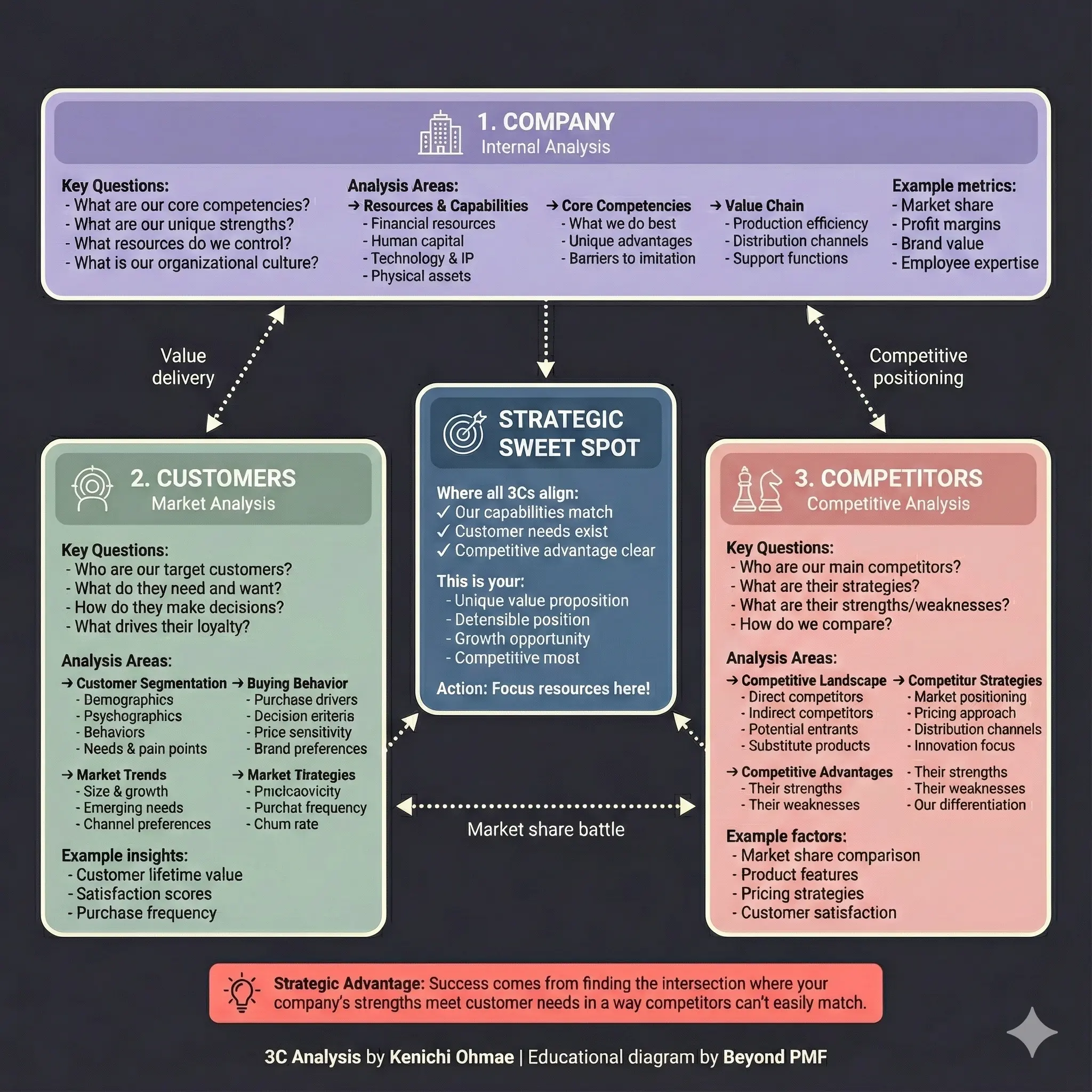
3C Analysis

Educational diagram illustrating the 3C Analysis framework by Kenichi Ohmae. Shows three sectionsβ€”Company, Customers, and Competitorsβ€”each with key questions, analysis areas, and example metrics. Arrows from all three lead to a central β€˜Strategic Sweet Spot’ where capabilities, customer needs, and competitive advantage align.
3C Analysis helps organizations understand factors that influence their strategic positioning, like company, customers, and competitors. This framework directly addresses unclear direction and lack of market alignment by focusing on external and internal factors for better strategic choices. By analyzing these three Cs, companies can refine their vision, strategy, and business model.

The 3C Analysis framework is centered around three key components: Company, Customers, and Competitors. It helps businesses to evaluate their internal and external environments to develop a robust business strategy. By analyzing these three areas, companies can identify their strengths, weaknesses, opportunities, and threats, enabling them to make informed decisions and optimize their market position.

Steps / Detailed Description

Analyze the Company: Assess internal capabilities, resources, and business processes. | Analyze the Customers: Understand customer needs, preferences, and buying behavior. | Analyze the Competitors: Evaluate the strengths, weaknesses, strategies, and market positions of current and potential competitors.

Best Practices

Regularly update the analysis to reflect changing market conditions. | Combine with other frameworks for a more holistic view. | Ensure objective and unbiased data collection and analysis.

Pros

Provides a comprehensive overview of the business landscape. | Helps in identifying competitive advantages and weaknesses. | Facilitates strategic planning by focusing on critical areas.

Cons

Can be time-consuming to gather all necessary data. | May require constant updates as market conditions change. | Focuses mainly on external factors, potentially overlooking internal issues.

When to Use

When entering a new market. | When reevaluating or updating business strategies.

When Not to Use

In highly stable and unchanging market environments. | When quick, tactical decisions are required without comprehensive analysis.

Related Frameworks

Scope

Scope not defined

Maturity Level

Maturity level not specified

Time to Implement

2–4 Weeks
3–6 Months
1–2 Weeks
3–6 Months
1–2 Months
3–6 Months
1–2 Weeks
Less Than 1 Day
1–2 Weeks
Longer Than 6 Months
1–2 Weeks
Longer Than 6 Months
1–2 Weeks
3–6 Months
1–2 Weeks
1–2 Weeks
1–2 Weeks
1–2 Weeks
1–2 Days
1–2 Weeks
1–2 Weeks
1–2 Weeks
1–2 Weeks
1–2 Weeks
1–2 Weeks
3–6 Months
1–2 Weeks
1–2 Weeks
1–2 Weeks
3–6 Months
1–2 Weeks
1–2 Weeks
2–4 Weeks
1–2 Weeks
1–2 Days
1–2 Weeks
Longer Than 6 Months
3–6 Months
Longer Than 6 Months
1–2 Weeks
Longer Than 6 Months
3–6 Months
Less Than 1 Day
3–6 Months
1–2 Months
3–6 Months
Longer Than 6 Months
3–6 Months
Less Than 1 Day
1–2 Weeks
3–6 Months
3–6 Months
1–2 Weeks
3–6 Months
1–2 Weeks
1–2 Weeks
1–2 Days
1–2 Weeks
1–2 Months
Longer Than 6 Months
1–2 Weeks
Longer Than 6 Months
1–2 Weeks
3–6 Months
1–2 Weeks
Less Than 1 Day
1–2 Weeks
3–6 Months
1–2 Weeks
3–6 Months
1–2 Weeks
1–2 Weeks
Longer Than 6 Months
Less Than 1 Day
3–6 Months
Longer Than 6 Months
1–2 Months
1–2 Weeks
Longer Than 6 Months
1–2 Weeks
3–6 Months
1–2 Weeks
1–2 Weeks
3–6 Months
Less Than 1 Day
1–2 Weeks
1–2 Weeks
3–6 Months
3–6 Months
Less Than 1 Day
1–2 Weeks
Longer Than 6 Months
1–2 Months
1–2 Weeks
1–2 Weeks
1–2 Weeks
Longer Than 6 Months

Copyright Information

Autor:
Kenichi Ohmae
1982
Publication:
The Mind of the Strategist: The Art of Japanese Business