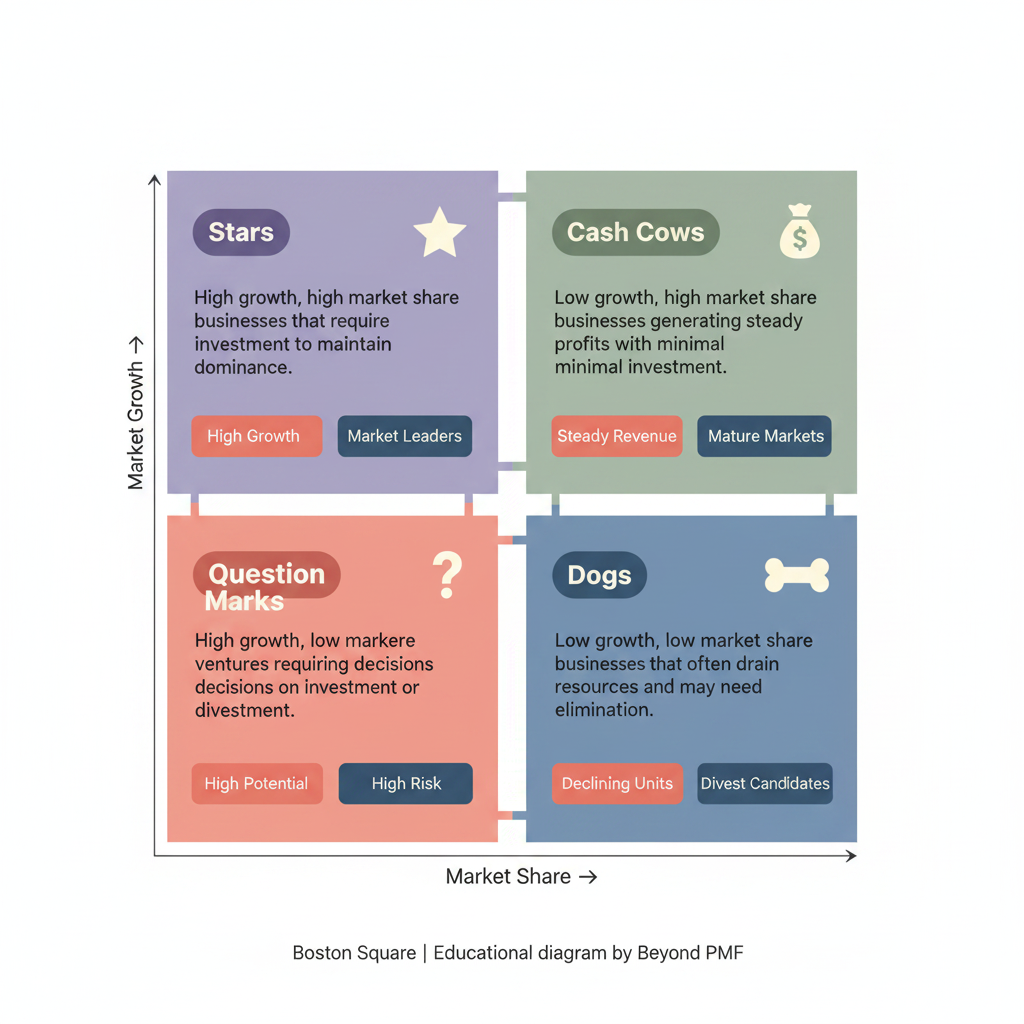
Boston Square

https://ik.imagekit.io/beyondpmf/frameworks/boston-square.png
The Boston Square, as a strategic tool, primarily addresses friction related to unclear direction, lack of market alignment, or conflicting priorities in business analysis. It helps in evaluating strategic options and positioning within the market.

The Boston Square is a strategic framework used primarily for evaluating positions or strategic options within business units. It is similar to but distinct from the more popular BCG Matrix. This framework helps organizations to categorize and prioritize different strategies based on two axes, usually involving factors like market growth and market share. The main benefit of using the Boston Square is its simplicity in visually categorizing complex strategic choices into manageable quadrants.

Steps / Detailed Description

Identify the key factors or criteria for analysis. | Define the axes of the square based on these factors. | Categorize the items or units into one of the four quadrants. | Analyze the results to determine strategic actions.

Best Practices

Clearly define the axes based on relevant and measurable criteria | Regularly update the data to reflect current market conditions | Use alongside other analytical tools for comprehensive analysis

Pros

Simplifies complex strategic decisions | Facilitates easy visualization of data | Helps in quick comparative analysis

Cons

Can oversimplify complex variables | May not account for external factors | Relies heavily on the accuracy of the chosen axes

When to Use

When needing to categorize business units for strategic review | When assessing market positioning of different products

When Not to Use

In highly dynamic markets where factors change rapidly | When detailed, nuanced analysis is required

Related Frameworks

Scope

Scope not defined

Maturity Level

Maturity level not specified

Time to Implement

2–4 Weeks
3–6 Months
1–2 Weeks
3–6 Months
1–2 Months
3–6 Months
1–2 Weeks
Less Than 1 Day
1–2 Weeks
Longer Than 6 Months
1–2 Weeks
Longer Than 6 Months
1–2 Weeks
3–6 Months
1–2 Weeks
1–2 Weeks
1–2 Weeks
1–2 Weeks
1–2 Days
1–2 Weeks
1–2 Weeks
1–2 Weeks
1–2 Weeks
1–2 Weeks
1–2 Weeks
3–6 Months
1–2 Weeks
1–2 Weeks
1–2 Weeks
3–6 Months
1–2 Weeks
1–2 Weeks
2–4 Weeks
1–2 Weeks
1–2 Days
1–2 Weeks
Longer Than 6 Months
3–6 Months
Longer Than 6 Months
1–2 Weeks
Longer Than 6 Months
3–6 Months
Less Than 1 Day
3–6 Months
1–2 Months
3–6 Months
Longer Than 6 Months
3–6 Months
Less Than 1 Day
1–2 Weeks
3–6 Months
3–6 Months
1–2 Weeks
3–6 Months
1–2 Weeks
1–2 Weeks
1–2 Days
1–2 Weeks
1–2 Months
Longer Than 6 Months
1–2 Weeks
Longer Than 6 Months
1–2 Weeks
3–6 Months
1–2 Weeks
Less Than 1 Day
1–2 Weeks
3–6 Months
1–2 Weeks
3–6 Months
1–2 Weeks
1–2 Weeks
Longer Than 6 Months
Less Than 1 Day
3–6 Months
Longer Than 6 Months
1–2 Months
1–2 Weeks
Longer Than 6 Months
1–2 Weeks
3–6 Months
1–2 Weeks
1–2 Weeks
3–6 Months
Less Than 1 Day
1–2 Weeks
1–2 Weeks
3–6 Months
3–6 Months
Less Than 1 Day
1–2 Weeks
Longer Than 6 Months
1–2 Months
1–2 Weeks
1–2 Weeks
1–2 Weeks
Longer Than 6 Months

Copyright Information

Autor:
Public Domain
N/A
Publication:
Generic Business Tool