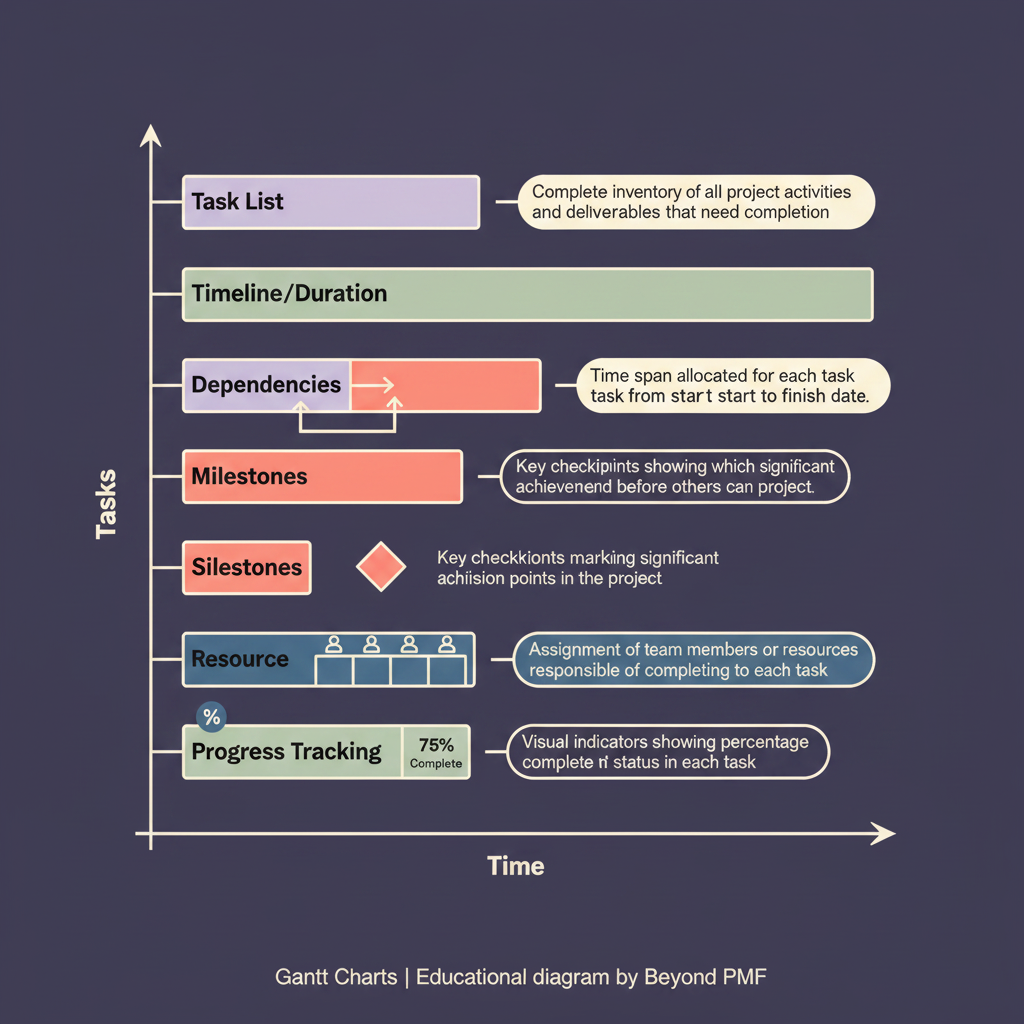
Gantt Charts

https://ik.imagekit.io/beyondpmf/frameworks/gantt-charts.png
Gantt Charts primarily address the friction of poor coordination and orchestration within projects. They provide a visual timeline to manage workflows and handoffs, reducing operational inefficiencies.

A Gantt Chart is a type of bar chart that represents a project schedule. It illustrates the start and finish dates of the various elements of a project. Gantt Charts are used to plan projects of all sizes and help in tracking project schedules. They are beneficial for ensuring that project tasks are completed on time, resources are allocated efficiently, and stakeholders are kept informed of project progress.

Steps / Detailed Description

Define the project scope and objectives. | Break down the project into tasks and subtasks. | Estimate the duration for each task. | Identify dependencies between tasks. | Assign resources to tasks. | Create the timeline and set milestones. | Monitor and update the Gantt Chart as the project progresses.

Best Practices

Keep the chart updated regularly. | Use software tools for dynamic adjustments. | Communicate changes promptly to all stakeholders.

Pros

Provides a clear visual timeline of the project. | Helps in identifying overlapping activities and resource allocation. | Facilitates better communication among stakeholders.

Cons

Can become complex with large projects. | Requires regular updates to maintain accuracy. | May not show the complexity of task dependencies in large projects.

When to Use

For planning and scheduling projects. | When managing multiple tasks and resources.

When Not to Use

For very simple or extremely short-term projects. | When project flexibility and adaptation are required frequently.

Related Frameworks

Lifecycle

Scope

Scope not defined

Maturity Level

Maturity level not specified

Time to Implement

2–4 Weeks
3–6 Months
1–2 Weeks
3–6 Months
1–2 Months
3–6 Months
1–2 Weeks
Less Than 1 Day
1–2 Weeks
Longer Than 6 Months
1–2 Weeks
Longer Than 6 Months
1–2 Weeks
3–6 Months
1–2 Weeks
1–2 Weeks
1–2 Weeks
1–2 Weeks
1–2 Days
1–2 Weeks
1–2 Weeks
1–2 Weeks
1–2 Weeks
1–2 Weeks
1–2 Weeks
3–6 Months
1–2 Weeks
1–2 Weeks
1–2 Weeks
3–6 Months
1–2 Weeks
1–2 Weeks
2–4 Weeks
1–2 Weeks
1–2 Days
1–2 Weeks
Longer Than 6 Months
3–6 Months
Longer Than 6 Months
1–2 Weeks
Longer Than 6 Months
3–6 Months
Less Than 1 Day
3–6 Months
1–2 Months
3–6 Months
Longer Than 6 Months
3–6 Months
Less Than 1 Day
1–2 Weeks
3–6 Months
3–6 Months
1–2 Weeks
3–6 Months
1–2 Weeks
1–2 Weeks
1–2 Days
1–2 Weeks
1–2 Months
Longer Than 6 Months
1–2 Weeks
Longer Than 6 Months
1–2 Weeks
3–6 Months
1–2 Weeks
Less Than 1 Day
1–2 Weeks
3–6 Months
1–2 Weeks
3–6 Months
1–2 Weeks
1–2 Weeks
Longer Than 6 Months
Less Than 1 Day
3–6 Months
Longer Than 6 Months
1–2 Months
1–2 Weeks
Longer Than 6 Months
1–2 Weeks
3–6 Months
1–2 Weeks
1–2 Weeks
3–6 Months
Less Than 1 Day
1–2 Weeks
1–2 Weeks
3–6 Months
3–6 Months
Less Than 1 Day
1–2 Weeks
Longer Than 6 Months
1–2 Months
1–2 Weeks
1–2 Weeks
1–2 Weeks
Longer Than 6 Months

Copyright Information

Autor:
Henry Gantt
1910
Publication:
Unknown