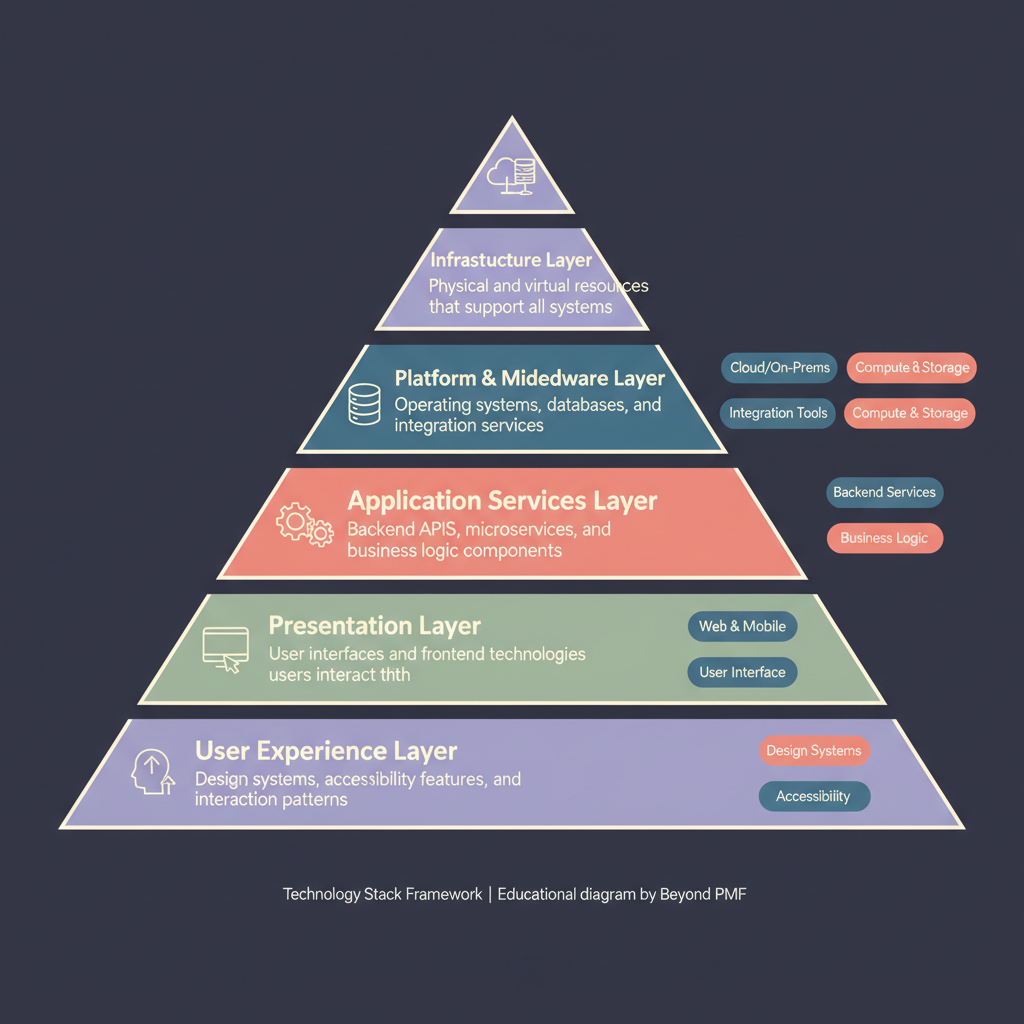
Technology Stack Framework

https://ik.imagekit.io/beyondpmf/frameworks/technology-stack-framework.png
The Technology Stack Framework primarily addresses friction in execution by guiding the selection and management of technologies. This impacts delivery speed, technical quality, and the overall customer experience by ensuring the right tools are in place to support business processes and objectives.

The Technology Stack Framework is a strategic approach used by businesses to evaluate, select, and integrate a coherent set of technologies that align with their business goals. It involves assessing current technological assets, identifying gaps, and strategically incorporating new technologies to enhance operational efficiency and competitive advantage. This framework helps organizations stay current with technological advancements and ensures that their technology stack evolves in alignment with their strategic objectives.

Steps / Detailed Description

Assess current technology stack and business requirements. | Identify gaps and opportunities for technological enhancement. | Research and evaluate potential technologies to fill identified gaps. | Develop an integration plan for new technologies with existing systems. | Implement new technologies in a phased or full rollout. | Monitor performance and adjust the technology stack as needed.

Best Practices

Regularly review and update the technology stack to align with evolving business needs | Involve stakeholders from different departments in the selection process | Prioritize technologies that offer scalability and integration capabilities

Pros

Ensures alignment of technology with business goals | Facilitates scalability and flexibility in operations | Enhances competitive advantage by leveraging new technologies

Cons

Can be resource-intensive in terms of time and finances | Risk of disruption during technology integration | Requires continuous monitoring and updating

When to Use

When planning a digital transformation | When updating or replacing outdated technology systems

When Not to Use

In very small businesses where simple solutions suffice | When frequent technological changes can disrupt business operations

Related Frameworks

Lifecycle

Not tied to a specific lifecycle stage

Scope

Scope not defined

Maturity Level

Maturity level not specified

Time to Implement

2–4 Weeks
3–6 Months
1–2 Weeks
3–6 Months
1–2 Months
3–6 Months
1–2 Weeks
Less Than 1 Day
1–2 Weeks
Longer Than 6 Months
1–2 Weeks
Longer Than 6 Months
1–2 Weeks
3–6 Months
1–2 Weeks
1–2 Weeks
1–2 Weeks
1–2 Weeks
1–2 Days
1–2 Weeks
1–2 Weeks
1–2 Weeks
1–2 Weeks
1–2 Weeks
1–2 Weeks
3–6 Months
1–2 Weeks
1–2 Weeks
1–2 Weeks
3–6 Months
1–2 Weeks
1–2 Weeks
2–4 Weeks
1–2 Weeks
1–2 Days
1–2 Weeks
Longer Than 6 Months
3–6 Months
Longer Than 6 Months
1–2 Weeks
Longer Than 6 Months
3–6 Months
Less Than 1 Day
3–6 Months
1–2 Months
3–6 Months
Longer Than 6 Months
3–6 Months
Less Than 1 Day
1–2 Weeks
3–6 Months
3–6 Months
1–2 Weeks
3–6 Months
1–2 Weeks
1–2 Weeks
1–2 Days
1–2 Weeks
1–2 Months
Longer Than 6 Months
1–2 Weeks
Longer Than 6 Months
1–2 Weeks
3–6 Months
1–2 Weeks
Less Than 1 Day
1–2 Weeks
3–6 Months
1–2 Weeks
3–6 Months
1–2 Weeks
1–2 Weeks
Longer Than 6 Months
Less Than 1 Day
3–6 Months
Longer Than 6 Months
1–2 Months
1–2 Weeks
Longer Than 6 Months
1–2 Weeks
3–6 Months
1–2 Weeks
1–2 Weeks
3–6 Months
Less Than 1 Day
1–2 Weeks
1–2 Weeks
3–6 Months
3–6 Months
Less Than 1 Day
1–2 Weeks
Longer Than 6 Months
1–2 Months
1–2 Weeks
1–2 Weeks
1–2 Weeks
Longer Than 6 Months

Copyright Information

Autor:
Public Domain
N/A
Publication:
Generic Business Tool