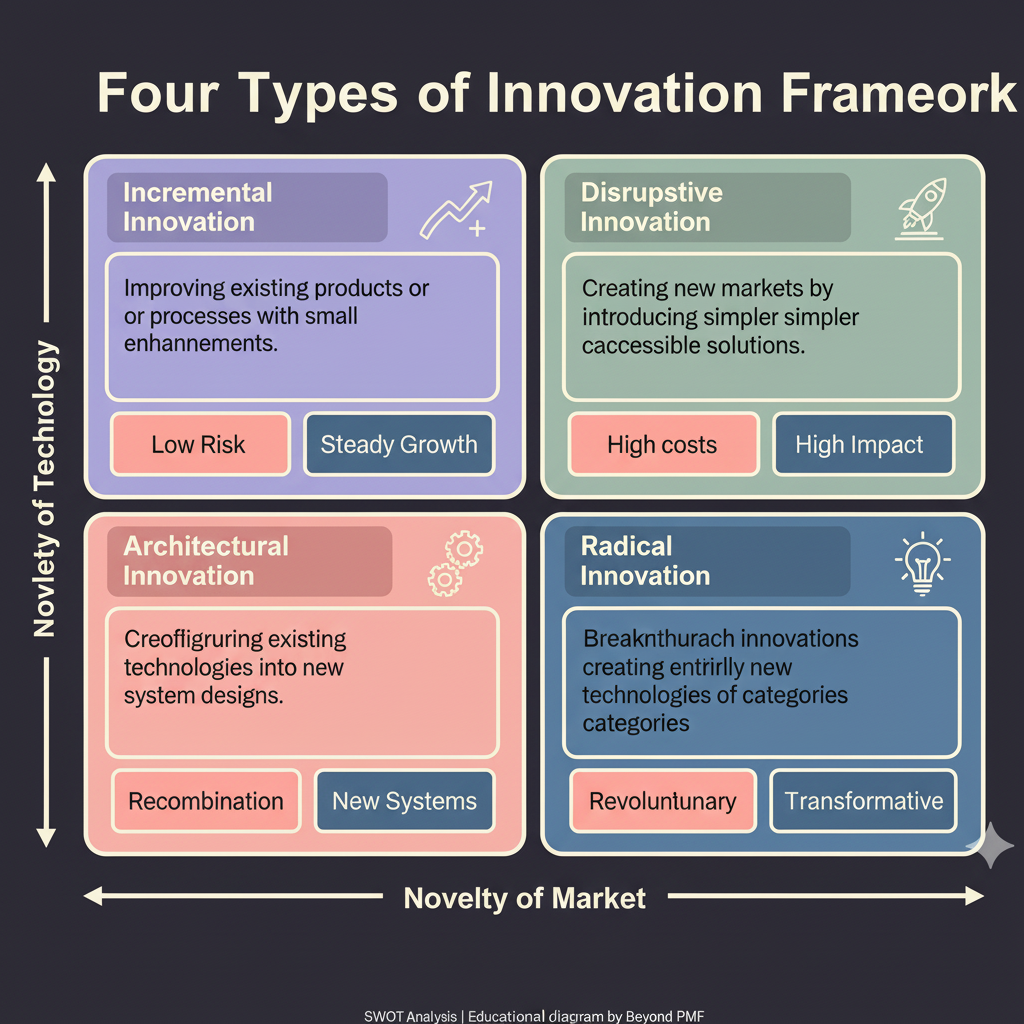
Four Types of Innovation Framework

https://ik.imagekit.io/beyondpmf/frameworks/four-types-of-innovation-framework.png
The Four Types of Innovation Framework helps organizations define and categorize their innovation efforts, which directly influences their strategic direction and market alignment. This framework provides a structured approach to innovation strategy.

The Four Types of Innovation Framework is a tool used by businesses to identify and develop different types of innovation: Incremental, Disruptive, Architectural, and Radical. Each type represents a different approach to market and technology changes, providing a structured way to explore new opportunities and improve existing products and services. This framework aids in aligning innovation strategies with business goals and market needs, enhancing competitive advantage and fostering sustainable growth.

Steps / Detailed Description

Identify the current market and technology position. | Classify innovation opportunities into one of the four categories: Incremental, Disruptive, Architectural, Radical. | Develop strategies tailored to the type of innovation identified. | Implement the innovation while continuously monitoring and adapting strategies as necessary.

Best Practices

Regularly review and update the categorization as market and technology evolve. | Encourage cross-functional teams to contribute to innovation processes. | Balance focus between all four types of innovation to maintain long-term growth.

Pros

Provides a clear categorization of innovation types. | Helps in aligning innovation with business strategy. | Facilitates targeted resource allocation.

Cons

May oversimplify the complexities of innovation. | Can lead to rigid categorization, missing hybrid opportunities. | Potentially overlooks the interdependencies between different types of innovations.

When to Use

When defining innovation strategy. | When seeking to diversify product or service offerings.

When Not to Use

In highly unstable or unpredictable markets. | When rapid, ad-hoc innovation is required.

Related Frameworks

Scope

Scope not defined

Maturity Level

Maturity level not specified

Time to Implement

2–4 Weeks
3–6 Months
1–2 Weeks
3–6 Months
1–2 Months
3–6 Months
1–2 Weeks
Less Than 1 Day
1–2 Weeks
Longer Than 6 Months
1–2 Weeks
Longer Than 6 Months
1–2 Weeks
3–6 Months
1–2 Weeks
1–2 Weeks
1–2 Weeks
1–2 Weeks
1–2 Days
1–2 Weeks
1–2 Weeks
1–2 Weeks
1–2 Weeks
1–2 Weeks
1–2 Weeks
3–6 Months
1–2 Weeks
1–2 Weeks
1–2 Weeks
3–6 Months
1–2 Weeks
1–2 Weeks
2–4 Weeks
1–2 Weeks
1–2 Days
1–2 Weeks
Longer Than 6 Months
3–6 Months
Longer Than 6 Months
1–2 Weeks
Longer Than 6 Months
3–6 Months
Less Than 1 Day
3–6 Months
1–2 Months
3–6 Months
Longer Than 6 Months
3–6 Months
Less Than 1 Day
1–2 Weeks
3–6 Months
3–6 Months
1–2 Weeks
3–6 Months
1–2 Weeks
1–2 Weeks
1–2 Days
1–2 Weeks
1–2 Months
Longer Than 6 Months
1–2 Weeks
Longer Than 6 Months
1–2 Weeks
3–6 Months
1–2 Weeks
Less Than 1 Day
1–2 Weeks
3–6 Months
1–2 Weeks
3–6 Months
1–2 Weeks
1–2 Weeks
Longer Than 6 Months
Less Than 1 Day
3–6 Months
Longer Than 6 Months
1–2 Months
1–2 Weeks
Longer Than 6 Months
1–2 Weeks
3–6 Months
1–2 Weeks
1–2 Weeks
3–6 Months
Less Than 1 Day
1–2 Weeks
1–2 Weeks
3–6 Months
3–6 Months
Less Than 1 Day
1–2 Weeks
Longer Than 6 Months
1–2 Months
1–2 Weeks
1–2 Weeks
1–2 Weeks
Longer Than 6 Months

Copyright Information

Autor:
Unknown
N/A
Publication:
Unknown