Ambidextrous Organization

https://ik.imagekit.io/beyondpmf/frameworks/ambidextrous-organization.png
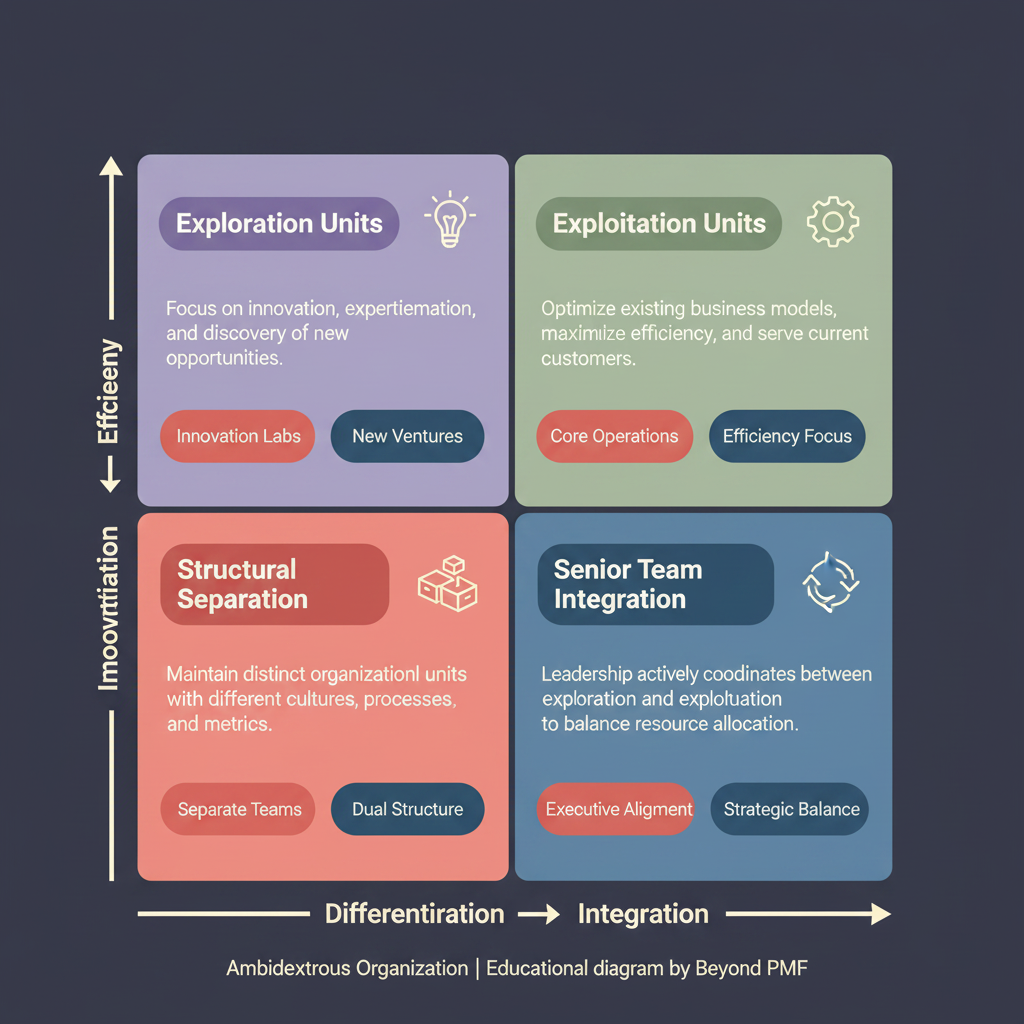
The Ambidextrous Organization framework directly addresses structural friction by designing the organization to manage conflicting priorities between incremental and radical innovation. It aims to resolve organizational design issues and potential conflicts in roles and team structures that arise from pursuing both types of innovation.

An Ambidextrous Organization is structured to handle both the exploitation of existing assets and capabilities through incremental innovation, and the exploration of new opportunities through radical innovation. This dual approach allows organizations to be stable yet agile, optimizing current business while also pursuing new growth areas. The framework is crucial for sustaining competitiveness in rapidly changing environments.

Steps / Detailed Description

Define clear strategic objectives for both exploration and exploitation. | Structure the organization to separate but integrate explorative and exploitative units. | Allocate resources effectively between both types of units. | Develop a culture that supports both innovation and execution. | Implement supporting processes and systems. | Regularly review and adjust strategies and structures.

Best Practices

Ensure leadership support and commitment. | Maintain clear communication and shared goals across units. | Regularly reassess and realign organizational structures and strategies.

Pros

Balances short-term performance with long-term innovation. | Reduces the risk of business obsolescence. | Enhances organizational agility and adaptability.

Cons

Can be complex to implement and manage. | Potential for conflict between different parts of the organization. | Requires significant leadership commitment and skill.

When to Use

In industries experiencing rapid technological changes. | When an organization needs to revitalize or disrupt its current business model.

When Not to Use

In highly stable or predictable market environments. | When the organization lacks the resources to manage dual structures.

Related Frameworks

Lifecycle

Not tied to a specific lifecycle stage

Scope

Scope not defined

Maturity Level

Maturity level not specified

Time to Implement

2–4 Weeks
3–6 Months
1–2 Weeks
3–6 Months
1–2 Months
3–6 Months
1–2 Weeks
Less Than 1 Day
1–2 Weeks
Longer Than 6 Months
1–2 Weeks
Longer Than 6 Months
1–2 Weeks
3–6 Months
1–2 Weeks
1–2 Weeks
1–2 Weeks
1–2 Weeks
1–2 Days
1–2 Weeks
1–2 Weeks
1–2 Weeks
1–2 Weeks
1–2 Weeks
1–2 Weeks
3–6 Months
1–2 Weeks
1–2 Weeks
1–2 Weeks
3–6 Months
1–2 Weeks
1–2 Weeks
2–4 Weeks
1–2 Weeks
1–2 Days
1–2 Weeks
Longer Than 6 Months
3–6 Months
Longer Than 6 Months
1–2 Weeks
Longer Than 6 Months
3–6 Months
Less Than 1 Day
3–6 Months
1–2 Months
3–6 Months
Longer Than 6 Months
3–6 Months
Less Than 1 Day
1–2 Weeks
3–6 Months
3–6 Months
1–2 Weeks
3–6 Months
1–2 Weeks
1–2 Weeks
1–2 Days
1–2 Weeks
1–2 Months
Longer Than 6 Months
1–2 Weeks
Longer Than 6 Months
1–2 Weeks
3–6 Months
1–2 Weeks
Less Than 1 Day
1–2 Weeks
3–6 Months
1–2 Weeks
3–6 Months
1–2 Weeks
1–2 Weeks
Longer Than 6 Months
Less Than 1 Day
3–6 Months
Longer Than 6 Months
1–2 Months
1–2 Weeks
Longer Than 6 Months
1–2 Weeks
3–6 Months
1–2 Weeks
1–2 Weeks
3–6 Months
Less Than 1 Day
1–2 Weeks
1–2 Weeks
3–6 Months
3–6 Months
Less Than 1 Day
1–2 Weeks
Longer Than 6 Months
1–2 Months
1–2 Weeks
1–2 Weeks
1–2 Weeks
Longer Than 6 Months

Copyright Information

Autor:
Public Domain
N/A
Publication:
Generic Business Tool