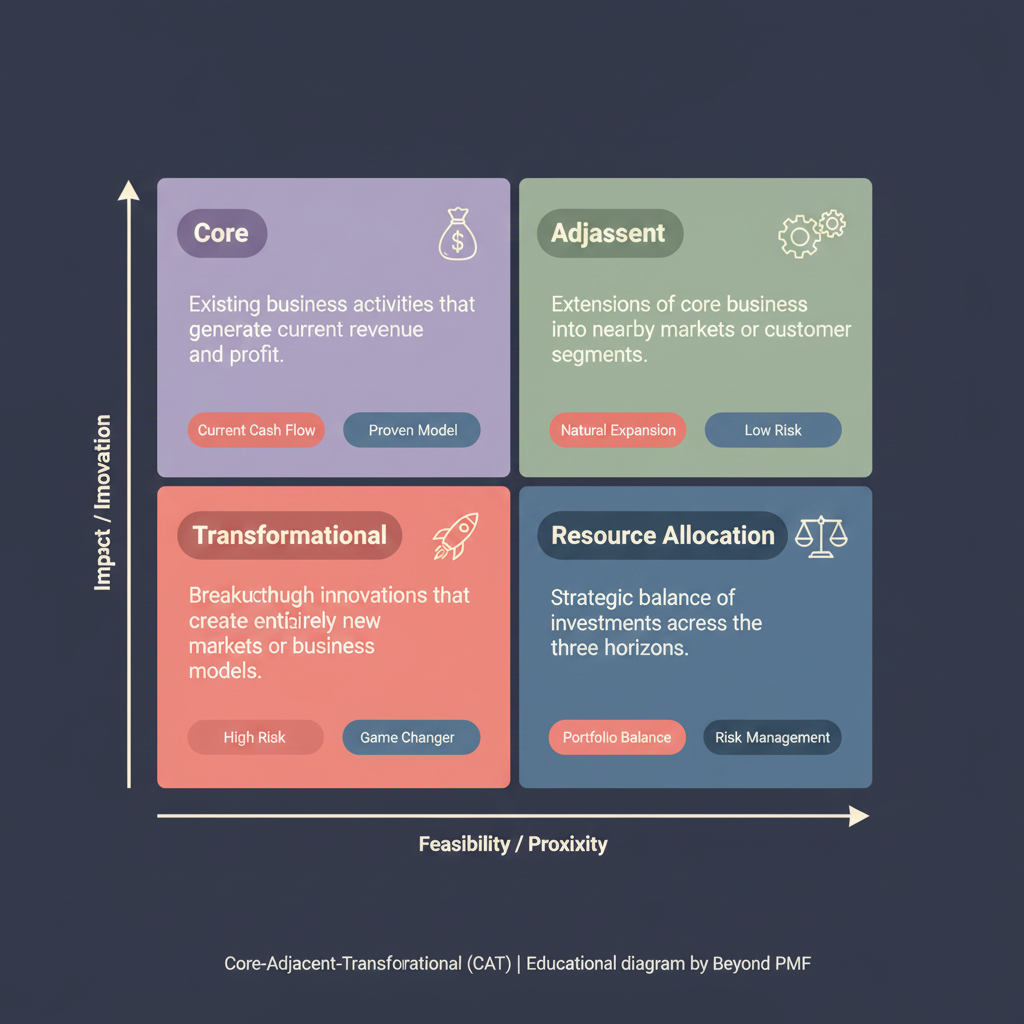
Core-Adjacent-Transformational (CAT)

https://ik.imagekit.io/beyondpmf/frameworks/core-adjacent-transformational-cat.png
The CAT framework primarily addresses strategic friction by helping businesses categorize innovation initiatives based on their strategic impact. It provides a framework for prioritizing projects aligned with different growth horizons, ensuring alignment with overall business direction and market opportunities.

The Core-Adjacent-Transformational (CAT) framework is a strategic tool used by businesses to manage and align their innovation portfolio. It divides projects into three categories: core innovations that optimize existing products for current customers, adjacent innovations that expand existing business into new markets or products, and transformational innovations that create completely new markets or services. This categorization helps companies allocate resources effectively, ensuring a balanced portfolio that supports sustainable growth.

Steps / Detailed Description

Identify and categorize all current and planned projects into core, adjacent, or transformational based on their nature and strategic impact. | Assess the potential market size, competitive advantage, and risk associated with each project. | Allocate resources strategically to ensure a balanced mix of safe, moderate, and high-risk projects. | Implement projects while continuously monitoring progress and adjusting strategies as necessary.

Best Practices

Regularly review and adjust the categorization of projects | Ensure top management involvement in the categorization process | Balance the portfolio to not overly focus on one type of innovation

Pros

Encourages a balanced approach to innovation | Helps in effective resource allocation | Facilitates strategic alignment across the organization

Cons

Can be challenging to accurately categorize projects | May lead to neglect of transformational projects due to higher risk | Requires constant review and adjustment

When to Use

When planning strategic business growth | When seeking to innovate while maintaining current business stability

When Not to Use

In very small or resource-constrained startups | When the market environment is extremely unstable

Related Frameworks

Lifecycle

Scope

Scope not defined

Maturity Level

Maturity level not specified

Time to Implement

2–4 Weeks
3–6 Months
1–2 Weeks
3–6 Months
1–2 Months
3–6 Months
1–2 Weeks
Less Than 1 Day
1–2 Weeks
Longer Than 6 Months
1–2 Weeks
Longer Than 6 Months
1–2 Weeks
3–6 Months
1–2 Weeks
1–2 Weeks
1–2 Weeks
1–2 Weeks
1–2 Days
1–2 Weeks
1–2 Weeks
1–2 Weeks
1–2 Weeks
1–2 Weeks
1–2 Weeks
3–6 Months
1–2 Weeks
1–2 Weeks
1–2 Weeks
3–6 Months
1–2 Weeks
1–2 Weeks
2–4 Weeks
1–2 Weeks
1–2 Days
1–2 Weeks
Longer Than 6 Months
3–6 Months
Longer Than 6 Months
1–2 Weeks
Longer Than 6 Months
3–6 Months
Less Than 1 Day
3–6 Months
1–2 Months
3–6 Months
Longer Than 6 Months
3–6 Months
Less Than 1 Day
1–2 Weeks
3–6 Months
3–6 Months
1–2 Weeks
3–6 Months
1–2 Weeks
1–2 Weeks
1–2 Days
1–2 Weeks
1–2 Months
Longer Than 6 Months
1–2 Weeks
Longer Than 6 Months
1–2 Weeks
3–6 Months
1–2 Weeks
Less Than 1 Day
1–2 Weeks
3–6 Months
1–2 Weeks
3–6 Months
1–2 Weeks
1–2 Weeks
Longer Than 6 Months
Less Than 1 Day
3–6 Months
Longer Than 6 Months
1–2 Months
1–2 Weeks
Longer Than 6 Months
1–2 Weeks
3–6 Months
1–2 Weeks
1–2 Weeks
3–6 Months
Less Than 1 Day
1–2 Weeks
1–2 Weeks
3–6 Months
3–6 Months
Less Than 1 Day
1–2 Weeks
Longer Than 6 Months
1–2 Months
1–2 Weeks
1–2 Weeks
1–2 Weeks
Longer Than 6 Months

Copyright Information

Autor:
Unknown
N/A
Publication:
Unknown