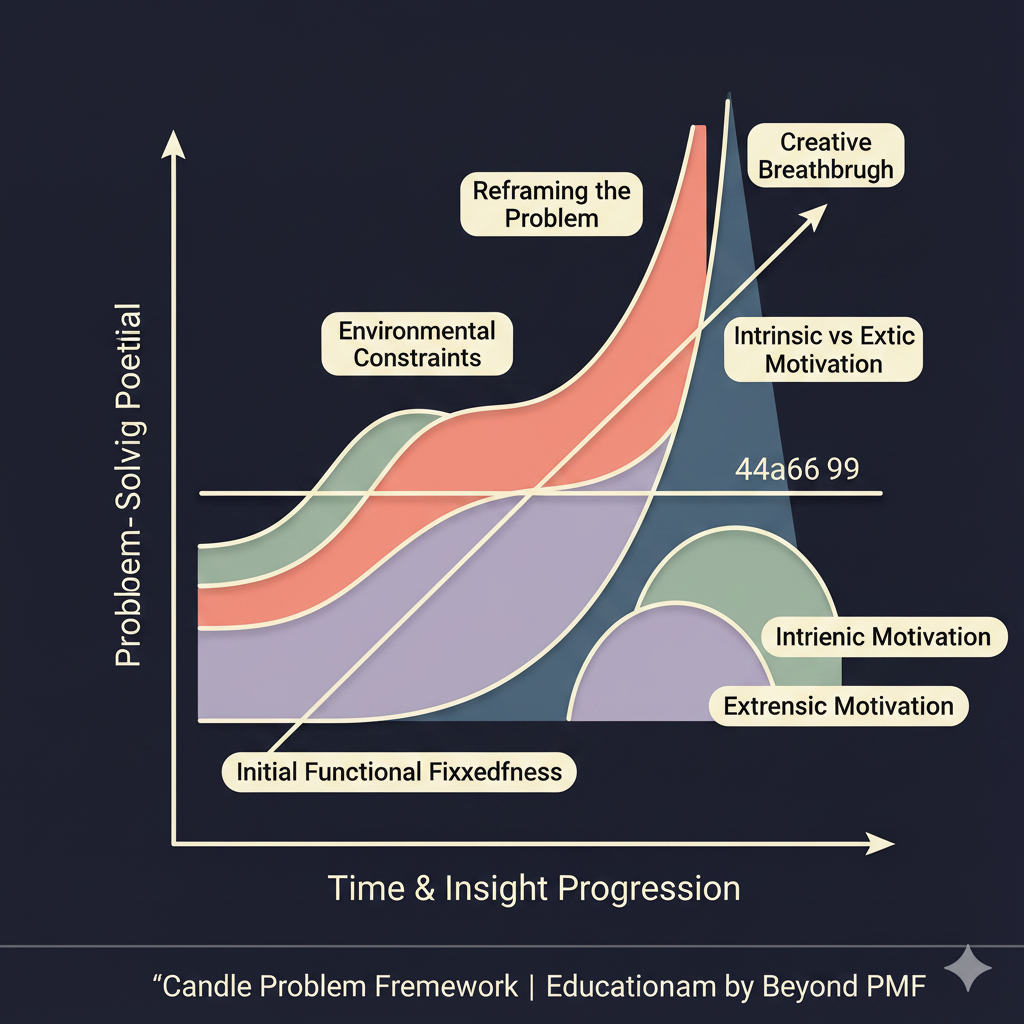
Candle Problem Framework

https://ik.imagekit.io/beyondpmf/frameworks/candle-problem-framework.png
The Candle Problem Framework focuses on improving creative problem-solving, which directly impacts the ability to deliver solutions and overcome challenges. This suggests a primary focus on the practical application of ideas and the execution of tasks, rather than strategic direction or organizational structure.

The Candle Problem Framework is inspired by a classic cognitive performance test used to evaluate an individual's ability to overcome functional fixedness and think outside the box. In a business context, this framework helps teams identify unconventional solutions to problems by challenging their preconceived notions about the use and function of resources. It encourages innovative thinking and can lead to breakthrough ideas and solutions.

Steps / Detailed Description

Identify the problem: Clearly define the problem that needs solving. | Gather resources: List all available resources and materials related to the problem. | Challenge assumptions: Question the conventional use of each resource and think of alternative ways they can be utilized. | Encourage brainstorming: Facilitate a brainstorming session where all ideas are considered without judgment. | Prototype solutions: Build prototypes using the resources in unconventional ways. | Test and refine: Test the effectiveness of each solution and refine based on feedback and results.

Best Practices

Encourage open-mindedness and defer judgment | Provide a safe space for all ideas | Use diverse teams to bring in different perspectives

Pros

Promotes creative thinking and innovation | Helps break down barriers of functional fixedness | Can lead to unique and effective solutions

Cons

May be time-consuming | Not suitable for problems requiring conventional solutions | Can lead to impractical ideas if not properly guided

When to Use

When conventional solutions have failed | When a fresh perspective is needed on a problem

When Not to Use

When the problem requires quick, conventional solutions | When resources are limited and cannot be used creatively

Related Frameworks

Lifecycle

Scope

Scope not defined

Maturity Level

Maturity level not specified

Time to Implement

2–4 Weeks
3–6 Months
1–2 Weeks
3–6 Months
1–2 Months
3–6 Months
1–2 Weeks
Less Than 1 Day
1–2 Weeks
Longer Than 6 Months
1–2 Weeks
Longer Than 6 Months
1–2 Weeks
3–6 Months
1–2 Weeks
1–2 Weeks
1–2 Weeks
1–2 Weeks
1–2 Days
1–2 Weeks
1–2 Weeks
1–2 Weeks
1–2 Weeks
1–2 Weeks
1–2 Weeks
3–6 Months
1–2 Weeks
1–2 Weeks
1–2 Weeks
3–6 Months
1–2 Weeks
1–2 Weeks
2–4 Weeks
1–2 Weeks
1–2 Days
1–2 Weeks
Longer Than 6 Months
3–6 Months
Longer Than 6 Months
1–2 Weeks
Longer Than 6 Months
3–6 Months
Less Than 1 Day
3–6 Months
1–2 Months
3–6 Months
Longer Than 6 Months
3–6 Months
Less Than 1 Day
1–2 Weeks
3–6 Months
3–6 Months
1–2 Weeks
3–6 Months
1–2 Weeks
1–2 Weeks
1–2 Days
1–2 Weeks
1–2 Months
Longer Than 6 Months
1–2 Weeks
Longer Than 6 Months
1–2 Weeks
3–6 Months
1–2 Weeks
Less Than 1 Day
1–2 Weeks
3–6 Months
1–2 Weeks
3–6 Months
1–2 Weeks
1–2 Weeks
Longer Than 6 Months
Less Than 1 Day
3–6 Months
Longer Than 6 Months
1–2 Months
1–2 Weeks
Longer Than 6 Months
1–2 Weeks
3–6 Months
1–2 Weeks
1–2 Weeks
3–6 Months
Less Than 1 Day
1–2 Weeks
1–2 Weeks
3–6 Months
3–6 Months
Less Than 1 Day
1–2 Weeks
Longer Than 6 Months
1–2 Months
1–2 Weeks
1–2 Weeks
1–2 Weeks
Longer Than 6 Months

Copyright Information

Autor:
Karl Duncker
1945
Publication:
Gestalt Psychology