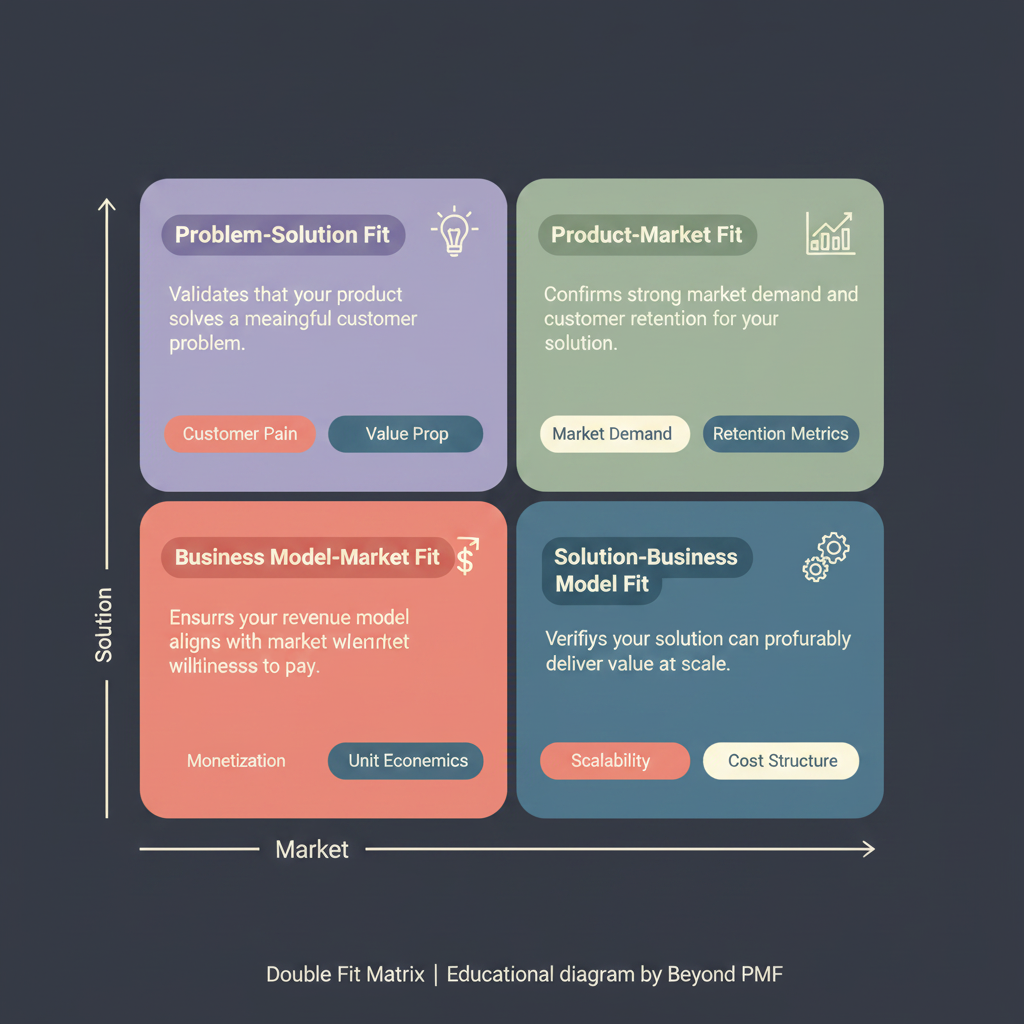
Double Fit Matrix

https://ik.imagekit.io/beyondpmf/frameworks/double-fit-matrix.png
The Double Fit Matrix primarily addresses the strategic alignment between different sets of variables within a business. It helps to ensure that various elements, such as product features and market needs, are appropriately matched to achieve the desired strategic goals and market positioning.

The Double Fit Matrix is a framework designed to assess and visualize the compatibility or fit between two distinct dimensions or variables within an organization. This can include the fit between a company's capabilities and market demands, or between employee skills and job requirements. The matrix helps in identifying areas of strong alignment and areas needing improvement, facilitating strategic decision-making and resource allocation.

Steps / Detailed Description

Identify the two dimensions or variables to analyze. | Define the criteria or parameters for each dimension. | Collect data or input relevant to each dimension. | Plot the data on a two-dimensional matrix. | Analyze the matrix to identify areas of fit and misfit. | Develop strategies based on the analysis to enhance fit.

Best Practices

Ensure comprehensive data collection for accuracy. | Regularly update the matrix with new data to keep it relevant. | Use alongside other analytical tools for a more holistic view.

Pros

Facilitates clear visualization of relationships between variables. | Aids in strategic decision-making by highlighting areas of strength and weakness. | Can be customized to fit various analytical needs.

Cons

Requires accurate and comprehensive data for effective use. | May oversimplify complex relationships into binary categories. | Can be time-consuming to set up and analyze properly.

When to Use

When assessing strategic alignment within the organization. | When planning resource allocation based on capabilities and needs.

When Not to Use

In situations where data is insufficient or unreliable. | When quick, less detailed analysis is required.

Related Frameworks

Scope

Scope not defined

Maturity Level

Maturity level not specified

Time to Implement

2–4 Weeks
3–6 Months
1–2 Weeks
3–6 Months
1–2 Months
3–6 Months
1–2 Weeks
Less Than 1 Day
1–2 Weeks
Longer Than 6 Months
1–2 Weeks
Longer Than 6 Months
1–2 Weeks
3–6 Months
1–2 Weeks
1–2 Weeks
1–2 Weeks
1–2 Weeks
1–2 Days
1–2 Weeks
1–2 Weeks
1–2 Weeks
1–2 Weeks
1–2 Weeks
1–2 Weeks
3–6 Months
1–2 Weeks
1–2 Weeks
1–2 Weeks
3–6 Months
1–2 Weeks
1–2 Weeks
2–4 Weeks
1–2 Weeks
1–2 Days
1–2 Weeks
Longer Than 6 Months
3–6 Months
Longer Than 6 Months
1–2 Weeks
Longer Than 6 Months
3–6 Months
Less Than 1 Day
3–6 Months
1–2 Months
3–6 Months
Longer Than 6 Months
3–6 Months
Less Than 1 Day
1–2 Weeks
3–6 Months
3–6 Months
1–2 Weeks
3–6 Months
1–2 Weeks
1–2 Weeks
1–2 Days
1–2 Weeks
1–2 Months
Longer Than 6 Months
1–2 Weeks
Longer Than 6 Months
1–2 Weeks
3–6 Months
1–2 Weeks
Less Than 1 Day
1–2 Weeks
3–6 Months
1–2 Weeks
3–6 Months
1–2 Weeks
1–2 Weeks
Longer Than 6 Months
Less Than 1 Day
3–6 Months
Longer Than 6 Months
1–2 Months
1–2 Weeks
Longer Than 6 Months
1–2 Weeks
3–6 Months
1–2 Weeks
1–2 Weeks
3–6 Months
Less Than 1 Day
1–2 Weeks
1–2 Weeks
3–6 Months
3–6 Months
Less Than 1 Day
1–2 Weeks
Longer Than 6 Months
1–2 Months
1–2 Weeks
1–2 Weeks
1–2 Weeks
Longer Than 6 Months

Copyright Information

Autor:
Unknown
N/A
Publication:
Generic Business Tool