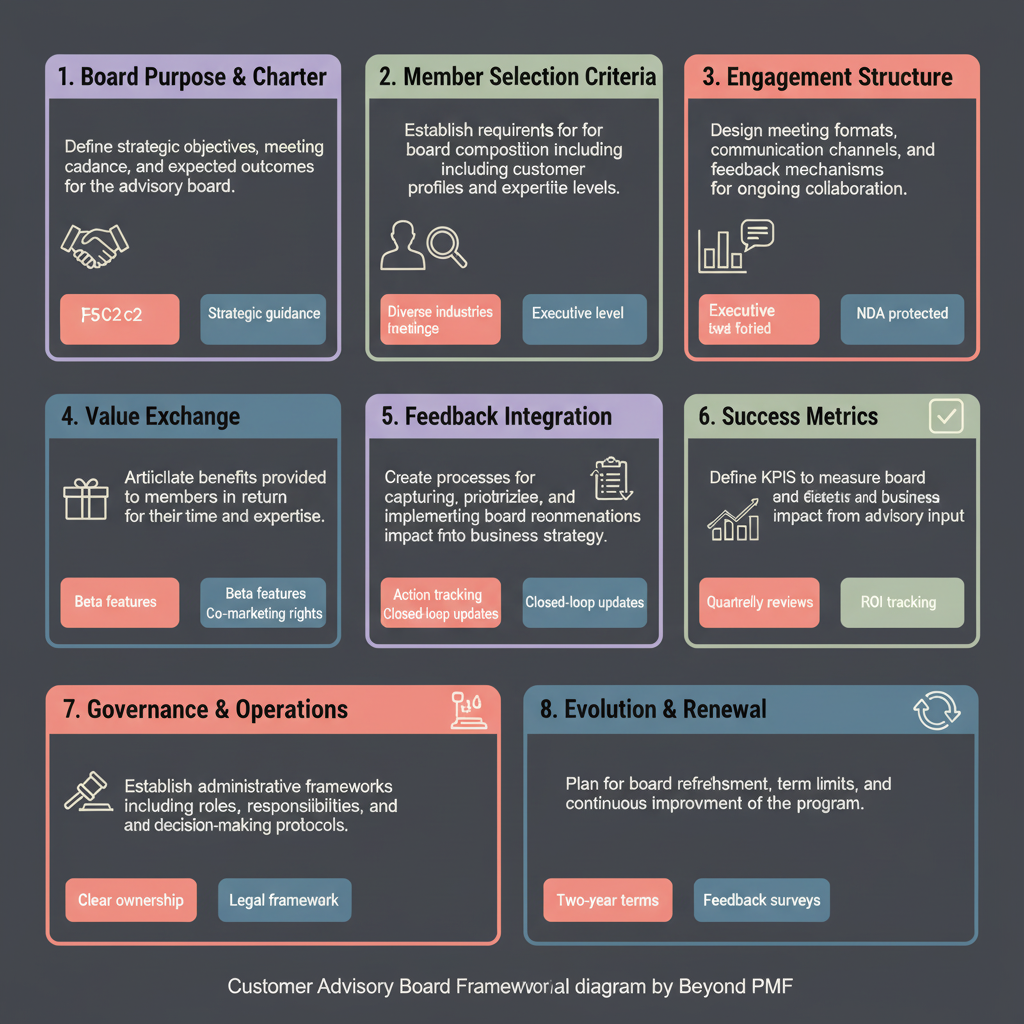
Customer Advisory Board Framework

https://ik.imagekit.io/beyondpmf/frameworks/customer-advisory-board-framework.png
The Customer Advisory Board Framework aims to ensure the company's decisions and product development are aligned with customer needs and market demands. It mitigates the friction of unclear direction and lack of market alignment by leveraging key customer insights.

The Customer Advisory Board (CAB) Framework involves forming a group of leading customers to provide feedback, insights, and guidance on various aspects of a business's operations, products, and services. This framework is used to align a company's offerings more closely with market needs and customer expectations, fostering a deeper relationship with top customers. The benefits include enhanced customer loyalty, valuable insights into customer needs, and direct feedback on products and services.

Steps / Detailed Description

Identify objectives for the CAB. | Select key customers to invite based on their influence, expertise, and engagement. | Plan and schedule regular CAB meetings. | Prepare discussion topics and materials in advance. | Facilitate meetings to encourage open and productive discussions. | Analyze feedback and integrate actionable insights into business strategies. | Maintain ongoing communication with CAB members.

Best Practices

Ensure a diverse representation of customers | Establish clear objectives and expectations | Regularly review and refresh the CAB membership to maintain relevance

Pros

Gains direct insights from top customers | Enhances customer engagement and loyalty | Improves product development and innovation

Cons

Can be resource-intensive to manage | Feedback may not represent the entire customer base | Potential for bias if not properly managed

When to Use

When seeking direct feedback on products or services | When developing new products or entering new markets

When Not to Use

When quick, statistically significant data is required | If unable to commit resources to manage the board effectively

Related Frameworks

Scope

Scope not defined

Maturity Level

Maturity level not specified

Time to Implement

2–4 Weeks
3–6 Months
1–2 Weeks
3–6 Months
1–2 Months
3–6 Months
1–2 Weeks
Less Than 1 Day
1–2 Weeks
Longer Than 6 Months
1–2 Weeks
Longer Than 6 Months
1–2 Weeks
3–6 Months
1–2 Weeks
1–2 Weeks
1–2 Weeks
1–2 Weeks
1–2 Days
1–2 Weeks
1–2 Weeks
1–2 Weeks
1–2 Weeks
1–2 Weeks
1–2 Weeks
3–6 Months
1–2 Weeks
1–2 Weeks
1–2 Weeks
3–6 Months
1–2 Weeks
1–2 Weeks
2–4 Weeks
1–2 Weeks
1–2 Days
1–2 Weeks
Longer Than 6 Months
3–6 Months
Longer Than 6 Months
1–2 Weeks
Longer Than 6 Months
3–6 Months
Less Than 1 Day
3–6 Months
1–2 Months
3–6 Months
Longer Than 6 Months
3–6 Months
Less Than 1 Day
1–2 Weeks
3–6 Months
3–6 Months
1–2 Weeks
3–6 Months
1–2 Weeks
1–2 Weeks
1–2 Days
1–2 Weeks
1–2 Months
Longer Than 6 Months
1–2 Weeks
Longer Than 6 Months
1–2 Weeks
3–6 Months
1–2 Weeks
Less Than 1 Day
1–2 Weeks
3–6 Months
1–2 Weeks
3–6 Months
1–2 Weeks
1–2 Weeks
Longer Than 6 Months
Less Than 1 Day
3–6 Months
Longer Than 6 Months
1–2 Months
1–2 Weeks
Longer Than 6 Months
1–2 Weeks
3–6 Months
1–2 Weeks
1–2 Weeks
3–6 Months
Less Than 1 Day
1–2 Weeks
1–2 Weeks
3–6 Months
3–6 Months
Less Than 1 Day
1–2 Weeks
Longer Than 6 Months
1–2 Months
1–2 Weeks
1–2 Weeks
1–2 Weeks
Longer Than 6 Months

Copyright Information

Autor:
Public Domain
N/A
Publication:
Generic Business Tool