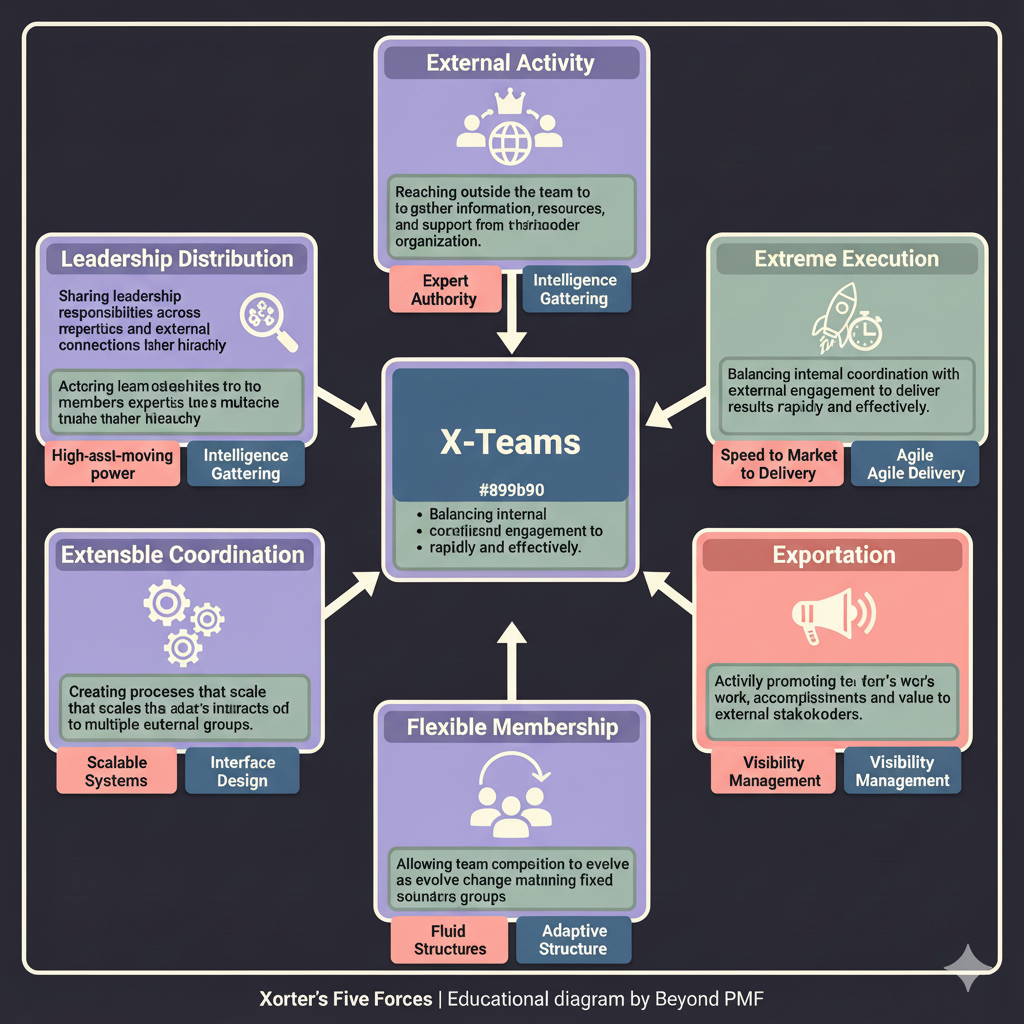
X‑Teams

https://ik.imagekit.io/beyondpmf/frameworks/x-teams.png
X-Teams focuses on external collaboration and adaptability, suggesting it addresses issues related to team structure and how teams interact with external stakeholders. This framework likely tackles problems arising from siloed teams and a lack of cross-functional alignment by encouraging external communication and adaptability.

X-Teams is a business framework that emphasizes the importance of teams extending their boundaries to include external elements such as stakeholders, other departments, and even customers. This approach fosters innovation, accelerates information exchange, and enhances problem-solving capabilities. By integrating external insights and resources, X-Teams can adapt more quickly to changing environments and deliver superior results.

Steps / Detailed Description

  • Identify key external stakeholders and resources relevant to the team's objectives.
  • Establish clear communication channels between the team and external entities.
  • Regularly update and adapt team goals based on external feedback and changes in the environment.
  • Encourage team members to take on ambassadorial roles to represent the team in external interactions.
  • Continuously evaluate and refine team strategies based on external insights and successes.

Best Practices

  • Regularly train team members on effective external communication and negotiation skills.
  • Set clear guidelines for the extent and nature of external interactions.
  • Maintain a balance between external engagement and focus on internal goals.

Pros

  • Enhanced innovation through diverse input
  • Faster adaptation to market or environmental changes
  • Improved problem-solving capabilities by leveraging external expertise

Cons

  • Potential for distraction from core objectives
  • Increased complexity in managing communications
  • Risk of information overload

When to Use

  • In dynamic industries where market conditions frequently change
  • When innovation is critical to the project or organizational success

When Not to Use

  • In highly regulated industries where external interactions are restricted
  • When the project requires deep focus and minimal external distractions

Related Frameworks

Lifecycle

Scope

Scope not defined

Maturity Level

Maturity level not specified

Time to Implement

2–4 Weeks
3–6 Months
1–2 Weeks
3–6 Months
1–2 Months
3–6 Months
1–2 Weeks
Less Than 1 Day
1–2 Weeks
Longer Than 6 Months
1–2 Weeks
Longer Than 6 Months
1–2 Weeks
3–6 Months
1–2 Weeks
1–2 Weeks
1–2 Weeks
1–2 Weeks
1–2 Days
1–2 Weeks
1–2 Weeks
1–2 Weeks
1–2 Weeks
1–2 Weeks
1–2 Weeks
3–6 Months
1–2 Weeks
1–2 Weeks
1–2 Weeks
3–6 Months
1–2 Weeks
1–2 Weeks
2–4 Weeks
1–2 Weeks
1–2 Days
1–2 Weeks
Longer Than 6 Months
3–6 Months
Longer Than 6 Months
1–2 Weeks
Longer Than 6 Months
3–6 Months
Less Than 1 Day
3–6 Months
1–2 Months
3–6 Months
Longer Than 6 Months
3–6 Months
Less Than 1 Day
1–2 Weeks
3–6 Months
3–6 Months
1–2 Weeks
3–6 Months
1–2 Weeks
1–2 Weeks
1–2 Days
1–2 Weeks
1–2 Months
Longer Than 6 Months
1–2 Weeks
Longer Than 6 Months
1–2 Weeks
3–6 Months
1–2 Weeks
Less Than 1 Day
1–2 Weeks
3–6 Months
1–2 Weeks
3–6 Months
1–2 Weeks
1–2 Weeks
Longer Than 6 Months
Less Than 1 Day
3–6 Months
Longer Than 6 Months
1–2 Months
1–2 Weeks
Longer Than 6 Months
1–2 Weeks
3–6 Months
1–2 Weeks
1–2 Weeks
3–6 Months
Less Than 1 Day
1–2 Weeks
1–2 Weeks
3–6 Months
3–6 Months
Less Than 1 Day
1–2 Weeks
Longer Than 6 Months
1–2 Months
1–2 Weeks
1–2 Weeks
1–2 Weeks
Longer Than 6 Months

Copyright Information

Autor:
Deborah Ancona
2007
Publication:
MIT Sloan Management Review