Team Topologies

https://ik.imagekit.io/beyondpmf/frameworks/team-topologies.png
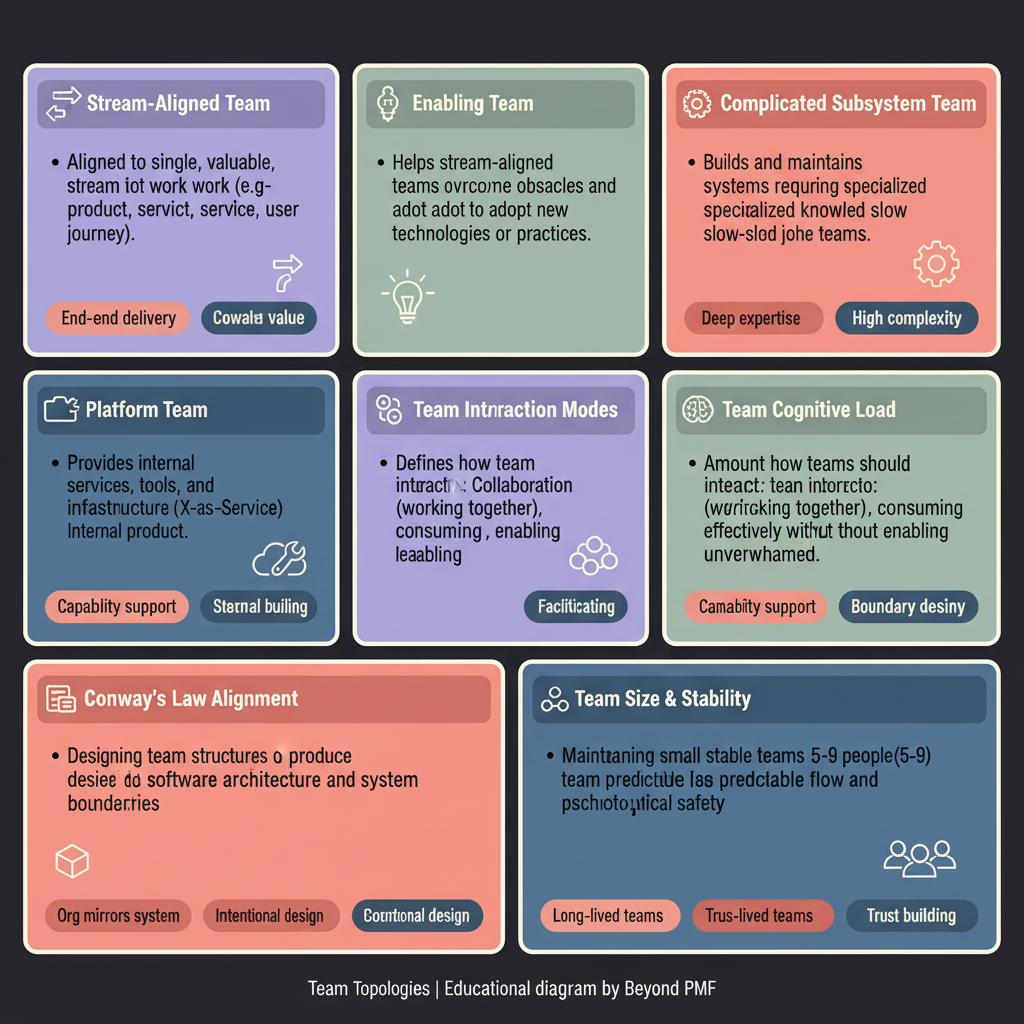
Team Topologies primarily addresses friction related to organizational design and team structure. It aims to optimize team interactions and responsibilities for better software delivery by defining team types and interaction patterns.

Team Topologies is a framework that provides a clear, adaptive model for organizing teams and their interactions. It focuses on streamlining communication and collaboration within an organization to enhance software delivery speed and quality. By defining four fundamental team types and three core interaction modes, Team Topologies helps organizations align their team structures with business goals, enabling faster adaptation to market changes and technological advancements.

Steps / Detailed Description

Identify the current team structures and their responsibilities. | Define the desired state of team interactions and outcomes. | Classify teams into one of the four types: Stream-aligned, Enabling, Complicated Subsystem, and Platform. | Establish interaction modes between teams: Collaboration, X-as-a-Service, or Facilitating. | Implement the changes and continuously adapt the team structures based on feedback and evolving requirements.

Best Practices

Regularly review and adjust team structures and interaction modes | Ensure clear communication of roles and responsibilities | Promote a culture of feedback and continuous improvement

Pros

Enhances collaboration and communication efficiency | Reduces complexity by clearly defining team roles and interactions | Improves adaptability to technological and market changes

Cons

Initial implementation can be complex and time-consuming | Requires continuous oversight and adaptation | May not fit well with all organizational cultures or sizes

When to Use

When optimizing team structures for better software delivery | When scaling operations or undergoing organizational changes

When Not to Use

In very small organizations where formal structures are less beneficial | When teams are already optimized and delivering efficiently without issues

Related Frameworks

Lifecycle

Scope

Scope not defined

Maturity Level

Maturity level not specified

Time to Implement

2–4 Weeks
3–6 Months
1–2 Weeks
3–6 Months
1–2 Months
3–6 Months
1–2 Weeks
Less Than 1 Day
1–2 Weeks
Longer Than 6 Months
1–2 Weeks
Longer Than 6 Months
1–2 Weeks
3–6 Months
1–2 Weeks
1–2 Weeks
1–2 Weeks
1–2 Weeks
1–2 Days
1–2 Weeks
1–2 Weeks
1–2 Weeks
1–2 Weeks
1–2 Weeks
1–2 Weeks
3–6 Months
1–2 Weeks
1–2 Weeks
1–2 Weeks
3–6 Months
1–2 Weeks
1–2 Weeks
2–4 Weeks
1–2 Weeks
1–2 Days
1–2 Weeks
Longer Than 6 Months
3–6 Months
Longer Than 6 Months
1–2 Weeks
Longer Than 6 Months
3–6 Months
Less Than 1 Day
3–6 Months
1–2 Months
3–6 Months
Longer Than 6 Months
3–6 Months
Less Than 1 Day
1–2 Weeks
3–6 Months
3–6 Months
1–2 Weeks
3–6 Months
1–2 Weeks
1–2 Weeks
1–2 Days
1–2 Weeks
1–2 Months
Longer Than 6 Months
1–2 Weeks
Longer Than 6 Months
1–2 Weeks
3–6 Months
1–2 Weeks
Less Than 1 Day
1–2 Weeks
3–6 Months
1–2 Weeks
3–6 Months
1–2 Weeks
1–2 Weeks
Longer Than 6 Months
Less Than 1 Day
3–6 Months
Longer Than 6 Months
1–2 Months
1–2 Weeks
Longer Than 6 Months
1–2 Weeks
3–6 Months
1–2 Weeks
1–2 Weeks
3–6 Months
Less Than 1 Day
1–2 Weeks
1–2 Weeks
3–6 Months
3–6 Months
Less Than 1 Day
1–2 Weeks
Longer Than 6 Months
1–2 Months
1–2 Weeks
1–2 Weeks
1–2 Weeks
Longer Than 6 Months

Copyright Information

Autor:
Matthew Skelton, Manuel Pais
2019
Publication:
Book - Team Topologies