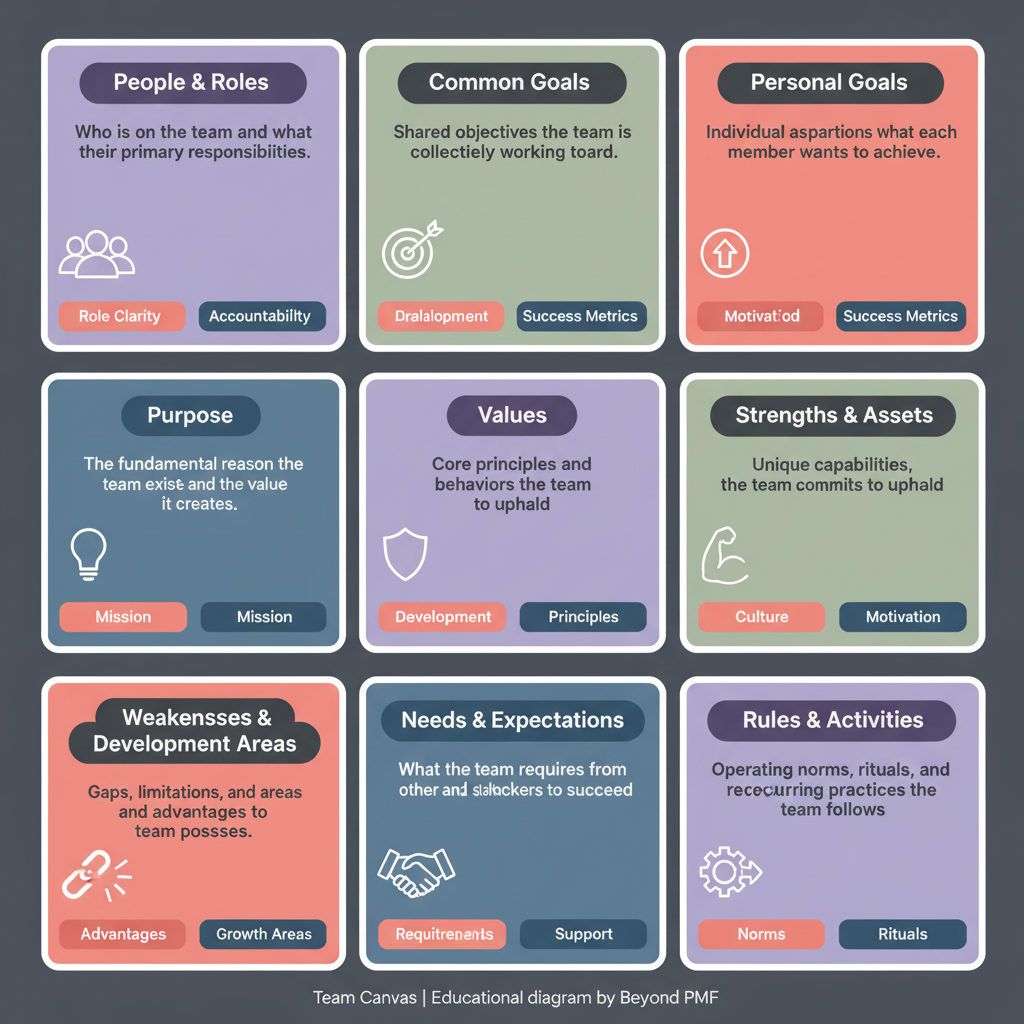
Team Canvas

Team Canvas aims to align teams and secure commitment. This directly addresses structural issues within a team, such as unclear roles, lack of accountability, and potential conflicts stemming from a lack of shared understanding of goals and responsibilities.

The Team Canvas is a framework designed to help teams align on their goals, roles, and values, enhancing collaboration and efficiency. It is used to facilitate discussions that clarify each team member's role, the team's objectives, and the expected behaviors within the group. This framework is beneficial as it promotes transparency, improves communication, and ensures that all team members are on the same page, which can lead to more effective teamwork and project success.

Steps / Detailed Description

Gather all team members for a meeting to discuss and fill out the Team Canvas. | Discuss and define the team's purpose and objectives to ensure alignment. | Clarify roles and responsibilities of each team member to prevent overlap and ensure coverage of all necessary areas. | Identify and agree on the team's values and norms to establish a positive team culture. | Set up goals and success metrics to measure the team's performance and progress. | Review and update the Team Canvas regularly to reflect any changes in the team structure or objectives.

Best Practices

Ensure full participation from all team members during the canvas sessions. | Regularly revisit and update the Team Canvas to keep it current with team changes. | Use the Team Canvas in conjunction with other project management and communication tools.

Pros

Enhances team alignment and clarity on objectives | Improves communication and understanding among team members | Facilitates a clear distribution of roles and responsibilities

Cons

Can be time-consuming to initially set up and maintain | May not be as effective if not all team members are fully engaged | Requires regular updates to remain relevant, which can be overlooked

When to Use

When forming a new team | When a team is facing communication or alignment issues

When Not to Use

In very small teams where roles and communication are already clear | When there is no time for thorough discussion and alignment

Related Frameworks

Lifecycle

Scope

Scope not defined

Maturity Level

Maturity level not specified

Time to Implement

2–4 Weeks
3–6 Months
1–2 Weeks
3–6 Months
1–2 Months
3–6 Months
1–2 Weeks
Less Than 1 Day
1–2 Weeks
Longer Than 6 Months
1–2 Weeks
Longer Than 6 Months
1–2 Weeks
3–6 Months
1–2 Weeks
1–2 Weeks
1–2 Weeks
1–2 Weeks
1–2 Days
1–2 Weeks
1–2 Weeks
1–2 Weeks
1–2 Weeks
1–2 Weeks
1–2 Weeks
3–6 Months
1–2 Weeks
1–2 Weeks
1–2 Weeks
3–6 Months
1–2 Weeks
1–2 Weeks
2–4 Weeks
1–2 Weeks
1–2 Days
1–2 Weeks
Longer Than 6 Months
3–6 Months
Longer Than 6 Months
1–2 Weeks
Longer Than 6 Months
3–6 Months
Less Than 1 Day
3–6 Months
1–2 Months
3–6 Months
Longer Than 6 Months
3–6 Months
Less Than 1 Day
1–2 Weeks
3–6 Months
3–6 Months
1–2 Weeks
3–6 Months
1–2 Weeks
1–2 Weeks
1–2 Days
1–2 Weeks
1–2 Months
Longer Than 6 Months
1–2 Weeks
Longer Than 6 Months
1–2 Weeks
3–6 Months
1–2 Weeks
Less Than 1 Day
1–2 Weeks
3–6 Months
1–2 Weeks
3–6 Months
1–2 Weeks
1–2 Weeks
Longer Than 6 Months
Less Than 1 Day
3–6 Months
Longer Than 6 Months
1–2 Months
1–2 Weeks
Longer Than 6 Months
1–2 Weeks
3–6 Months
1–2 Weeks
1–2 Weeks
3–6 Months
Less Than 1 Day
1–2 Weeks
1–2 Weeks
3–6 Months
3–6 Months
Less Than 1 Day
1–2 Weeks
Longer Than 6 Months
1–2 Months
1–2 Weeks
1–2 Weeks
1–2 Weeks
Longer Than 6 Months

Copyright Information

Autor:
Alexandre F. Magno
2013
Publication:
Unknown