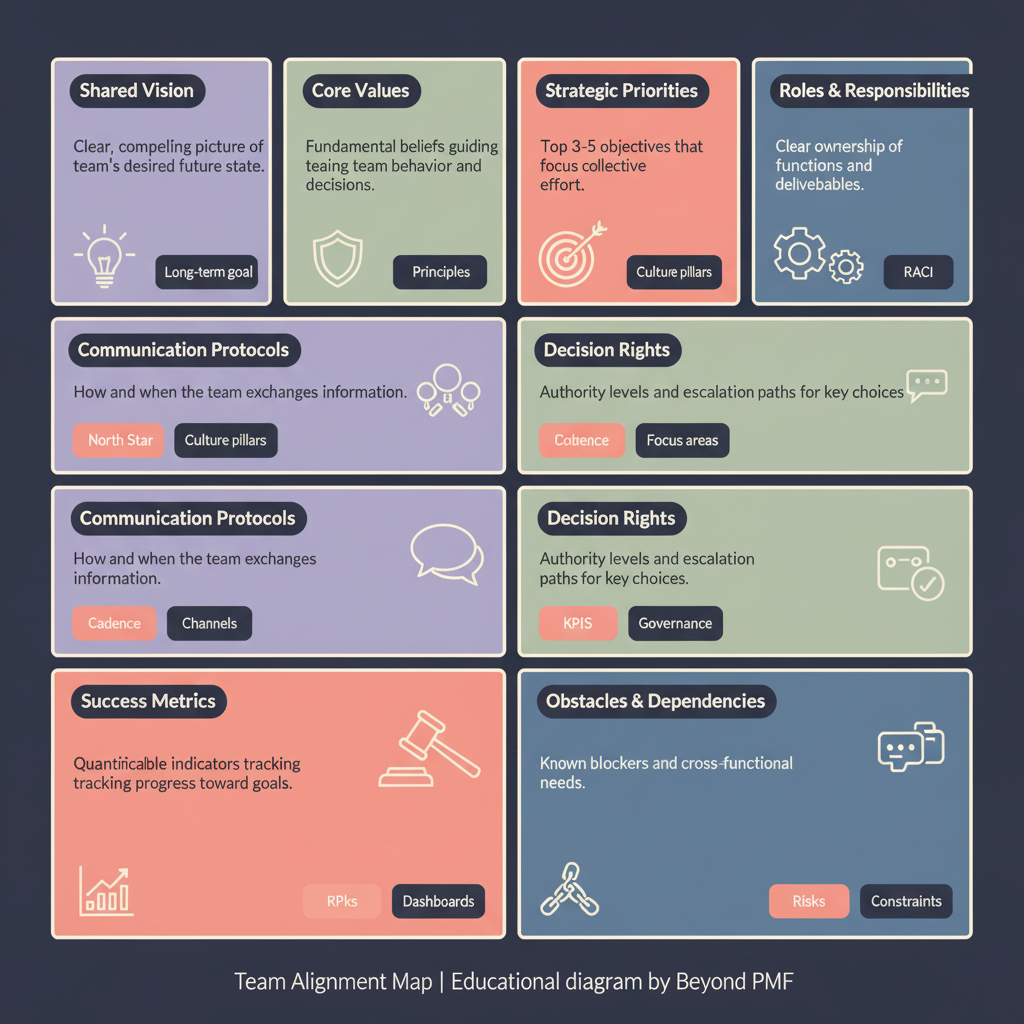
The Team Alignment Map (TAM) is a collaborative framework used to ensure all team members are aligned in terms of objectives, responsibilities, and the resources available for a project. It helps in visualizing the contributions of each team member and the dependencies between different tasks. This framework is particularly beneficial in complex projects where interdependencies and roles need to be clearly defined to avoid confusion and enhance productivity.
Define project goals and expected outcomes. | Identify and list all necessary tasks and activities. | Assign responsibilities to team members for each task. | Map out resources available and required for each task. | Establish dependencies and interactions between tasks. | Review and adjust the map regularly as the project progresses.
Involve all team members in the mapping process to ensure buy-in and accuracy. | Keep the map visible and accessible to all team members throughout the project. | Regularly review and update the map to reflect changes in the project scope or team.
Enhances clarity and transparency among team members. | Improves coordination and efficiency by clearly defining roles and dependencies. | Facilitates proactive resource management.
Can be time-consuming to initially set up. | Requires regular updates to remain effective, which can be resource-intensive. | May not be as effective in very small teams or overly simplistic projects.
When starting a new project with multiple stakeholders. | In projects where clear role and task delineation is necessary.
For very small or short-term projects where the setup might outweigh the benefits. | When team members are already aligned and communication is effective without additional tools.