Affinity Mapping

Affinity Mapping primarily addresses operational friction by improving the organization and categorization of information. This leads to better coordination and clarity in understanding the relationships between different pieces of data.

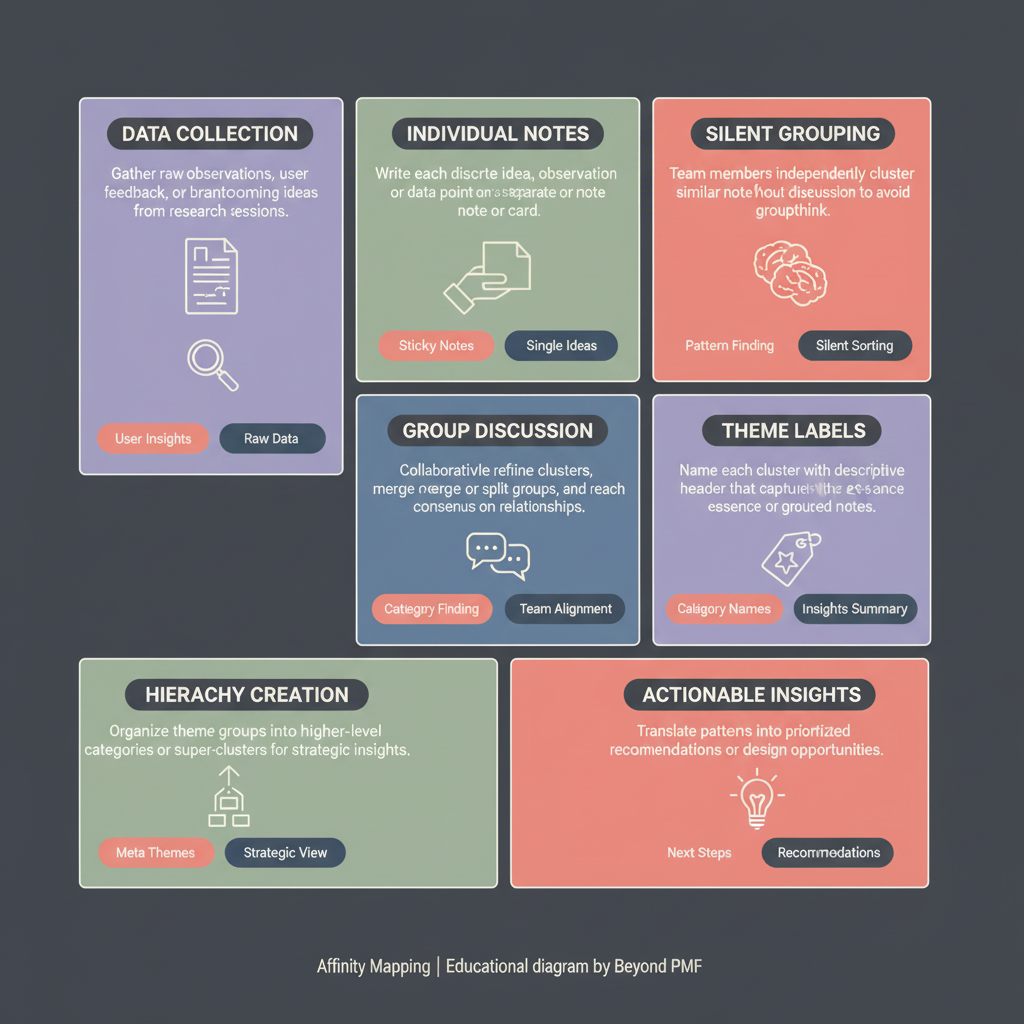
Affinity Mapping, also known as affinity diagramming, is a tool that helps teams to organize large amounts of data into clusters for analysis and insights. It is commonly used to capture and group ideas generated during brainstorming sessions. The process involves collecting various ideas, sorting them into related groups, and then synthesizing the information into actionable insights. This technique is particularly beneficial for identifying patterns and relationships in complex data, making it easier to address issues or make decisions.

Steps / Detailed Description

Gather all necessary data and ideas from participants. | Write each idea or data point on a separate sticky note or card. | Randomly spread these notes on a large surface where all participants can see them. | As a group, sort the notes into categories based on their natural relationships. | Discuss and refine the categories, merging or dividing them as necessary. | Label each category and summarize the overarching theme or insight.

Best Practices

Ensure all participants understand the process and objectives | Use a large, visible working area | Encourage equal participation among all team members

Pros

Facilitates the organization of complex information | Enhances team collaboration and consensus | Helps identify underlying patterns and relationships

Cons

Can be time-consuming with large volumes of data | Depends heavily on the quality of initial ideas | May require facilitation to avoid groupthink

When to Use

During post-brainstorming sessions to organize ideas | When analyzing user feedback or research data

When Not to Use

With very small sets of data where relationships are clear | When quick, decisive action is needed without detailed analysis

Related Frameworks

Lifecycle

Scope

Scope not defined

Maturity Level

Maturity level not specified

Time to Implement

2–4 Weeks
3–6 Months
1–2 Weeks
3–6 Months
1–2 Months
3–6 Months
1–2 Weeks
Less Than 1 Day
1–2 Weeks
Longer Than 6 Months
1–2 Weeks
Longer Than 6 Months
1–2 Weeks
3–6 Months
1–2 Weeks
1–2 Weeks
1–2 Weeks
1–2 Weeks
1–2 Days
1–2 Weeks
1–2 Weeks
1–2 Weeks
1–2 Weeks
1–2 Weeks
1–2 Weeks
3–6 Months
1–2 Weeks
1–2 Weeks
1–2 Weeks
3–6 Months
1–2 Weeks
1–2 Weeks
2–4 Weeks
1–2 Weeks
1–2 Days
1–2 Weeks
Longer Than 6 Months
3–6 Months
Longer Than 6 Months
1–2 Weeks
Longer Than 6 Months
3–6 Months
Less Than 1 Day
3–6 Months
1–2 Months
3–6 Months
Longer Than 6 Months
3–6 Months
Less Than 1 Day
1–2 Weeks
3–6 Months
3–6 Months
1–2 Weeks
3–6 Months
1–2 Weeks
1–2 Weeks
1–2 Days
1–2 Weeks
1–2 Months
Longer Than 6 Months
1–2 Weeks
Longer Than 6 Months
1–2 Weeks
3–6 Months
1–2 Weeks
Less Than 1 Day
1–2 Weeks
3–6 Months
1–2 Weeks
3–6 Months
1–2 Weeks
1–2 Weeks
Longer Than 6 Months
Less Than 1 Day
3–6 Months
Longer Than 6 Months
1–2 Months
1–2 Weeks
Longer Than 6 Months
1–2 Weeks
3–6 Months
1–2 Weeks
1–2 Weeks
3–6 Months
Less Than 1 Day
1–2 Weeks
1–2 Weeks
3–6 Months
3–6 Months
Less Than 1 Day
1–2 Weeks
Longer Than 6 Months
1–2 Months
1–2 Weeks
1–2 Weeks
1–2 Weeks
Longer Than 6 Months

Copyright Information

Autor:
Public Domain
N/A
Publication:
Generic Business Tool