Weighted Scoring Model

https://ik.imagekit.io/beyondpmf/frameworks/weighted-scoring-model.png
The Weighted Scoring Model primarily addresses friction related to coordination and decision-making processes. It helps to streamline how options are evaluated based on defined criteria, improving the efficiency and clarity of operational choices.

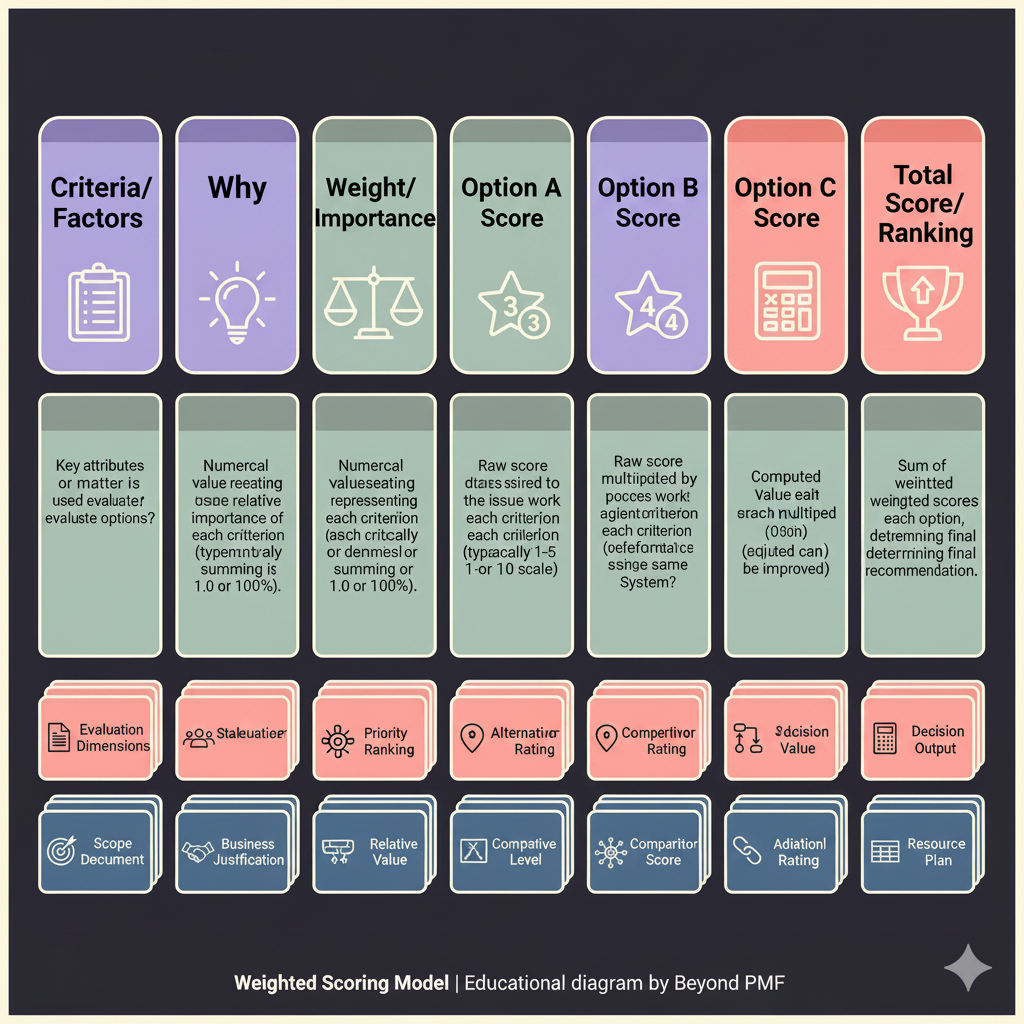
The Weighted Scoring Model is a versatile decision-making framework that helps organizations evaluate various options against a set of predefined criteria, each weighted according to its importance. This method quantifies qualitative data, enabling decision-makers to make informed choices by assessing the relative value of different alternatives. It is particularly beneficial for prioritizing projects, allocating resources, and strategic planning.

Steps / Detailed Description

  • Identify the decision criteria relevant to the project or decision.
  • Assign weights to each criterion based on its importance to the overall objective.
  • Score each option against the criteria on a consistent scale (e.g., 1-10).
  • Multiply the score for each option by the weights of the criteria.
  • Sum the weighted scores for each option to get a total score.
  • Compare the total scores to determine the best option.

Best Practices

  • Ensure criteria are comprehensive and relevant to the decision at hand.
  • Involve stakeholders in assigning weights to ensure alignment.
  • Regularly review and adjust weights and scores as needed.

Pros

  • Provides a structured approach to decision-making.
  • Helps quantify qualitative factors and subjective opinions.
  • Facilitates comparison of diverse options on a common scale.

Cons

  • Dependent on the accuracy of the initial weights and scores.
  • Can be time-consuming to gather and analyze all necessary data.
  • Might oversimplify complex decisions.

When to Use

  • When prioritizing projects based on multiple factors.
  • When allocating resources among competing initiatives.

When Not to Use

  • When there is insufficient data to accurately score options.
  • When decisions are highly subjective and personal preferences dominate.

Related Frameworks

Categories

Scope

Scope not defined

Maturity Level

Maturity level not specified

Time to Implement

2–4 Weeks
3–6 Months
1–2 Weeks
3–6 Months
1–2 Months
3–6 Months
1–2 Weeks
Less Than 1 Day
1–2 Weeks
Longer Than 6 Months
1–2 Weeks
Longer Than 6 Months
1–2 Weeks
3–6 Months
1–2 Weeks
1–2 Weeks
1–2 Weeks
1–2 Weeks
1–2 Days
1–2 Weeks
1–2 Weeks
1–2 Weeks
1–2 Weeks
1–2 Weeks
1–2 Weeks
3–6 Months
1–2 Weeks
1–2 Weeks
1–2 Weeks
3–6 Months
1–2 Weeks
1–2 Weeks
2–4 Weeks
1–2 Weeks
1–2 Days
1–2 Weeks
Longer Than 6 Months
3–6 Months
Longer Than 6 Months
1–2 Weeks
Longer Than 6 Months
3–6 Months
Less Than 1 Day
3–6 Months
1–2 Months
3–6 Months
Longer Than 6 Months
3–6 Months
Less Than 1 Day
1–2 Weeks
3–6 Months
3–6 Months
1–2 Weeks
3–6 Months
1–2 Weeks
1–2 Weeks
1–2 Days
1–2 Weeks
1–2 Months
Longer Than 6 Months
1–2 Weeks
Longer Than 6 Months
1–2 Weeks
3–6 Months
1–2 Weeks
Less Than 1 Day
1–2 Weeks
3–6 Months
1–2 Weeks
3–6 Months
1–2 Weeks
1–2 Weeks
Longer Than 6 Months
Less Than 1 Day
3–6 Months
Longer Than 6 Months
1–2 Months
1–2 Weeks
Longer Than 6 Months
1–2 Weeks
3–6 Months
1–2 Weeks
1–2 Weeks
3–6 Months
Less Than 1 Day
1–2 Weeks
1–2 Weeks
3–6 Months
3–6 Months
Less Than 1 Day
1–2 Weeks
Longer Than 6 Months
1–2 Months
1–2 Weeks
1–2 Weeks
1–2 Weeks
Longer Than 6 Months

Copyright Information

Autor:
Public Domain
N/A
Publication:
Generic Business Tool