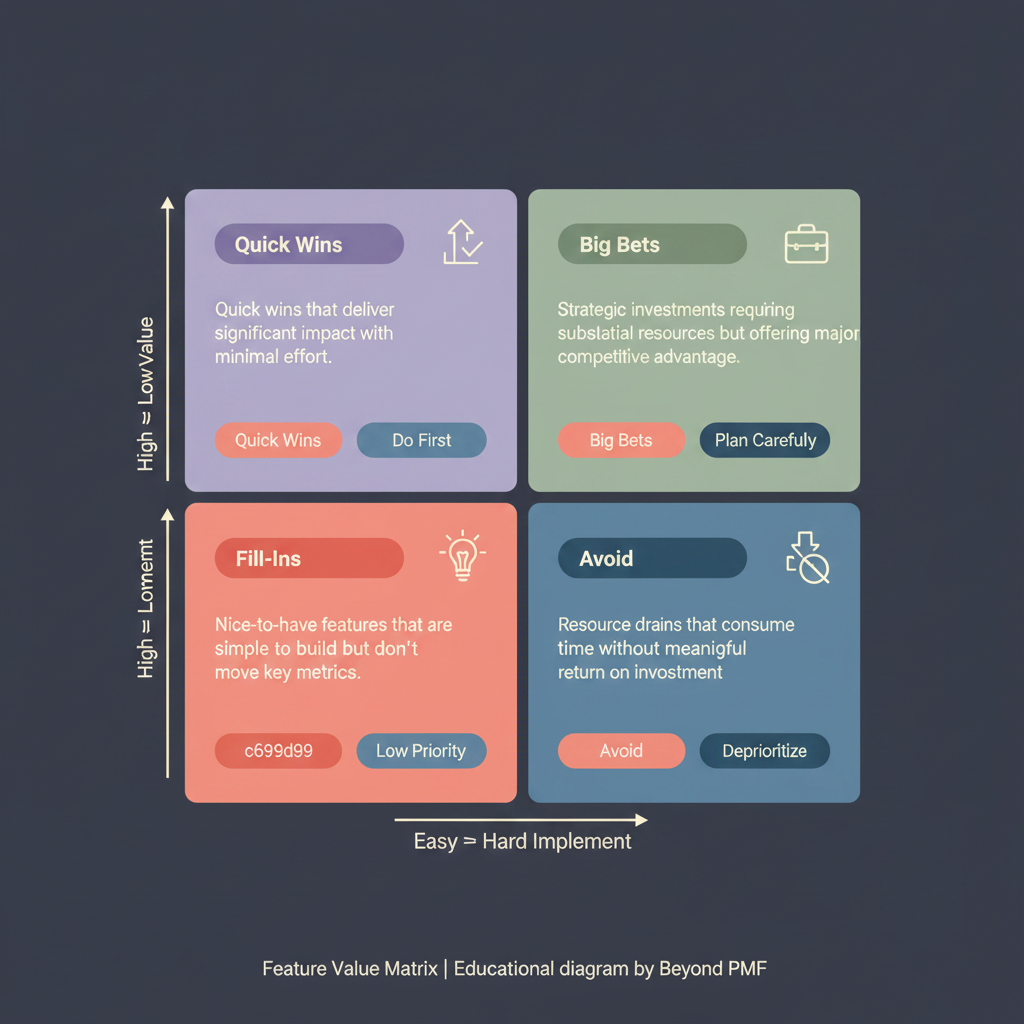
The Feature Value Matrix is a strategic framework used primarily in product management and development. It helps teams prioritize features by assessing and comparing their potential value against the cost or effort required to implement them. This matrix is particularly beneficial in aligning product features with business goals, optimizing resource allocation, and enhancing decision-making processes by providing a clear visual representation of where the greatest value can be generated.
Identify all potential features or enhancements for the product. | Define criteria for value and cost (e.g., user impact, revenue potential, development effort). | Rate each feature against these criteria on a scale (e.g., 1-10). | Plot the features on a matrix with value on one axis and cost on the other. | Analyze the matrix to prioritize features that offer high value with relatively low cost.
Ensure comprehensive and unbiased data collection for accurate feature evaluation. | Regularly update the matrix to reflect changes in business strategy or market conditions. | Involve cross-functional teams to gain diverse perspectives on feature value and cost.
Facilitates objective decision-making by quantifying feature value and cost. | Helps in aligning product development with strategic business goals. | Improves resource allocation by identifying high-impact, cost-effective features.
May oversimplify complex decisions if not all factors are accurately quantified. | Can be biased by the subjective nature of rating the features. | Depends heavily on accurate and comprehensive data collection.
When launching a new product and deciding which features to include. | During product updates to determine which enhancements should be prioritized.
For decisions that require deep qualitative insights rather than quantitative analysis. | When there is insufficient data to accurately assess the value or cost of features.