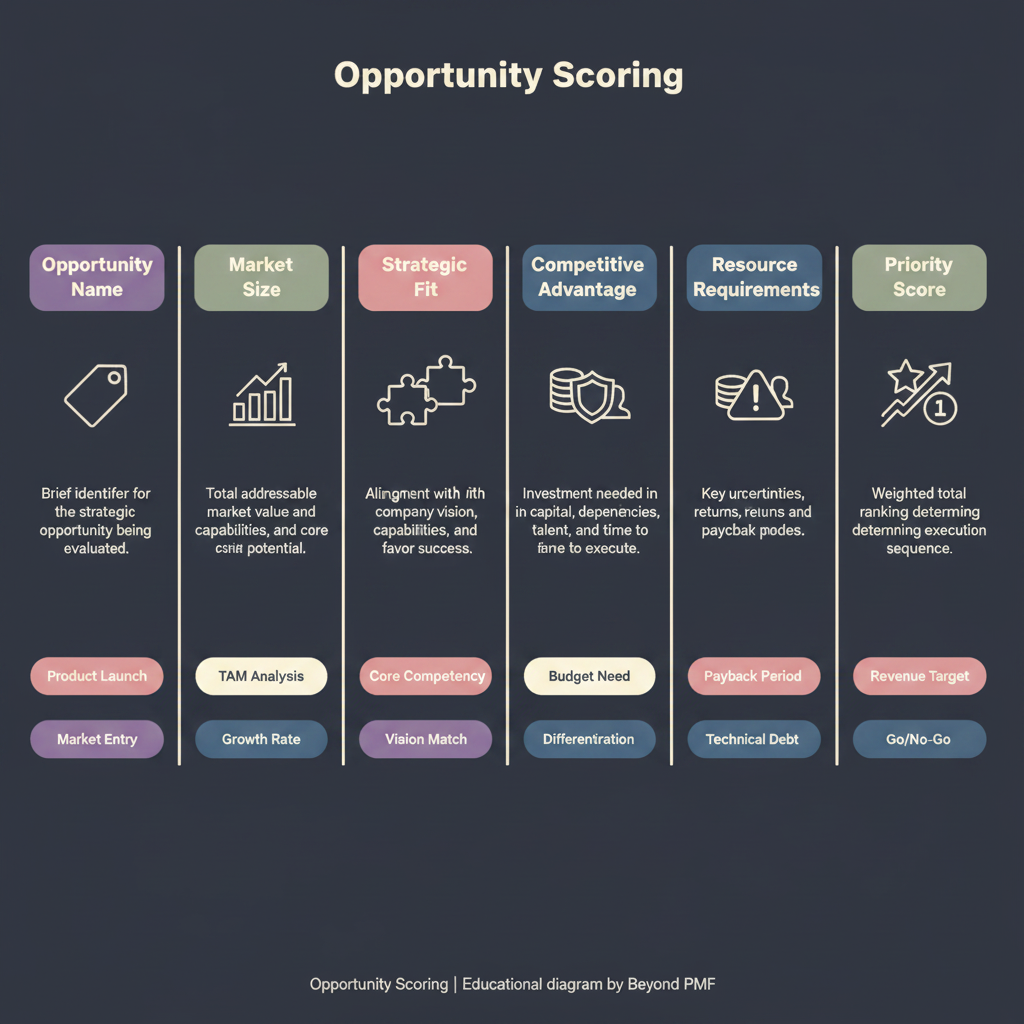
Opportunity Scoring is a framework designed to help organizations assess and rank various business opportunities by assigning scores based on specific criteria such as market potential, resource requirements, and strategic fit. This methodical approach enables decision-makers to objectively compare different opportunities, facilitating more informed and strategic decisions. The framework is particularly beneficial in optimizing resource allocation and enhancing the strategic planning process.
Identify potential opportunities: Gather a comprehensive list of all possible opportunities for evaluation. | Define scoring criteria: Establish criteria relevant to the business's strategic goals and resource capabilities. | Assign weights to criteria: Prioritize the criteria based on their importance to the organization's objectives. | Score each opportunity: Evaluate each opportunity against the criteria and assign scores accordingly. | Rank opportunities: Sort the opportunities based on their total scores to identify the most promising ones. | Review and decide: Conduct a final review of the top-scoring opportunities and make decisions on which to pursue.
Regularly update scoring criteria to reflect changing business goals | Involve stakeholders from various departments to ensure comprehensive evaluation | Use a mix of quantitative and qualitative data to inform scoring
Facilitates objective decision-making | Helps prioritize opportunities based on strategic fit and potential return | Enhances resource allocation efficiency
Can be time-consuming to implement correctly | Dependent on the accuracy of the data and criteria used | May overlook qualitative factors not easily quantifiable
When evaluating multiple business opportunities | In strategic planning sessions to align opportunities with business goals
For day-to-day operational decisions | When there is insufficient data to score opportunities accurately