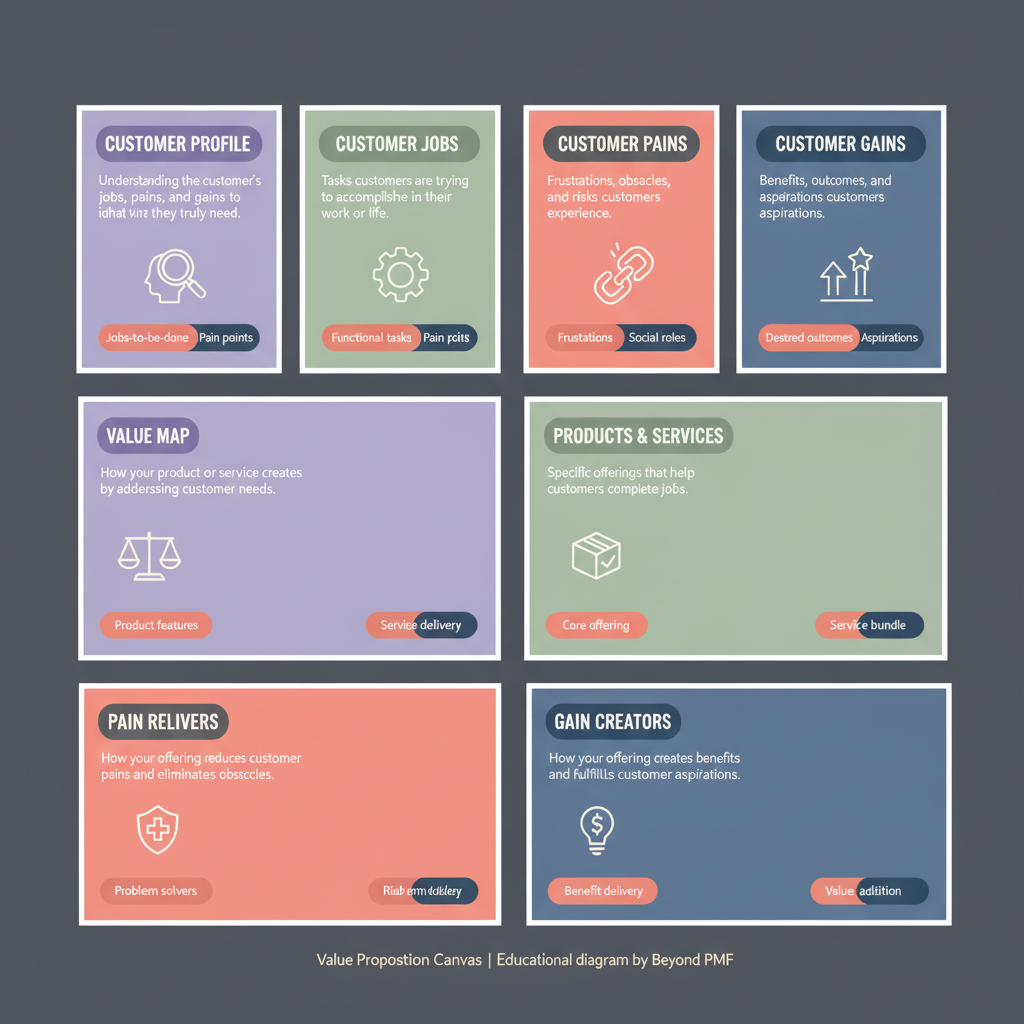
The Value Proposition Canvas is a strategic management tool used to ensure that a product or service is positioned around what the customer values and needs. Developed by Alex Osterwalder, this framework helps organizations understand their customer segments and create products and services that directly solve their problems or fulfill their needs. The canvas facilitates clearer communication and more precise product development, making it a vital tool for businesses aiming to enhance their market fit.
Identify your customer segments: Understand who your customers are and segment them based on their needs and behaviors. | Define customer jobs: Determine what tasks your customers are trying to accomplish. | Highlight customer pains: Identify the negative experiences, emotions, and risks that customers face in the process of getting the job done. | Outline customer gains: Describe the benefits and positive outcomes your customers seek. | List product and service features: Detail the specific features or services your offering provides. | Match products to pains: Connect how your product alleviates customer pains. | Align products with gains: Show how your product enhances customer gains.
Regularly update the canvas based on customer feedback | Use real customer data for accurate insights | Integrate findings with other business strategy tools
Enhances understanding of customer needs | Improves product-market fit | Facilitates focused and effective marketing
Can be overly simplistic for complex products | May require substantial customer research | Risk of assumptions if not validated with real customer data
Developing a new product | Revising or improving an existing product
When detailed technical solutions are more critical than market fit | In highly stable markets where customer needs are well understood and static