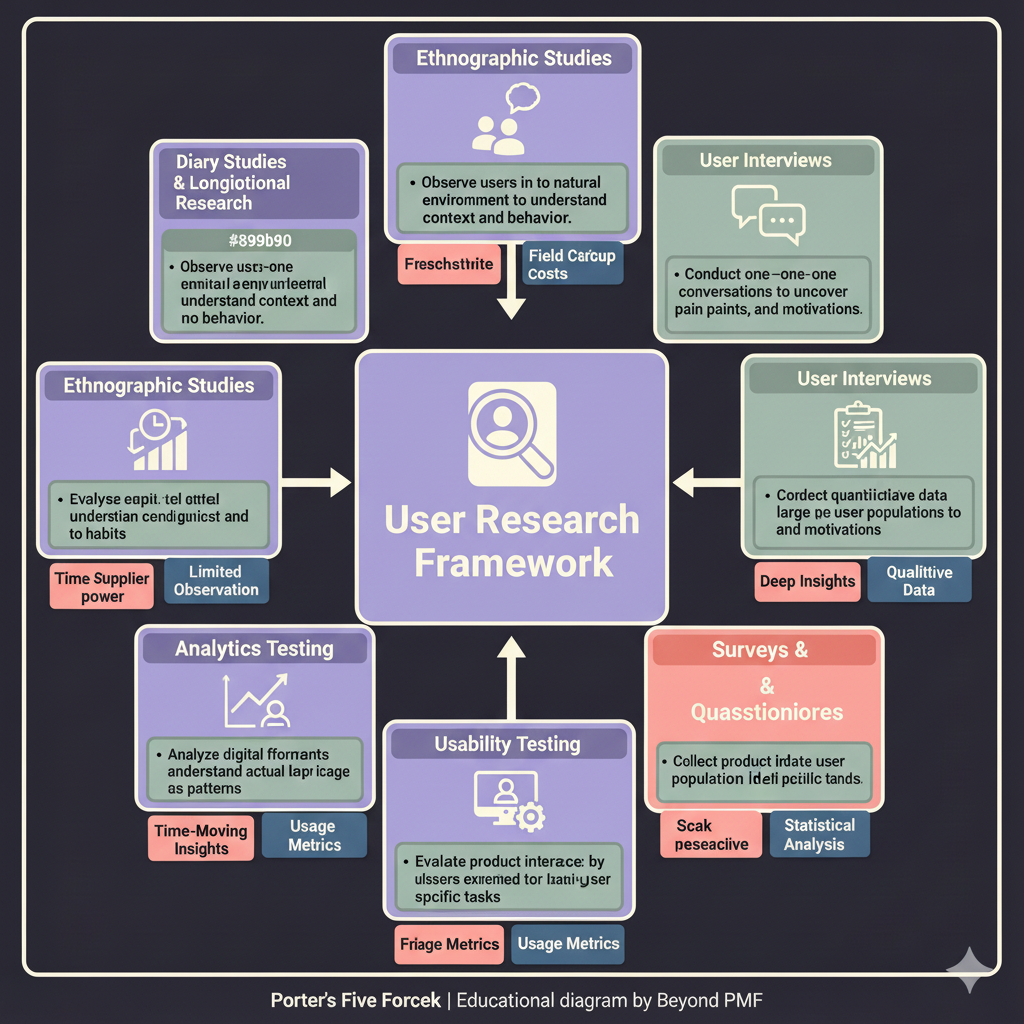
User Research Framework

https://ik.imagekit.io/beyondpmf/frameworks/user-research-framework.png
The User Research Framework directly addresses friction related to customer experience by gathering data to inform design and business strategies. This focuses on implementation and improving the user experience, therefore falling under execution-related friction.

The User Research Framework is a comprehensive methodology used to understand user behaviors, needs, and motivations through various techniques such as interviews, surveys, and usability testing. This framework helps organizations tailor their products, services, and user experiences to meet the specific needs of their target audience. By implementing this framework, companies can enhance user satisfaction, improve product usability, and increase overall business performance.

Steps / Detailed Description

Define research objectives: Clearly outline what you want to learn from your research. | Choose appropriate methods: Select methods like surveys, interviews, or observation based on objectives. | Recruit participants: Identify and recruit a representative sample of users to study. | Collect data: Execute the chosen research methods and gather data from participants. | Analyze data: Systematically analyze the collected data to extract meaningful insights. | Report findings: Compile the insights into a report that informs stakeholders and guides decision-making. | Implement changes: Use the insights to make informed decisions and iterate on product designs.

Best Practices

Clearly define the scope and objectives before starting | Ensure diversity in the participant pool to avoid biased results | Regularly update and refine user research methods

Pros

Provides deep insights into user needs and behaviors | Helps create more user-centered products and services | Increases the likelihood of product success and user satisfaction

Cons

Can be time-consuming and resource-intensive | Requires skilled professionals to conduct and analyze | Potential biases in data collection and interpretation

When to Use

When launching a new product | When redesigning or improving an existing service

When Not to Use

When there is insufficient time or resources for thorough research | When the product is in a very early conceptual stage and user input is limited

Related Frameworks

Scope

Scope not defined

Maturity Level

Maturity level not specified

Time to Implement

2–4 Weeks
3–6 Months
1–2 Weeks
3–6 Months
1–2 Months
3–6 Months
1–2 Weeks
Less Than 1 Day
1–2 Weeks
Longer Than 6 Months
1–2 Weeks
Longer Than 6 Months
1–2 Weeks
3–6 Months
1–2 Weeks
1–2 Weeks
1–2 Weeks
1–2 Weeks
1–2 Days
1–2 Weeks
1–2 Weeks
1–2 Weeks
1–2 Weeks
1–2 Weeks
1–2 Weeks
3–6 Months
1–2 Weeks
1–2 Weeks
1–2 Weeks
3–6 Months
1–2 Weeks
1–2 Weeks
2–4 Weeks
1–2 Weeks
1–2 Days
1–2 Weeks
Longer Than 6 Months
3–6 Months
Longer Than 6 Months
1–2 Weeks
Longer Than 6 Months
3–6 Months
Less Than 1 Day
3–6 Months
1–2 Months
3–6 Months
Longer Than 6 Months
3–6 Months
Less Than 1 Day
1–2 Weeks
3–6 Months
3–6 Months
1–2 Weeks
3–6 Months
1–2 Weeks
1–2 Weeks
1–2 Days
1–2 Weeks
1–2 Months
Longer Than 6 Months
1–2 Weeks
Longer Than 6 Months
1–2 Weeks
3–6 Months
1–2 Weeks
Less Than 1 Day
1–2 Weeks
3–6 Months
1–2 Weeks
3–6 Months
1–2 Weeks
1–2 Weeks
Longer Than 6 Months
Less Than 1 Day
3–6 Months
Longer Than 6 Months
1–2 Months
1–2 Weeks
Longer Than 6 Months
1–2 Weeks
3–6 Months
1–2 Weeks
1–2 Weeks
3–6 Months
Less Than 1 Day
1–2 Weeks
1–2 Weeks
3–6 Months
3–6 Months
Less Than 1 Day
1–2 Weeks
Longer Than 6 Months
1–2 Months
1–2 Weeks
1–2 Weeks
1–2 Weeks
Longer Than 6 Months

Copyright Information

Autor:
Unknown
N/A
Publication:
Generic Business Tool