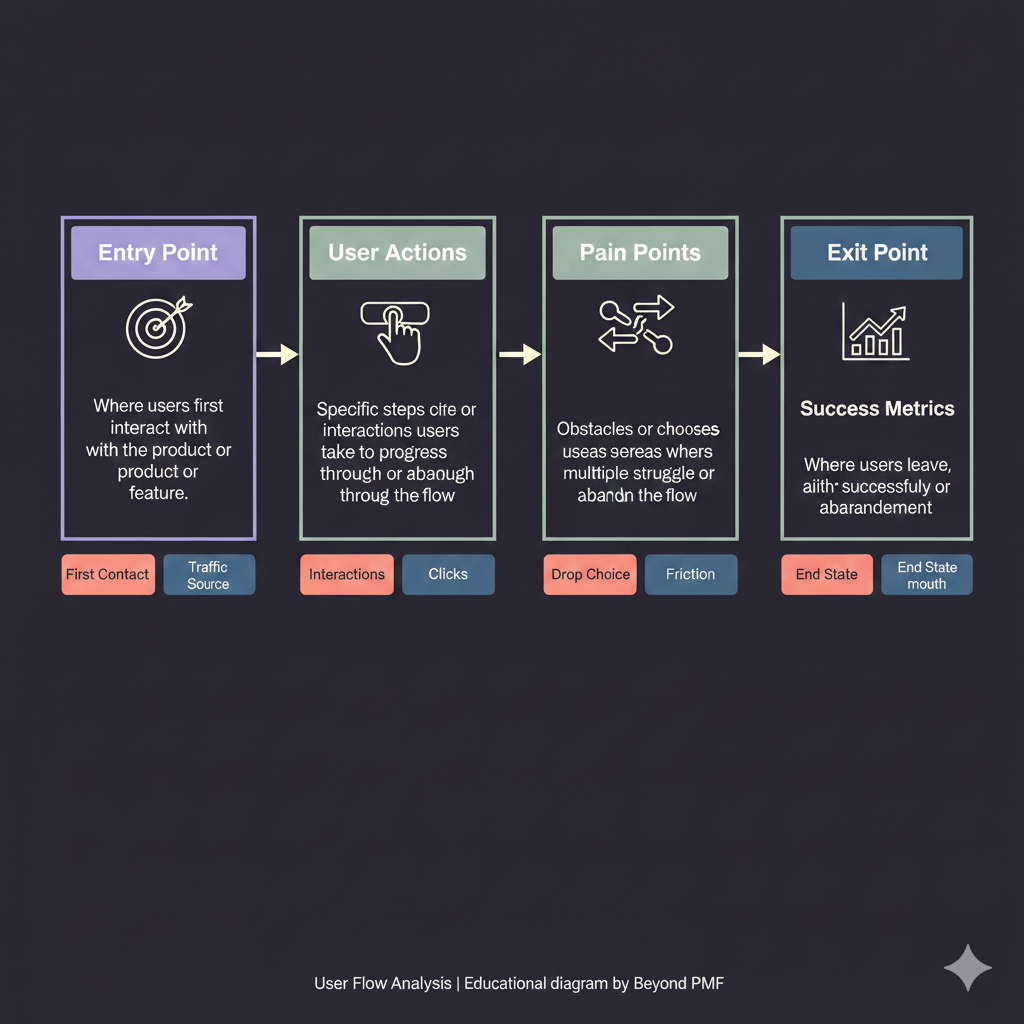
User Flow Analysis is a framework that maps out the sequence of actions taken by a user to accomplish a specific goal within a product or service. This analysis helps in understanding the user's journey through an interface, identifying any potential friction points, and optimizing the overall user experience. It is particularly beneficial for improving conversion rates, enhancing user satisfaction, and ensuring intuitive navigation.
Define the objectives of the analysis to focus on specific user interactions. | Identify key user tasks and the desired outcomes for each task. | Map out the user's journey for each task, detailing every step and decision point. | Collect data on user interactions through analytics tools and user feedback. | Analyze the data to identify bottlenecks, drop-offs, and areas of user confusion. | Propose improvements based on the analysis to streamline and enhance the user flow. | Implement changes and continuously monitor the impact on user behavior.
Regularly update the user flow analysis to reflect changes in user behavior and product updates. | Use a combination of qualitative and quantitative data for a comprehensive analysis. | Involve multidisciplinary teams to gain diverse insights into the user flow.
Improves user experience by identifying and removing friction points. | Increases conversion rates through optimized user paths. | Facilitates better design decisions based on user behavior insights.
Can be time-consuming to gather and analyze all necessary data. | Requires access to user data, which may raise privacy concerns. | Dependent on the accuracy of user feedback and data collection tools.
When designing or redesigning a website or application. | When experiencing high drop-off rates or poor conversion metrics.
When there is insufficient data on user interactions. | For very simple tasks or products where the user journey is straightforward and well understood.