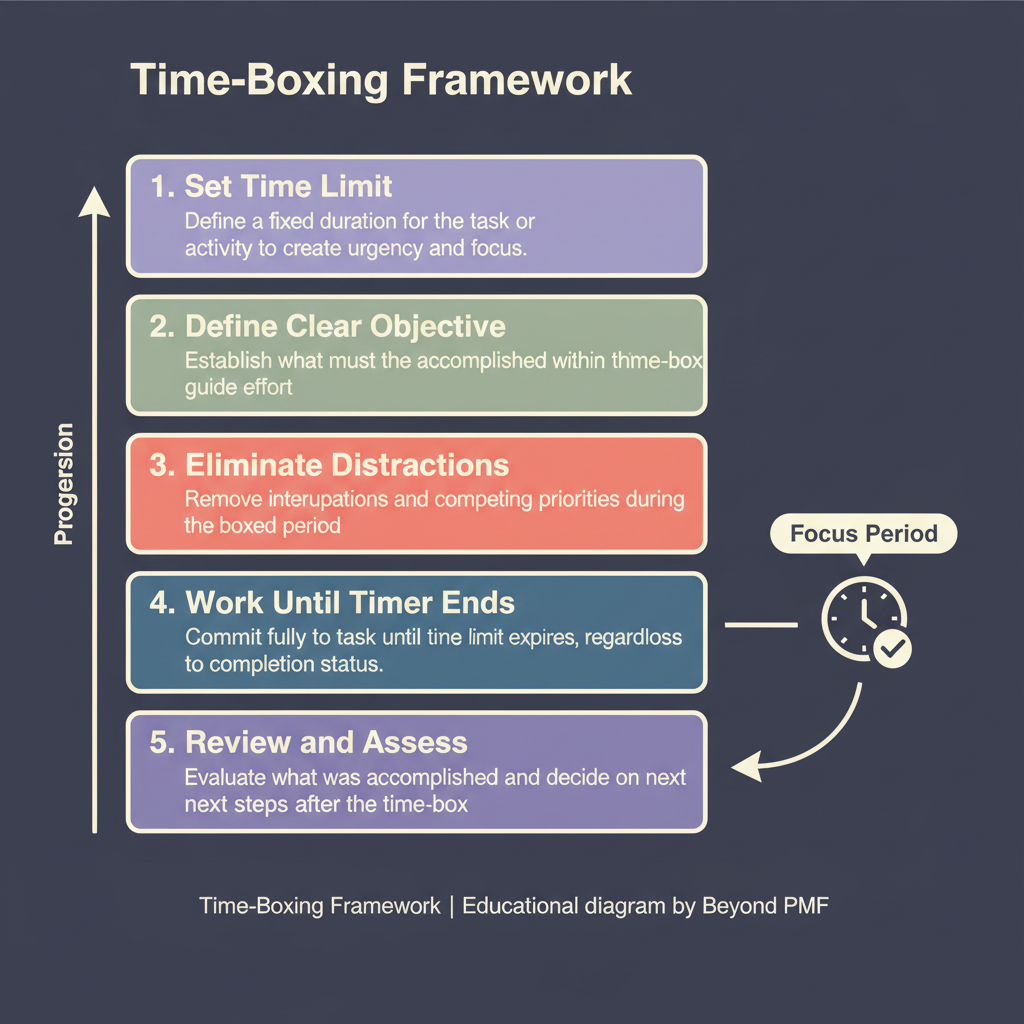
Time-Boxing Framework

https://ik.imagekit.io/beyondpmf/frameworks/time-boxing-framework.png
Time-boxing primarily addresses operational friction by improving coordination and workflow efficiency. It helps manage processes and allocate time, which directly impacts how tasks are executed and coordinated within a team or individual work.

The Time-Boxing Framework is a method used to manage time and enhance productivity by dividing work into uninterrupted, fixed time segments, known as 'time boxes'. Each time box is dedicated to accomplishing a specific task or group of tasks, and no task is allowed to exceed its allotted time. This approach helps in focusing efforts, limiting procrastination, and increasing the sense of urgency, which can lead to more efficient work habits.

Steps / Detailed Description

Identify the tasks to be accomplished. | Determine the total time available for tasks. | Assign a specific, fixed time period to each task. | Start the timer and begin working on the task. | Stop working when the time box ends, regardless of task completion. | Review the work and adjust time allocations as necessary.

Best Practices

Use realistic time estimates for each task. | Include short breaks between time boxes to maintain productivity. | Review and adjust the time-boxing plan regularly based on task performance.

Pros

Increases focus and productivity by limiting distractions. | Helps in managing time effectively by preventing task overrun. | Enhances prioritization of tasks based on available time.

Cons

Can be rigid, not allowing for unexpected task complications. | May lead to incomplete tasks if time estimates are inaccurate. | Can cause stress if time allocations are too strict.

When to Use

When working on projects with tight deadlines. | For routine tasks to increase daily productivity.

When Not to Use

For tasks requiring creativity and flexibility. | When detailed quality or precision is more important than speed.

Related Frameworks

Categories

Scope

Scope not defined

Maturity Level

Maturity level not specified

Time to Implement

2–4 Weeks
3–6 Months
1–2 Weeks
3–6 Months
1–2 Months
3–6 Months
1–2 Weeks
Less Than 1 Day
1–2 Weeks
Longer Than 6 Months
1–2 Weeks
Longer Than 6 Months
1–2 Weeks
3–6 Months
1–2 Weeks
1–2 Weeks
1–2 Weeks
1–2 Weeks
1–2 Days
1–2 Weeks
1–2 Weeks
1–2 Weeks
1–2 Weeks
1–2 Weeks
1–2 Weeks
3–6 Months
1–2 Weeks
1–2 Weeks
1–2 Weeks
3–6 Months
1–2 Weeks
1–2 Weeks
2–4 Weeks
1–2 Weeks
1–2 Days
1–2 Weeks
Longer Than 6 Months
3–6 Months
Longer Than 6 Months
1–2 Weeks
Longer Than 6 Months
3–6 Months
Less Than 1 Day
3–6 Months
1–2 Months
3–6 Months
Longer Than 6 Months
3–6 Months
Less Than 1 Day
1–2 Weeks
3–6 Months
3–6 Months
1–2 Weeks
3–6 Months
1–2 Weeks
1–2 Weeks
1–2 Days
1–2 Weeks
1–2 Months
Longer Than 6 Months
1–2 Weeks
Longer Than 6 Months
1–2 Weeks
3–6 Months
1–2 Weeks
Less Than 1 Day
1–2 Weeks
3–6 Months
1–2 Weeks
3–6 Months
1–2 Weeks
1–2 Weeks
Longer Than 6 Months
Less Than 1 Day
3–6 Months
Longer Than 6 Months
1–2 Months
1–2 Weeks
Longer Than 6 Months
1–2 Weeks
3–6 Months
1–2 Weeks
1–2 Weeks
3–6 Months
Less Than 1 Day
1–2 Weeks
1–2 Weeks
3–6 Months
3–6 Months
Less Than 1 Day
1–2 Weeks
Longer Than 6 Months
1–2 Months
1–2 Weeks
1–2 Weeks
1–2 Weeks
Longer Than 6 Months

Copyright Information

Autor:
Public Domain
N/A
Publication:
Generic Business Tool