Eisenhower Matrix

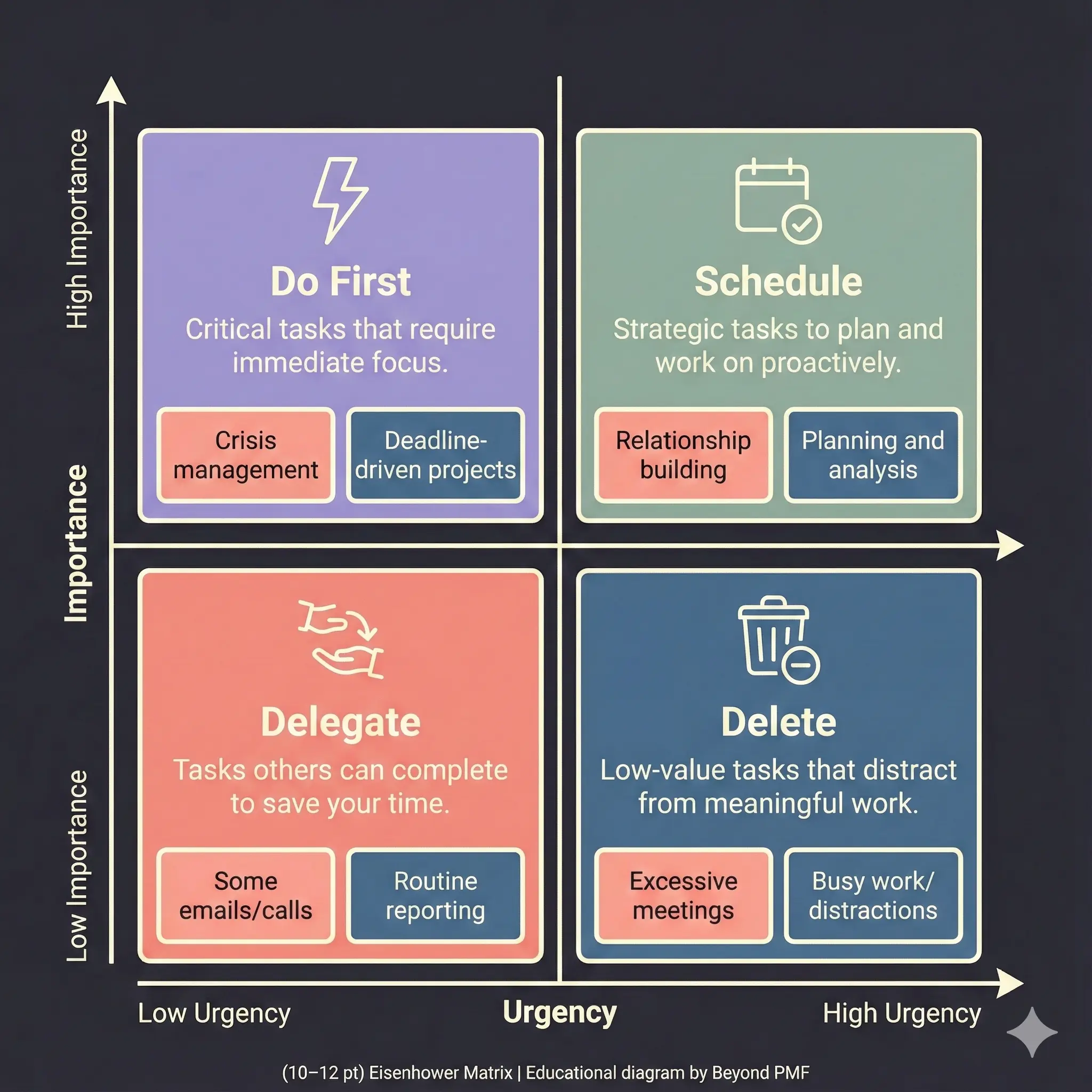
Eisenhower Matrix diagram showing four quadrants: Do First (high importance, high urgency with crisis management and deadline-driven tasks), Schedule (high importance, low urgency with relationship building and planning), Delegate (low importance, low urgency with routine reporting and some emails), and Delete (low importance, high urgency with excessive meetings and busy-work distractions).
The Eisenhower Matrix primarily addresses the friction of poor coordination and prioritization in daily tasks. It helps individuals manage their workflows, ensuring that the most important tasks are tackled first. This framework aims to improve the efficiency of processes.

The Eisenhower Matrix, also known as the Urgency-Importance Matrix, is a decision-making tool used to prioritize tasks by categorizing them into four quadrants: urgent and important, important but not urgent, urgent but not important, and neither urgent nor important. This framework helps individuals and teams focus on what truly matters, manage distractions, and increase productivity by clearly identifying which tasks to delegate, delay, or delete.

Steps / Detailed Description

Identify all tasks and responsibilities. | Categorize each task into one of the four quadrants: urgent and important, important but not urgent, urgent but not important, and neither urgent nor important. | Focus primarily on tasks in the 'urgent and important' quadrant to manage crises and meet deadlines. | Schedule tasks in the 'important but not urgent' quadrant to progress towards goals without pressure. | Delegate or minimize time spent on 'urgent but not important' tasks to avoid distraction. | Eliminate or automate tasks in the 'neither urgent nor important' quadrant to increase efficiency.

Best Practices

Review and update the matrix regularly to reflect changes in priorities. | Use digital tools or apps designed for the Eisenhower Matrix to track tasks efficiently. | Combine the matrix with other time management practices for comprehensive planning.

Pros

Enhances prioritization skills | Reduces stress by organizing tasks based on urgency and importance | Increases productivity by focusing on what truly matters

Cons

Can oversimplify task complexity | May lead to neglect of long-term planning | Risk of ignoring tasks that do not fit neatly into the urgent-important framework

When to Use

When overwhelmed by a large number of tasks | When needing to distinguish between urgent and important tasks

When Not to Use

When tasks require equal attention and prioritization | In environments where task priorities frequently change

Related Frameworks

Categories

Scope

Scope not defined

Maturity Level

Maturity level not specified

Time to Implement

2–4 Weeks
3–6 Months
1–2 Weeks
3–6 Months
1–2 Months
3–6 Months
1–2 Weeks
Less Than 1 Day
1–2 Weeks
Longer Than 6 Months
1–2 Weeks
Longer Than 6 Months
1–2 Weeks
3–6 Months
1–2 Weeks
1–2 Weeks
1–2 Weeks
1–2 Weeks
1–2 Days
1–2 Weeks
1–2 Weeks
1–2 Weeks
1–2 Weeks
1–2 Weeks
1–2 Weeks
3–6 Months
1–2 Weeks
1–2 Weeks
1–2 Weeks
3–6 Months
1–2 Weeks
1–2 Weeks
2–4 Weeks
1–2 Weeks
1–2 Days
1–2 Weeks
Longer Than 6 Months
3–6 Months
Longer Than 6 Months
1–2 Weeks
Longer Than 6 Months
3–6 Months
Less Than 1 Day
3–6 Months
1–2 Months
3–6 Months
Longer Than 6 Months
3–6 Months
Less Than 1 Day
1–2 Weeks
3–6 Months
3–6 Months
1–2 Weeks
3–6 Months
1–2 Weeks
1–2 Weeks
1–2 Days
1–2 Weeks
1–2 Months
Longer Than 6 Months
1–2 Weeks
Longer Than 6 Months
1–2 Weeks
3–6 Months
1–2 Weeks
Less Than 1 Day
1–2 Weeks
3–6 Months
1–2 Weeks
3–6 Months
1–2 Weeks
1–2 Weeks
Longer Than 6 Months
Less Than 1 Day
3–6 Months
Longer Than 6 Months
1–2 Months
1–2 Weeks
Longer Than 6 Months
1–2 Weeks
3–6 Months
1–2 Weeks
1–2 Weeks
3–6 Months
Less Than 1 Day
1–2 Weeks
1–2 Weeks
3–6 Months
3–6 Months
Less Than 1 Day
1–2 Weeks
Longer Than 6 Months
1–2 Months
1–2 Weeks
1–2 Weeks
1–2 Weeks
Longer Than 6 Months

Copyright Information

Autor:
Public Domain
N/A
Publication:
Generic Business Tool