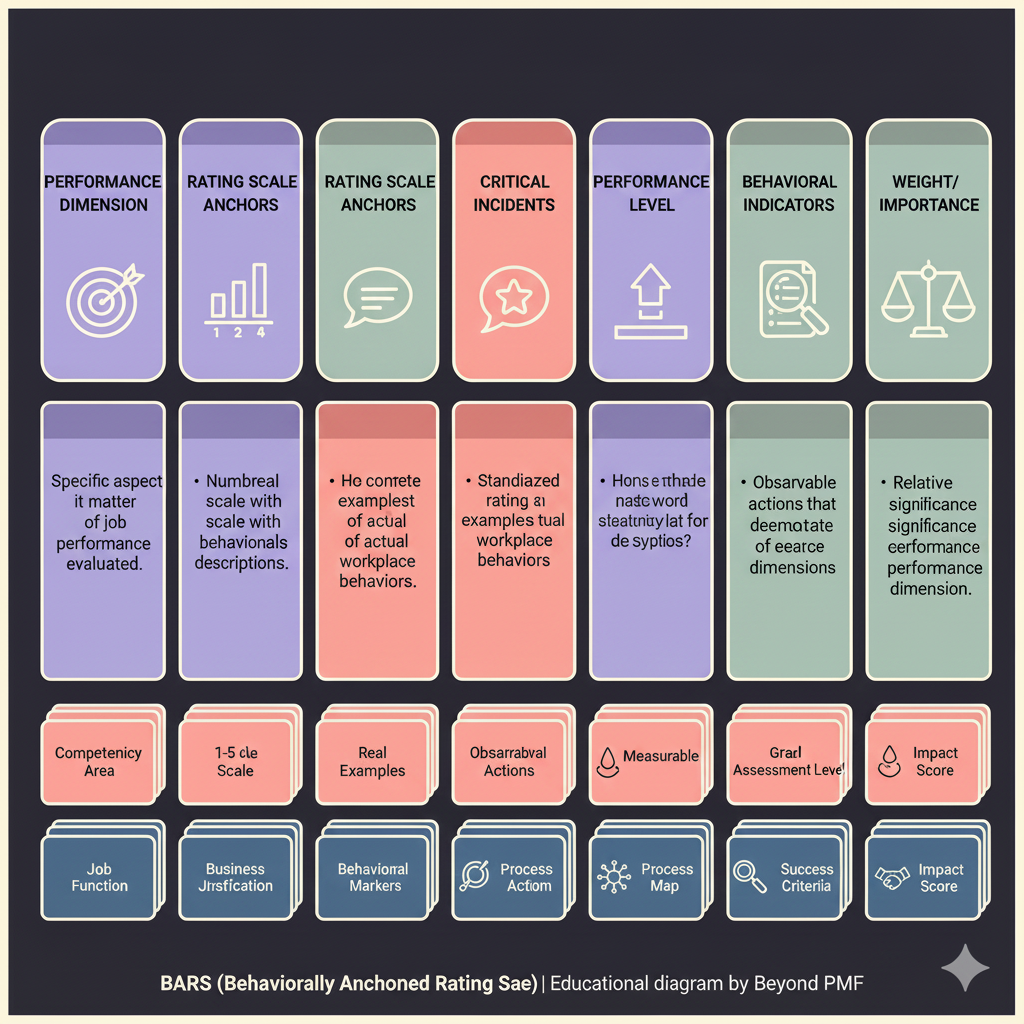
Behaviorally Anchored Rating Scales (BARS) is a quantitative and qualitative method for performance evaluation. This framework combines elements from traditional rating scales and critical incidents methods to provide a more comprehensive analysis of an employee's performance. BARS is used to improve the accuracy of performance evaluations, reduce rating errors, and align employee behaviors with the organization's goals. It benefits organizations by providing clearer standards and a more precise measurement of performance.
Identify key job dimensions and gather critical incidents. | Develop performance dimensions specific to the job. | Reallocate incidents, ensuring they are accurately placed within the correct dimensions. | Scale the incidents to create a range that defines poor to excellent performance. | Develop the final instrument by selecting incidents that most accurately describe each performance level.
Regularly update the BARS to reflect current job requirements | Train raters thoroughly to ensure consistency and understanding of the scales | Use a diverse group of raters and incidents to develop the scales
Increases accuracy of performance appraisals | Reduces subjectivity and bias in ratings | Provides clear behavioral standards for performance expectations
Time-consuming to develop and implement | Requires continuous updates to remain relevant | Potential for overemphasis on observable behaviors
In detailed performance reviews | When precise measurement of job performance is required
In small companies with limited resources | When rapid performance evaluation is needed