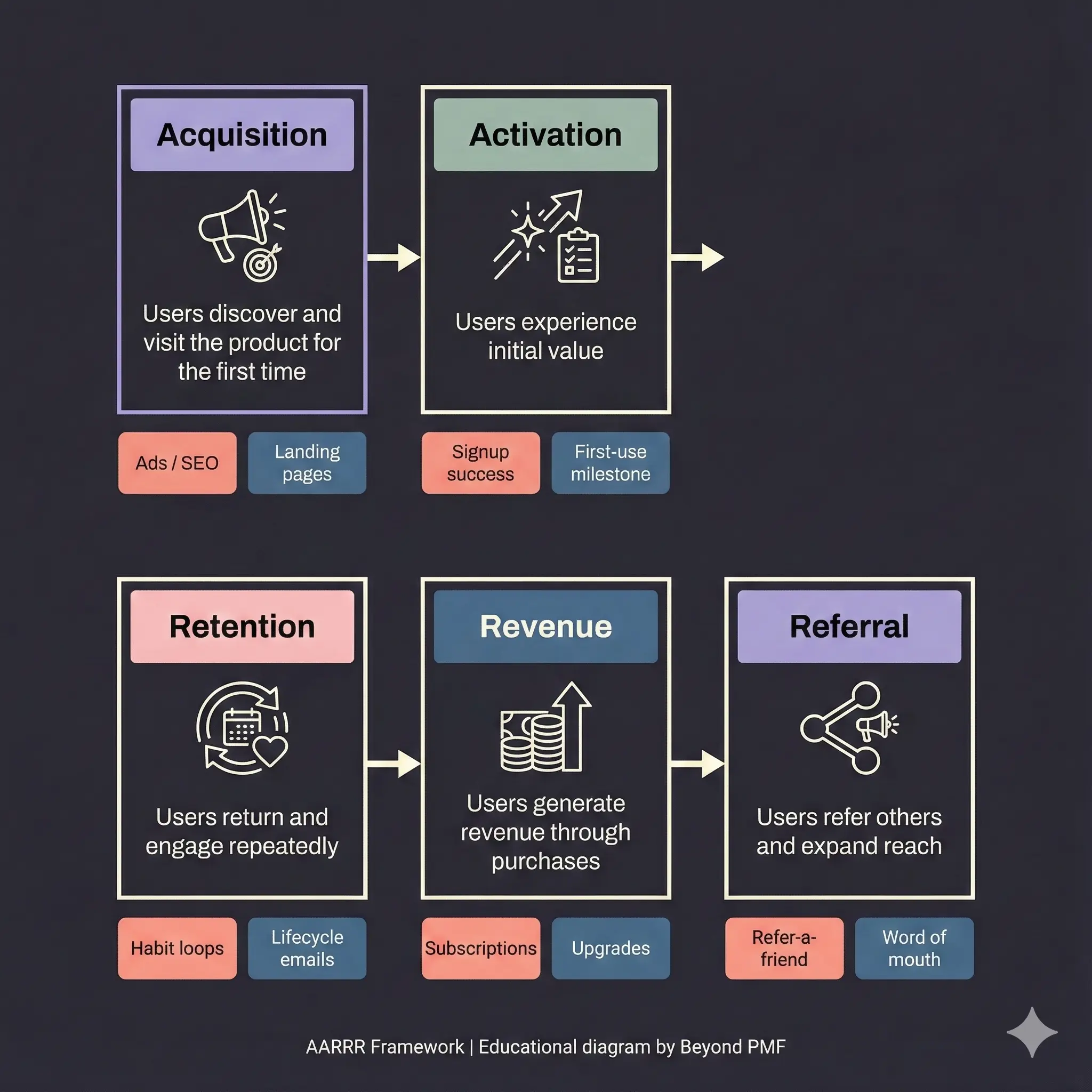
The AARRR framework, also known as Pirate Metrics, was developed by Dave McClure and serves as a roadmap for startups to focus on critical metrics that drive growth. It breaks down the customer lifecycle into five sequential stages: Acquisition, Activation, Retention, Revenue, and Referral. This framework helps businesses to identify weaknesses in the user experience and optimize strategies for each stage, ultimately leading to increased user engagement and profitability.
Acquisition: Identifying where users are coming from and optimizing the channels that bring in the most valuable users. | Activation: Ensuring that users have a great first experience with the product or service. | Retention: Keeping users coming back and using the product or service. | Revenue: Optimizing the process of turning users into paying customers. | Referral: Encouraging satisfied users to refer others to the product or service.
Regularly review and analyze data at each stage of the framework | Experiment with different strategies to optimize each metric | Align team objectives around improving metrics at each stage
Provides a clear focus on key metrics that matter for growth | Facilitates structured analysis of the customer journey | Helps in optimizing marketing spend and improving ROI
May oversimplify the user journey by focusing only on five stages | Can lead to neglecting other important aspects of the business | Requires consistent data collection and analysis, which can be resource-intensive
When launching a new product to understand user behavior | When trying to optimize and scale a startup's growth
In well-established businesses with different strategic priorities | When the business model does not rely on digital user engagement