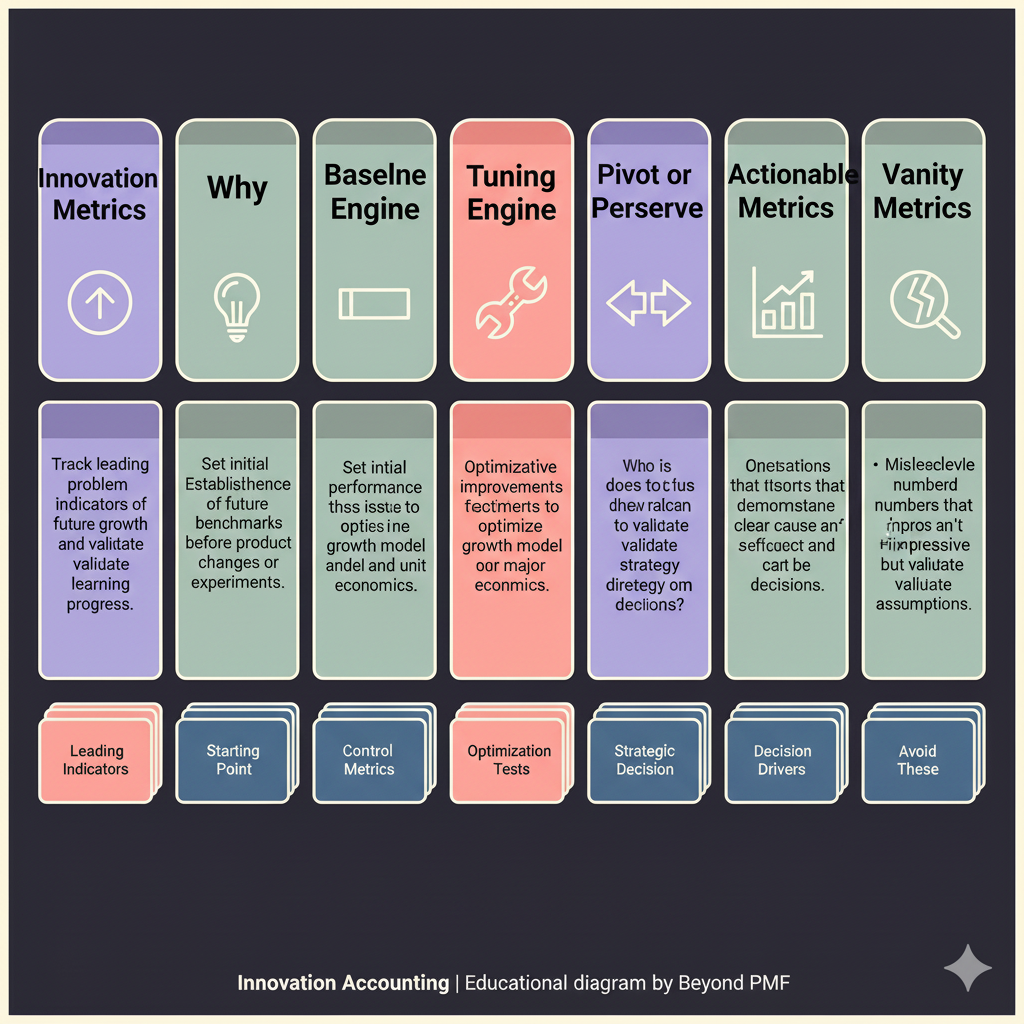
The Innovation Accounting Framework is designed to provide a structured approach to assess and track the performance of innovation within a company, especially when traditional metrics are not applicable. This framework helps organizations to make informed decisions by evaluating experiments and learning iterations, rather than just financial metrics. It is particularly useful in early-stage startups and new product development in larger companies where future revenues and traditional metrics are unknown.
Define Success Metrics: Establish what metrics will indicate progress beyond traditional financial KPIs. | Set Up Experiments: Design experiments to test hypotheses related to the innovation's impact. | Measure Learning: Track progress and gather data from each experiment to learn about customer behavior and market needs. | Pivot or Persevere: Decide whether to continue on the current path or to pivot based on the insights gained from the data. | Scale: If the innovation proves successful, plan and execute scaling strategies.
Regularly review and adjust metrics to ensure they remain relevant | Encourage a culture of experimentation and learning within the organization | Integrate qualitative insights with quantitative data for a comprehensive view
Allows for flexible and adaptive learning in uncertain environments | Focuses on actionable metrics instead of vanity metrics | Supports iterative development and continuous improvement
Can be time-consuming to set up and manage | Requires a cultural shift towards acceptance of failure and experimentation | May not provide immediate financial metrics that are often required by investors
In early-stage startups testing new product ideas | In established companies launching innovative products into new markets
In stable, well-understood markets where traditional metrics suffice | When immediate, short-term financial results are the primary focus