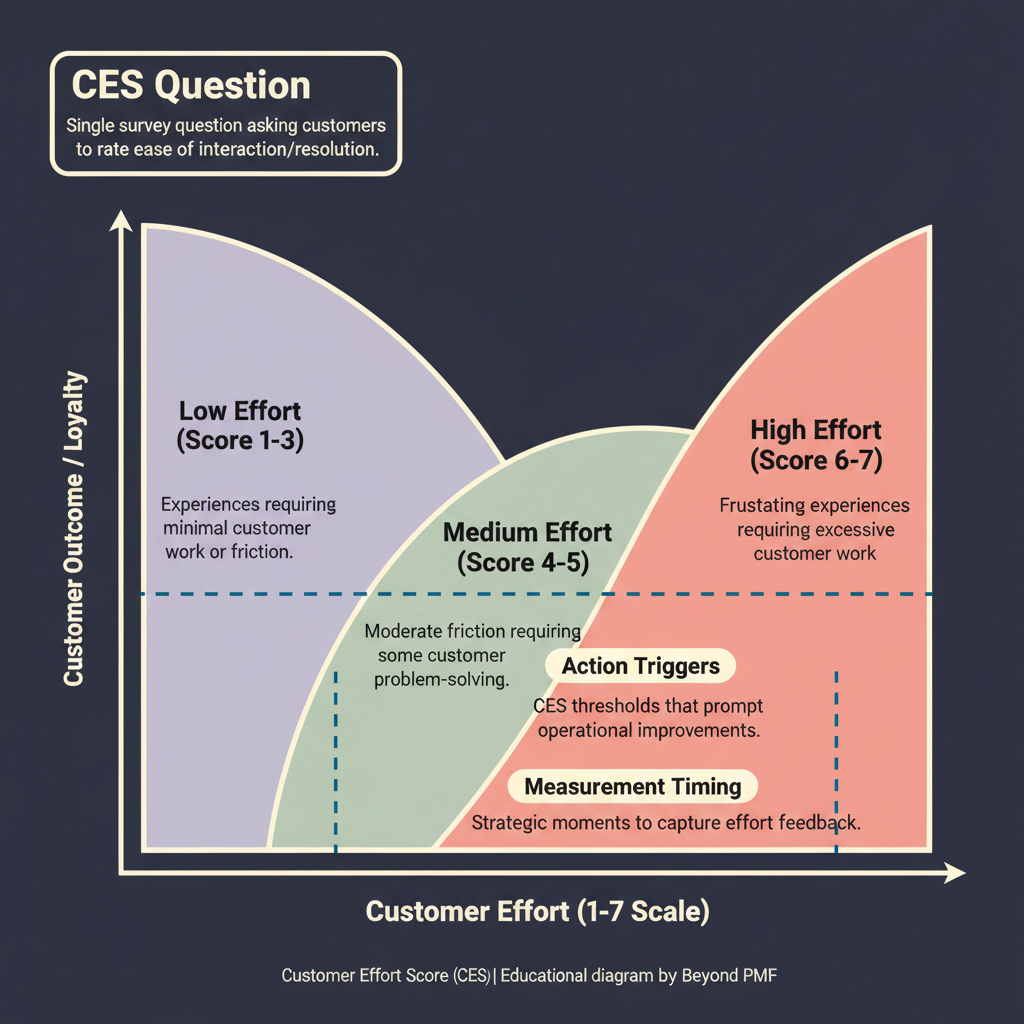
Customer Effort Score (CES) is a customer service evaluation metric that measures the ease of service experience from the customer's perspective. It asks customers to rate the effort they had to exert to get their issues resolved, typically on a scale from 'very easy' to 'very difficult'. This metric is crucial for businesses aiming to streamline customer interactions, reduce friction, and enhance overall customer satisfaction. Implementing CES can lead to improved customer loyalty and better resource allocation.
Identify the touchpoint or interaction to measure. | Design a CES survey with a clear, relevant question about customer effort. | Distribute the survey immediately after the interaction. | Collect and analyze the responses to calculate the average CES score. | Use insights to make targeted improvements to reduce customer effort.
Ensure the CES question is specific to the interaction | Survey customers immediately after the interaction for accurate measurement | Regularly update and adapt the survey as services and products evolve
Directly measures ease of interaction | Helps identify pain points in the customer journey | Can be linked to customer loyalty and retention
Focuses only on effort, not overall satisfaction | May not capture emotional or subjective aspects of customer experience | Responses can be influenced by recent customer emotions
After specific customer service interactions | Post-purchase or post-resolution of a customer issue
For measuring overall customer satisfaction | When detailed feedback on product quality is needed