5P Framework

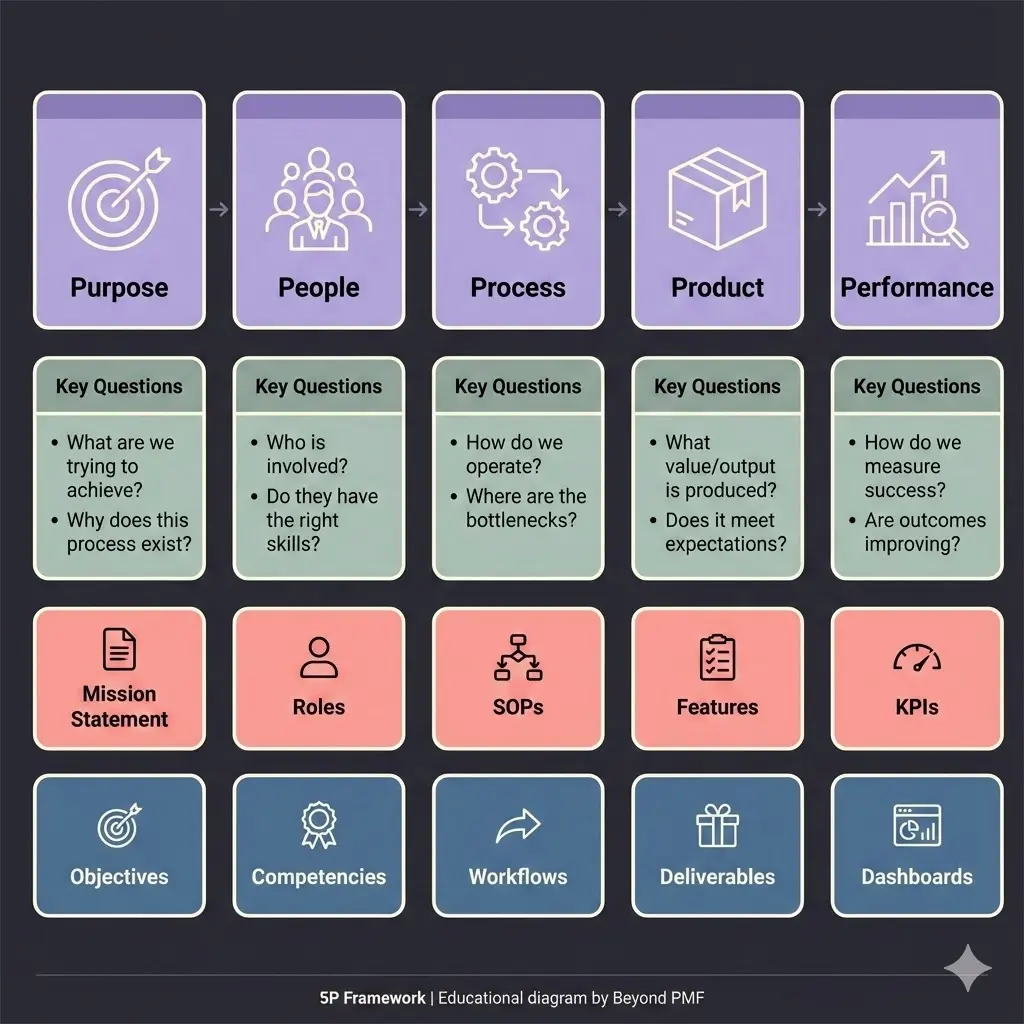
Diagram of the 5P Framework showing five elementsβ€”Purpose, People, Process, Product, and Performanceβ€”each with key questions and examples such as mission statement, roles, SOPs, deliverables, and KPIs. Icons and columns illustrate how each P contributes to understanding and improving organizational workflows.
The 5P Framework focuses on improving business processes, which inherently deals with friction related to workflows, coordination, and the overall orchestration of activities. By analyzing five key elements, it aims to streamline operations and enhance efficiency.

The 5P Framework is a comprehensive model that helps organizations enhance their operational effectiveness by examining five critical aspects: Purpose, People, Process, Product, and Performance. This framework guides businesses in aligning their objectives with their operational strategies, ensuring that all elements contribute towards achieving the desired outcomes. It is widely used for its ability to simplify complex business environments and foster continuous improvement.

Steps / Detailed Description

Define the Purpose: Clearly articulate the goals and objectives of the organization or project. | Analyze the People: Assess the roles, skills, and capabilities of the team involved. | Optimize the Process: Streamline processes for efficiency and effectiveness. | Evaluate the Product: Review the quality and relevance of the products or services offered. | Measure the Performance: Use metrics and KPIs to track success and areas for improvement.

Best Practices

Regularly update and review each component of the framework | Engage all stakeholders in the evaluation process | Use data-driven insights to guide decisions

Pros

Provides a holistic view of business operations | Facilitates alignment between different aspects of the organization | Encourages continuous improvement and efficiency

Cons

Can be overly simplistic for complex organizations | Requires significant data and insights for effective implementation | May overlook external factors affecting the organization

When to Use

When refining strategic objectives | During organizational restructuring

When Not to Use

In highly unpredictable or volatile market conditions | When quick, tactical decisions are required

Related Frameworks

Scope

Scope not defined

Maturity Level

Maturity level not specified

Time to Implement

2–4 Weeks
3–6 Months
1–2 Weeks
3–6 Months
1–2 Months
3–6 Months
1–2 Weeks
Less Than 1 Day
1–2 Weeks
Longer Than 6 Months
1–2 Weeks
Longer Than 6 Months
1–2 Weeks
3–6 Months
1–2 Weeks
1–2 Weeks
1–2 Weeks
1–2 Weeks
1–2 Days
1–2 Weeks
1–2 Weeks
1–2 Weeks
1–2 Weeks
1–2 Weeks
1–2 Weeks
3–6 Months
1–2 Weeks
1–2 Weeks
1–2 Weeks
3–6 Months
1–2 Weeks
1–2 Weeks
2–4 Weeks
1–2 Weeks
1–2 Days
1–2 Weeks
Longer Than 6 Months
3–6 Months
Longer Than 6 Months
1–2 Weeks
Longer Than 6 Months
3–6 Months
Less Than 1 Day
3–6 Months
1–2 Months
3–6 Months
Longer Than 6 Months
3–6 Months
Less Than 1 Day
1–2 Weeks
3–6 Months
3–6 Months
1–2 Weeks
3–6 Months
1–2 Weeks
1–2 Weeks
1–2 Days
1–2 Weeks
1–2 Months
Longer Than 6 Months
1–2 Weeks
Longer Than 6 Months
1–2 Weeks
3–6 Months
1–2 Weeks
Less Than 1 Day
1–2 Weeks
3–6 Months
1–2 Weeks
3–6 Months
1–2 Weeks
1–2 Weeks
Longer Than 6 Months
Less Than 1 Day
3–6 Months
Longer Than 6 Months
1–2 Months
1–2 Weeks
Longer Than 6 Months
1–2 Weeks
3–6 Months
1–2 Weeks
1–2 Weeks
3–6 Months
Less Than 1 Day
1–2 Weeks
1–2 Weeks
3–6 Months
3–6 Months
Less Than 1 Day
1–2 Weeks
Longer Than 6 Months
1–2 Months
1–2 Weeks
1–2 Weeks
1–2 Weeks
Longer Than 6 Months

Copyright Information

Autor:
Unknown
N/A
Publication:
Generic Business Tool