Flow Efficiency Framework

https://ik.imagekit.io/beyondpmf/frameworks/flow-efficiency-framework.png
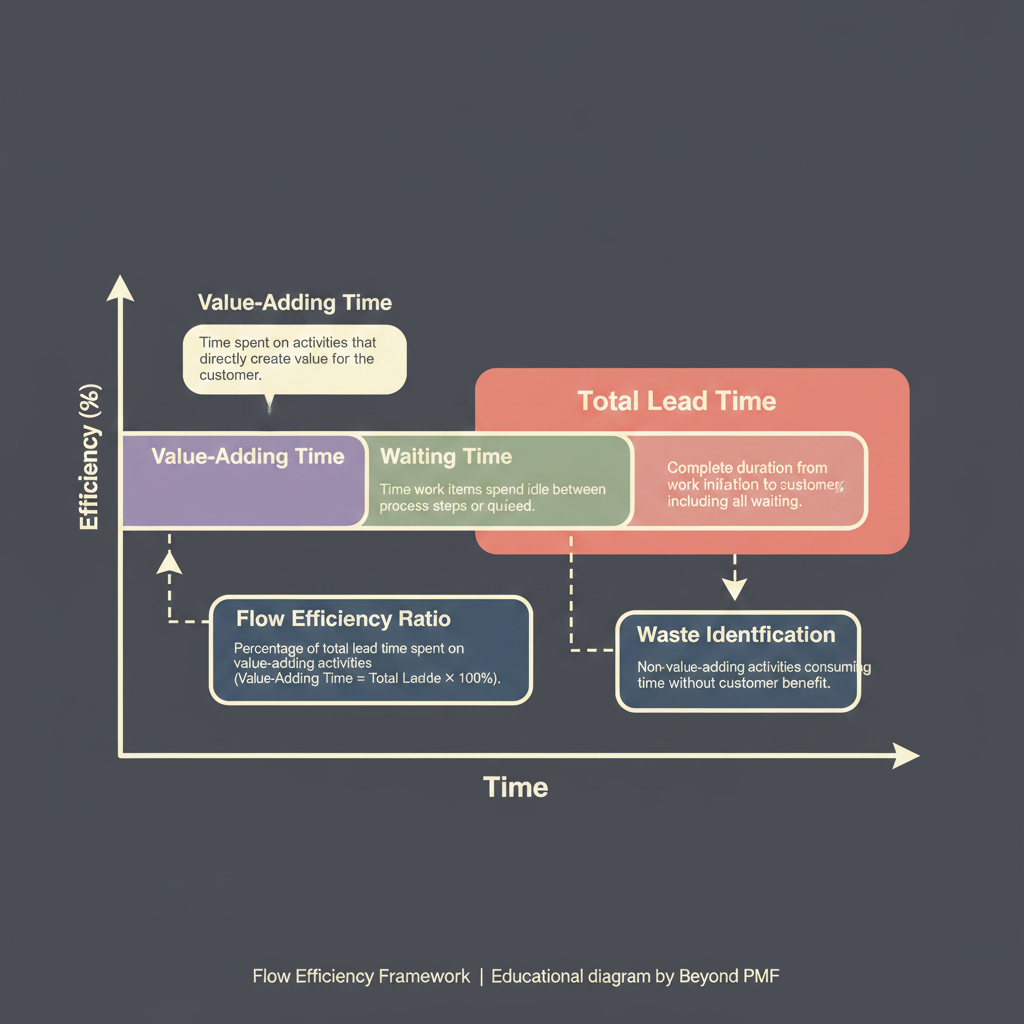
The Flow Efficiency Framework primarily addresses friction in operational processes by quantifying the time spent on active work versus the total time elapsed. This helps identify bottlenecks and inefficiencies in workflows and coordination.

The Flow Efficiency Framework is a tool used primarily in project management and operations to analyze and improve the efficiency of workflows. It focuses on identifying the proportion of value-added time in the total cycle time of a process. By highlighting the non-value-added times, such as wait times or delays, it helps organizations streamline operations, reduce waste, and enhance productivity. The framework is beneficial in environments where process efficiency is critical for success, such as manufacturing, software development, and service delivery.

Steps / Detailed Description

Identify the process or workflow to be analyzed. | Map out the entire process, identifying all steps and associated wait times. | Measure the actual working time versus the total elapsed time for each step. | Calculate the flow efficiency by dividing the value-added time by the total time. | Identify bottlenecks and areas with high non-value-added time. | Implement improvements to enhance flow efficiency. | Reassess the process to measure the impact of changes made.

Best Practices

Regularly update and review process maps | Engage all stakeholders in the efficiency improvement initiatives | Use automated tools for tracking and calculating efficiency

Pros

Increases process transparency | Reduces cycle times and eliminates waste | Improves overall operational efficiency

Cons

Can be time-consuming to implement | May require significant changes to existing processes | Relies heavily on accurate data collection

When to Use

When aiming to reduce process cycle times | In environments where efficiency directly impacts profitability

When Not to Use

In highly variable processes where standard times are difficult to establish | When the cost of data collection and analysis outweighs the potential efficiency gains

Related Frameworks

Scope

Scope not defined

Maturity Level

Maturity level not specified

Time to Implement

2–4 Weeks
3–6 Months
1–2 Weeks
3–6 Months
1–2 Months
3–6 Months
1–2 Weeks
Less Than 1 Day
1–2 Weeks
Longer Than 6 Months
1–2 Weeks
Longer Than 6 Months
1–2 Weeks
3–6 Months
1–2 Weeks
1–2 Weeks
1–2 Weeks
1–2 Weeks
1–2 Days
1–2 Weeks
1–2 Weeks
1–2 Weeks
1–2 Weeks
1–2 Weeks
1–2 Weeks
3–6 Months
1–2 Weeks
1–2 Weeks
1–2 Weeks
3–6 Months
1–2 Weeks
1–2 Weeks
2–4 Weeks
1–2 Weeks
1–2 Days
1–2 Weeks
Longer Than 6 Months
3–6 Months
Longer Than 6 Months
1–2 Weeks
Longer Than 6 Months
3–6 Months
Less Than 1 Day
3–6 Months
1–2 Months
3–6 Months
Longer Than 6 Months
3–6 Months
Less Than 1 Day
1–2 Weeks
3–6 Months
3–6 Months
1–2 Weeks
3–6 Months
1–2 Weeks
1–2 Weeks
1–2 Days
1–2 Weeks
1–2 Months
Longer Than 6 Months
1–2 Weeks
Longer Than 6 Months
1–2 Weeks
3–6 Months
1–2 Weeks
Less Than 1 Day
1–2 Weeks
3–6 Months
1–2 Weeks
3–6 Months
1–2 Weeks
1–2 Weeks
Longer Than 6 Months
Less Than 1 Day
3–6 Months
Longer Than 6 Months
1–2 Months
1–2 Weeks
Longer Than 6 Months
1–2 Weeks
3–6 Months
1–2 Weeks
1–2 Weeks
3–6 Months
Less Than 1 Day
1–2 Weeks
1–2 Weeks
3–6 Months
3–6 Months
Less Than 1 Day
1–2 Weeks
Longer Than 6 Months
1–2 Months
1–2 Weeks
1–2 Weeks
1–2 Weeks
Longer Than 6 Months

Copyright Information

Autor:
Unknown
N/A
Publication:
Generic Business Tool