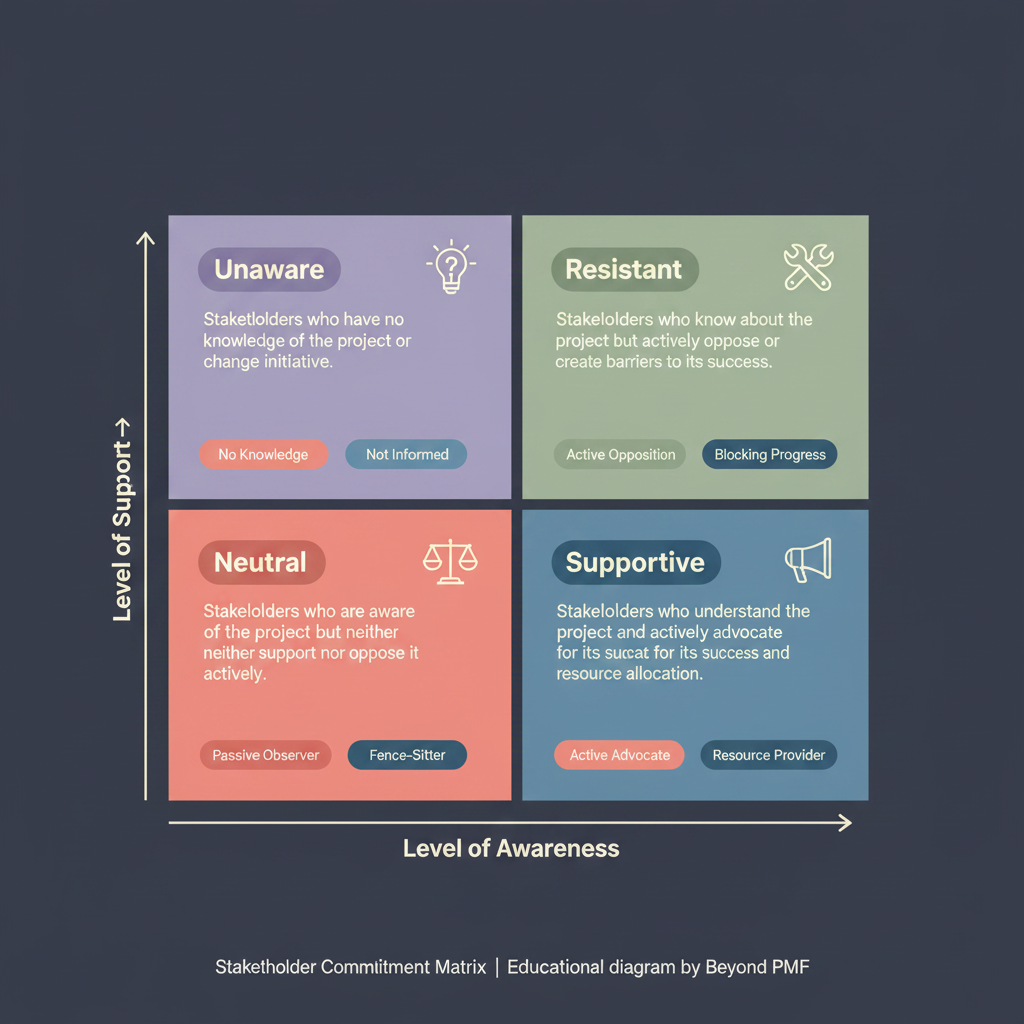
Stakeholder Commitment Matrix

https://ik.imagekit.io/beyondpmf/frameworks/stakeholder-commitment-matrix.png
The Stakeholder Commitment Matrix primarily addresses the friction associated with coordinating and governing stakeholder involvement throughout a project. It helps to ensure alignment and manage the operational aspects of stakeholder engagement, such as communication and expectations.

The Stakeholder Commitment Matrix is a framework designed to map out the level of commitment and influence of stakeholders in a project. It helps project managers and teams to identify which stakeholders are supporters, which are neutral, and which may be blockers. This understanding is crucial for effective stakeholder management, enabling targeted communication and engagement strategies that can lead to a more successful project outcome.

Steps / Detailed Description

Identify all relevant stakeholders for the project. | Assess each stakeholder's current level of commitment and influence. | Map stakeholders on the matrix based on their commitment and influence. | Develop tailored strategies to increase commitment where necessary. | Regularly update the matrix as the project progresses and as stakeholder attitudes shift.

Best Practices

Engage with stakeholders early to accurately assess their positions. | Use a mix of qualitative and quantitative data for mapping. | Regularly communicate with stakeholders to update their positions on the matrix.

Pros

Provides clear visualization of stakeholder positions. | Facilitates targeted stakeholder management strategies. | Helps in prioritizing stakeholder engagement efforts.

Cons

Can be time-consuming to gather accurate stakeholder data. | May not account for hidden influences or informal power structures. | Requires regular updates to remain effective, adding to project management overhead.

When to Use

At the beginning of a project to plan stakeholder engagement. | When a project is facing challenges due to stakeholder issues.

When Not to Use

In very small or short-term projects where stakeholder impact is minimal. | When stakeholder positions and commitments are already well understood and stable.

Related Frameworks

Lifecycle

Scope

Scope not defined

Maturity Level

Maturity level not specified

Time to Implement

2–4 Weeks
3–6 Months
1–2 Weeks
3–6 Months
1–2 Months
3–6 Months
1–2 Weeks
Less Than 1 Day
1–2 Weeks
Longer Than 6 Months
1–2 Weeks
Longer Than 6 Months
1–2 Weeks
3–6 Months
1–2 Weeks
1–2 Weeks
1–2 Weeks
1–2 Weeks
1–2 Days
1–2 Weeks
1–2 Weeks
1–2 Weeks
1–2 Weeks
1–2 Weeks
1–2 Weeks
3–6 Months
1–2 Weeks
1–2 Weeks
1–2 Weeks
3–6 Months
1–2 Weeks
1–2 Weeks
2–4 Weeks
1–2 Weeks
1–2 Days
1–2 Weeks
Longer Than 6 Months
3–6 Months
Longer Than 6 Months
1–2 Weeks
Longer Than 6 Months
3–6 Months
Less Than 1 Day
3–6 Months
1–2 Months
3–6 Months
Longer Than 6 Months
3–6 Months
Less Than 1 Day
1–2 Weeks
3–6 Months
3–6 Months
1–2 Weeks
3–6 Months
1–2 Weeks
1–2 Weeks
1–2 Days
1–2 Weeks
1–2 Months
Longer Than 6 Months
1–2 Weeks
Longer Than 6 Months
1–2 Weeks
3–6 Months
1–2 Weeks
Less Than 1 Day
1–2 Weeks
3–6 Months
1–2 Weeks
3–6 Months
1–2 Weeks
1–2 Weeks
Longer Than 6 Months
Less Than 1 Day
3–6 Months
Longer Than 6 Months
1–2 Months
1–2 Weeks
Longer Than 6 Months
1–2 Weeks
3–6 Months
1–2 Weeks
1–2 Weeks
3–6 Months
Less Than 1 Day
1–2 Weeks
1–2 Weeks
3–6 Months
3–6 Months
Less Than 1 Day
1–2 Weeks
Longer Than 6 Months
1–2 Months
1–2 Weeks
1–2 Weeks
1–2 Weeks

Copyright Information

Autor:
Unknown
N/A
Publication:
Generic Business Tool