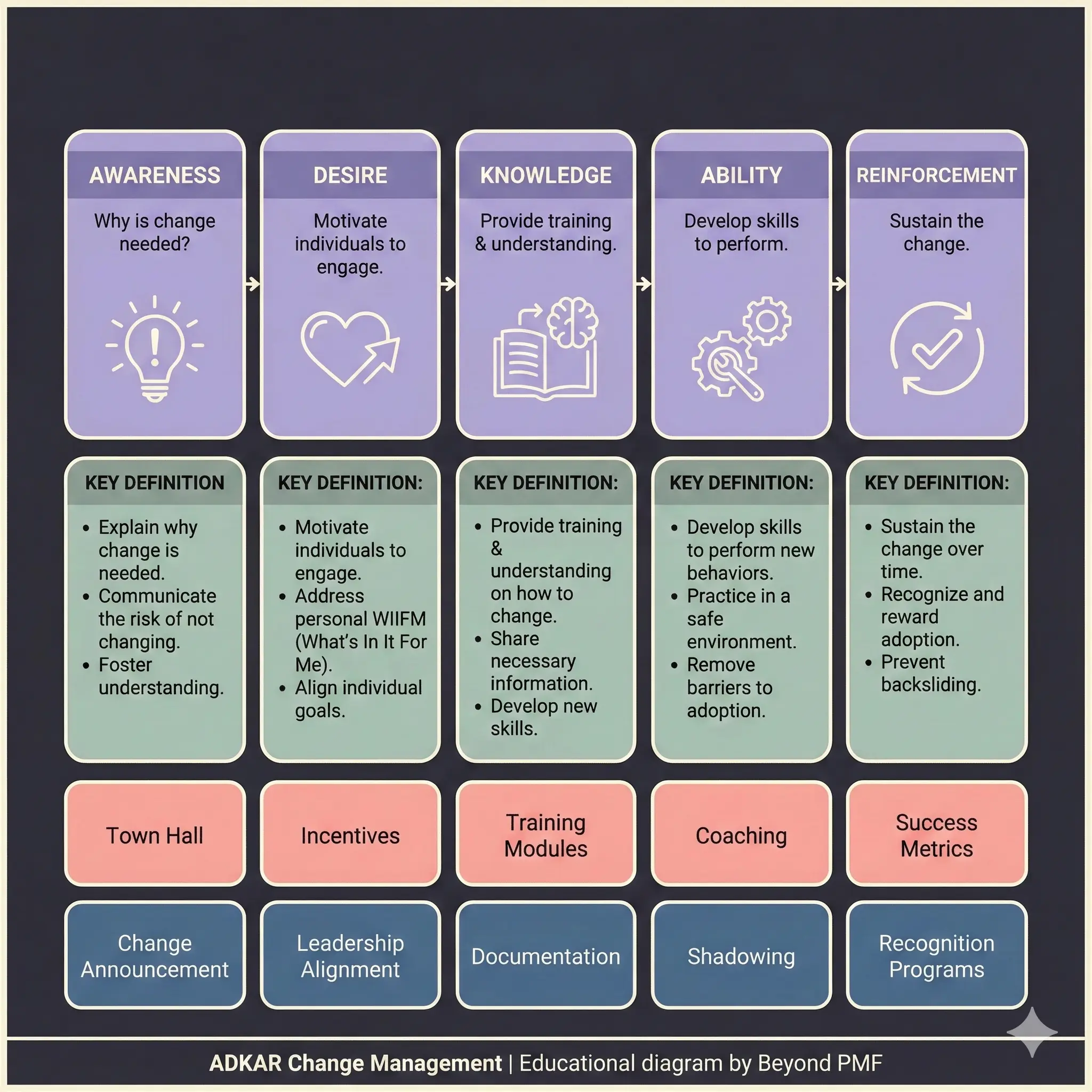
ADKAR Change Management

Diagram of the ADKAR Change Management model showing five stages: Awareness, Desire, Knowledge, Ability, and Reinforcement. Each stage includes key definitions such as explaining the need for change, motivating engagement, providing training, developing skills, and sustaining adoption. Example activities like town halls, incentives, training modules, coaching, and success metrics appear along the bottom.
ADKAR focuses on guiding individuals through the change process. While it can help with various aspects of change, its primary aim is to ensure effective implementation and adoption of changes by individuals, thus minimizing friction related to the execution of a new process or system.

The ADKAR Change Management framework, developed by Prosci, focuses on guiding individuals and organizations through change using a structured approach. It emphasizes the human side of change management, aiming to ensure that changes are smoothly and effectively implemented. The framework is popular for its clear, easy-to-understand model that outlines the steps necessary for successful change, making it a valuable tool for managers and change leaders.

Steps / Detailed Description

Awareness: Creating awareness of the need for change. | Desire: Fostering a desire to participate and support the change. | Knowledge: Providing the knowledge on how to change. | Ability: Developing the ability to implement new skills and behaviors. | Reinforcement: Implementing reinforcements to sustain the change.

Best Practices

Communicate transparently about the reasons for change. | Engage stakeholders early and often throughout the change process. | Regularly measure the effectiveness of the change initiatives.

Pros

Provides a clear, step-by-step process for managing change. | Focuses on individual change, which is critical for organizational success. | Easy to understand and apply across various types of changes.

Cons

Can be overly simplistic for complex organizational changes. | Requires significant buy-in from all levels of an organization to be effective. | May not address all aspects of organizational culture that could impact change.

When to Use

Implementing new technologies within an organization. | During major organizational restructuring.

When Not to Use

When changes are minor and do not significantly impact employees. | In highly dynamic environments where changes occur rapidly.

Related Frameworks

Lifecycle

Scope

Scope not defined

Maturity Level

Maturity level not specified

Time to Implement

2–4 Weeks
3–6 Months
1–2 Weeks
3–6 Months
1–2 Months
3–6 Months
1–2 Weeks
Less Than 1 Day
1–2 Weeks
Longer Than 6 Months
1–2 Weeks
Longer Than 6 Months
1–2 Weeks
3–6 Months
1–2 Weeks
1–2 Weeks
1–2 Weeks
1–2 Weeks
1–2 Days
1–2 Weeks
1–2 Weeks
1–2 Weeks
1–2 Weeks
1–2 Weeks
1–2 Weeks
3–6 Months
1–2 Weeks
1–2 Weeks
1–2 Weeks
3–6 Months
1–2 Weeks
1–2 Weeks
2–4 Weeks
1–2 Weeks
1–2 Days
1–2 Weeks
Longer Than 6 Months
3–6 Months
Longer Than 6 Months
1–2 Weeks
Longer Than 6 Months
3–6 Months
Less Than 1 Day
3–6 Months
1–2 Months
3–6 Months
Longer Than 6 Months
3–6 Months
Less Than 1 Day
1–2 Weeks
3–6 Months
3–6 Months
1–2 Weeks
3–6 Months
1–2 Weeks
1–2 Weeks
1–2 Days
1–2 Weeks
1–2 Months
Longer Than 6 Months
1–2 Weeks
Longer Than 6 Months
1–2 Weeks
3–6 Months
1–2 Weeks
Less Than 1 Day
1–2 Weeks
3–6 Months
1–2 Weeks
3–6 Months
1–2 Weeks
1–2 Weeks
Longer Than 6 Months
Less Than 1 Day
3–6 Months
Longer Than 6 Months
1–2 Months
1–2 Weeks
Longer Than 6 Months
1–2 Weeks
3–6 Months
1–2 Weeks
1–2 Weeks
3–6 Months
Less Than 1 Day
1–2 Weeks
1–2 Weeks
3–6 Months
3–6 Months
Less Than 1 Day
1–2 Weeks
Longer Than 6 Months
1–2 Months
1–2 Weeks
1–2 Weeks
1–2 Weeks
Longer Than 6 Months

Copyright Information

Autor:
Jeff Hiatt
2003
Publication:
Prosci